
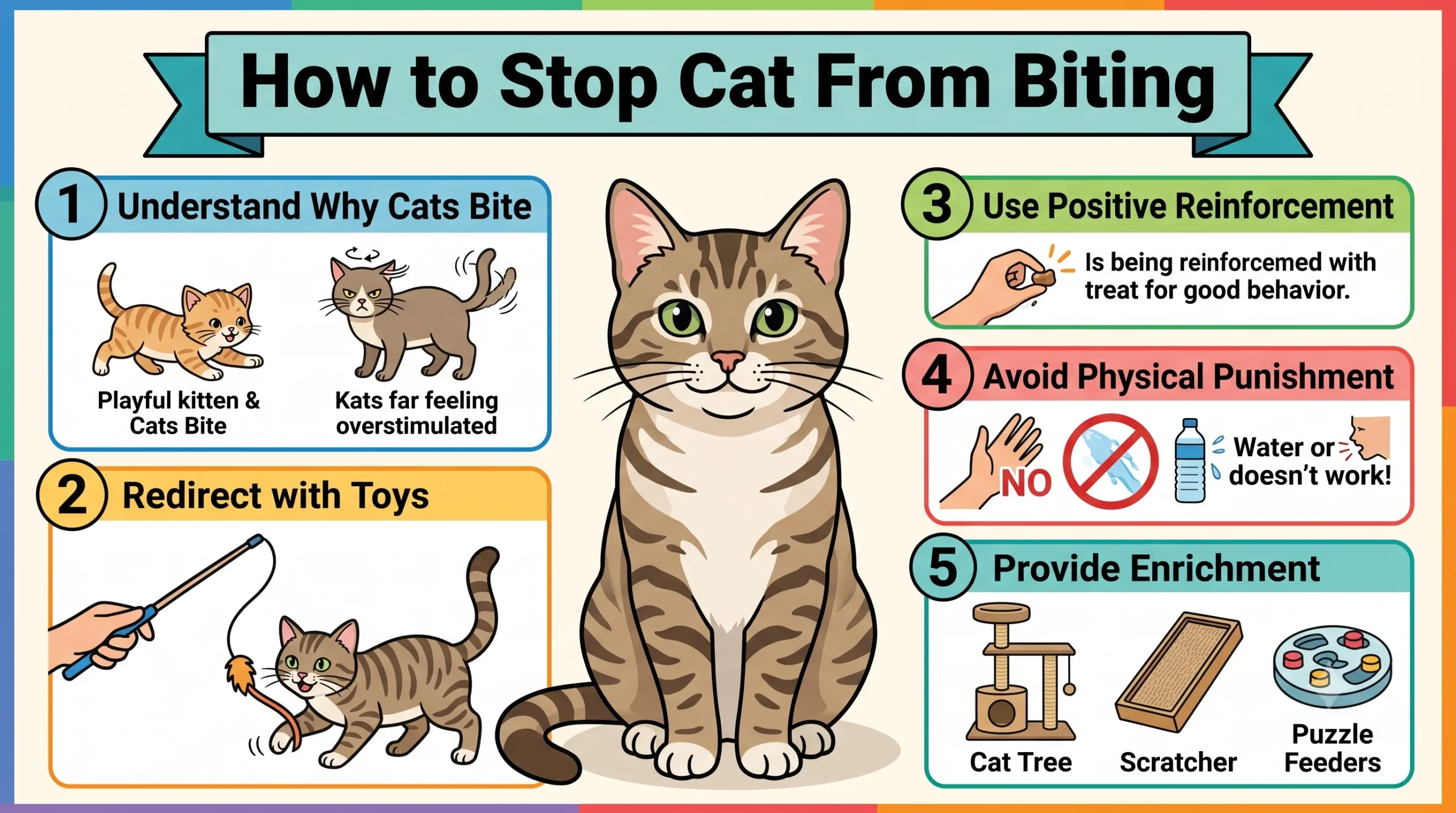

Table of Contents
How to Stop Cat From Biting
You’re petting your cat. They’re purring. Everything is perfect. Then without warning they clamp their teeth into your hand, kick with their back legs, and draw blood. You pull away confused and hurt. What just happened? Were they angry? Did you do something wrong? Is your cat aggressive? The truth is that cat biting is one of the most common behavioral complaints cat owners have, and understanding why it happens is the only way to stop it. Biting isn’t random. It isn’t vindictive. It’s communication, and once you learn the language, you can change the behavior.
As a certified veterinary expert and professional cat behaviorist, I’ve worked with hundreds of cats who bite — from kittens who haven’t learned bite inhibition to adult cats whose biting has become a deeply ingrained habit. And I can tell you that most biting is preventable, trainable, and fixable. The key is identifying why your specific cat is biting, because the solution for play aggression looks different from the solution for petting-induced aggression, which looks different from fear-based biting. This guide covers every type of cat bite, every reason behind them, and every proven technique for stopping the behavior without damaging your relationship with your cat.
📚 Recommended Cat Guides
🐱 The Trainable Cat Book
Learn proven methods to train your cat and stop unwanted behaviors.
View Book →❤️ Complete Cat Care Manual
Your complete guide to cat nutrition, health, grooming, behavior, and daily care.
Get the Manual →Why Cats Bite
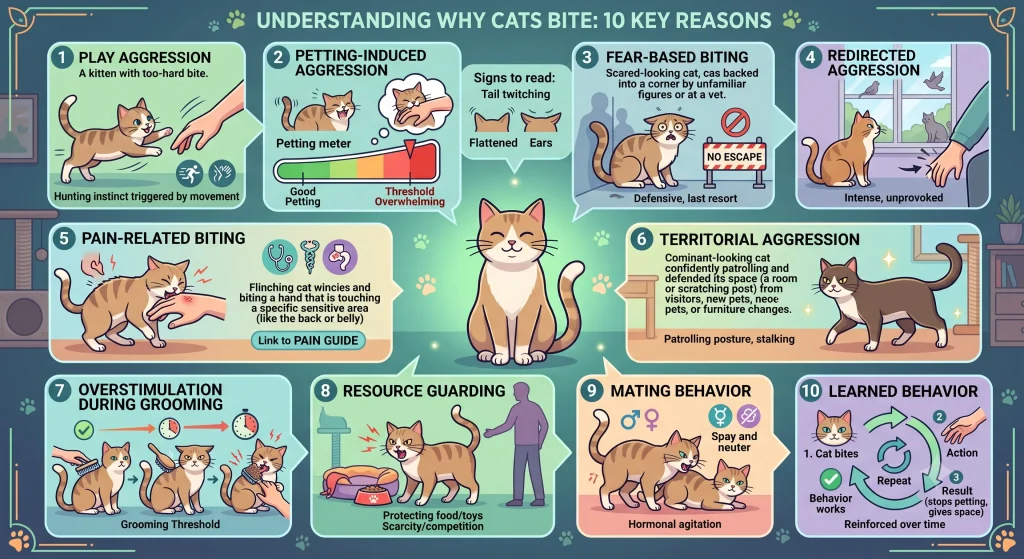
1. Play Aggression
The most common reason cats bite during interaction is play aggression. Kittens learn bite inhibition through play with littermates — when they bite too hard, the other kitten yelps and stops playing. This teaches them to control bite pressure. Kittens adopted too early — before eight weeks old — often miss this lesson and grow up biting harder than they should because they never learned where the line is. Adult cats also bite during play when they’re overstimulated, when toys mimic prey too closely to hands, or when play sessions don’t burn enough energy. Your hand moving across the couch looks like prey. Your cat pounces and bites. It’s not aggression — it’s hunting instinct triggered by movement.
2. Petting-Induced Aggression
This is the biting that happens during seemingly affectionate petting. You’re stroking your cat’s back, they seem relaxed, then they suddenly bite. This occurs because cats have a threshold for physical stimulation. Below the threshold, petting feels good. Above it, petting becomes overwhelming and uncomfortable. The cat tolerates petting until they can’t tolerate it anymore, then they bite to make it stop. Learning to read the signs of approaching overload — tail flicking, skin twitching, ears rotating, pupils dilating — lets you stop before the bite happens.
3. Fear-Based Biting
Cats who feel trapped, cornered, or threatened bite defensively. This is different from play or petting aggression — the cat is genuinely scared and biting is their last resort. Common triggers include unfamiliar people, veterinary visits, being picked up by someone they don’t trust, or encountering a new cat. Fear-based bites are usually preceded by clear warning signs — flattened ears, wide eyes, hissing, growling, and an attempt to flee. If the cat can’t flee, they bite.
4. Redirected Aggression
When a cat is aroused or aggressive toward something they can’t reach — another cat outside the window, a bird, a loud noise — they may redirect that aggression onto whatever is closest. That might be you, another pet, or an object. The cat doesn’t distinguish between the source of their frustration and the convenient target. Redirected aggression is intense, seemingly unprovoked, and can result in severe bites because the cat’s arousal level is extremely high.
5. Pain-Related Biting
Cats in pain bite when touched in sensitive areas. Arthritis, dental disease, urinary tract infections, ear infections, and injuries all create pain that makes physical contact unbearable. A cat who has always enjoyed being petted but suddenly starts biting may be experiencing pain rather than behavioral change. Pain-related biting requires veterinary evaluation, not behavioral correction. Our sick cat guide covers pain recognition in cats.
6. Territorial Aggression
Cats who feel their territory is threatened — by visitors, new pets, or even changes in furniture arrangement — may bite to defend their space. This is more common in cats who weren’t properly socialized to tolerate environmental changes and new individuals. Territorial biting is accompanied by body tension, stalking, and confident posturing rather than the fearful body language of defensive biting.
📚 The Complete Cat Care Bundle
Get 3 premium eBooks covering cat training, behavior, nutrition, and health. Instant digital download in one value-packed bundle.
Get the Bundle →7. Overstimulation During Grooming
Some cats tolerate grooming — brushing, nail trimming, ear cleaning — initially but become overstimulated and bite when the process continues too long. This is especially common with sensitive cats who have low stimulation thresholds. The grooming creates physical overstimulation that escalates until the cat bites to stop the handling.
8. Resource Guarding
Cats who guard food, treats, toys, or favorite resting spots may bite when approached during possession. This is less common than in dogs but does occur, especially in multi-cat households where resources are scarce or competition is high. The cat perceives a threat to their valued resource and bites to protect it.
9. Mating Behavior
Intact male cats may bite during mating attempts, and females in heat may bite when handled due to hormonal agitation. Spaying and neutering typically resolves mating-related biting.
10. Learned Behavior
Cats who have learned that biting produces a result — you stop petting them, you move away, you give them space — repeat the behavior because it works. Inadvertently rewarding biting with attention or removal of the stimulus reinforces the behavior over time.
Types of Cat Bites
Play Bites
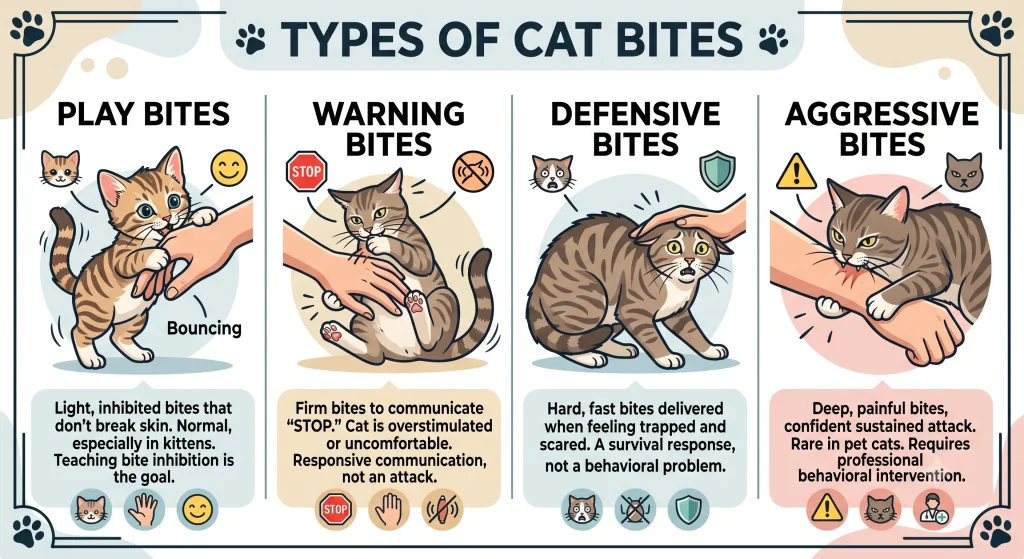
Light, inhibited bites that don’t break skin. Often accompanied by playful body language — dilated pupils, forward ears, puffed tail, bouncing movements. These are normal, especially in kittens and young cats. The goal is teaching bite inhibition rather than eliminating the behavior entirely.
Warning Bites
Firm but not injurious bites that communicate “stop.” The cat is overstimulated or uncomfortable and gives a clear signal that the interaction needs to end. These bites are actually progress — the cat is communicating rather than attacking. They’re responding appropriately to discomfort.
Defensive Bites
Hard, fast bites delivered while the cat is in a defensive posture — ears flat, body crouched, tail tucked. These happen when the cat feels trapped and scared. The bite is a survival response, not a behavioral problem. Address the fear, and the biting stops.
Aggressive Bites
Deep, injurious bites delivered with confidence — ears forward, body tense, sustained attack. These are rare in pet cats and usually indicate redirected aggression, territorial defense, or extreme fear. These bites require professional behavioral intervention.
How to Stop Cat Biting
Technique 1: Recognize Overstimulation Signs
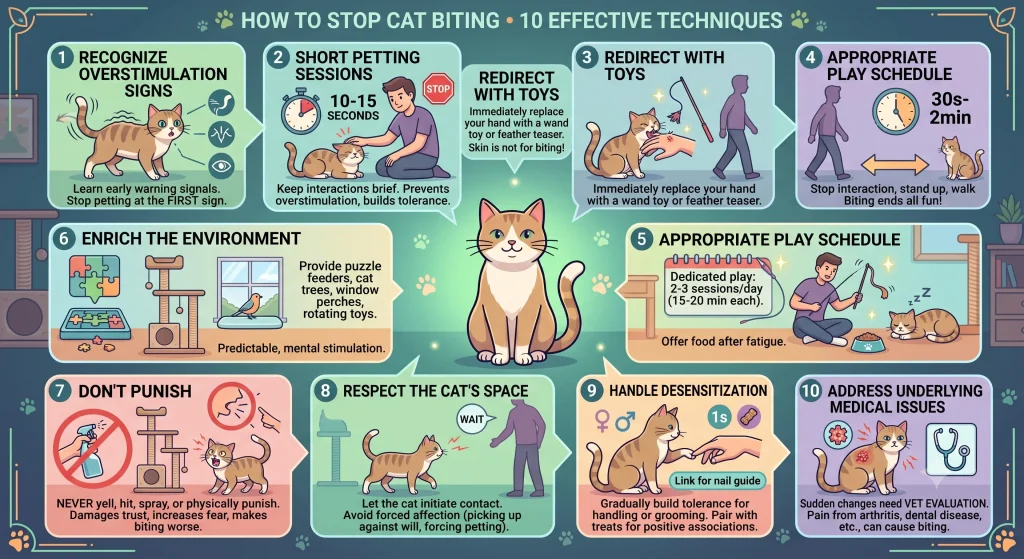
Learn your cat’s early warning signals and stop petting before the bite happens. Common signs of approaching overstimulation include:
- Tail flicking or lashing. The tail switches back and forth with increasing speed as stimulation builds.
- Skin twitching. The skin along the back ripples or twitches, indicating growing discomfort.
- Ear rotation. Ears rotate sideways or flatten slightly, moving away from the relaxed forward position.
- Pupil dilation. Eyes widen as arousal increases, even in normal lighting.
- Head turning. The cat turns their head toward your hand, tracking its movement — assessing whether to bite.
- Stillness. A cat who freezes during petting is processing overstimulation and may bite if it continues.
- Low growl or meow. Vocal warning signals that the cat has reached their limit.
Stop petting at the FIRST sign of these behaviors. Don’t push through to see what happens. Respect the threshold.
Technique 2: Short Petting Sessions
Instead of long petting sessions that inevitably cross the overstimulation threshold, keep interactions brief. Pet for ten to fifteen seconds, then stop. If the cat solicits more by nudging your hand or rubbing against you, pet for another ten seconds. Short sessions prevent overstimulation while maintaining positive interaction. Over time, some cats increase their tolerance as they learn that petting has a predictable, comfortable duration.
Technique 3: Redirect With Toys
When your cat bites during play, immediately redirect to an appropriate toy. Replace your hand with a wand toy, feather teaser, or stuffed mouse. This teaches the cat that toys are for biting and human skin is not. Keep toys nearby during all play interactions so the redirect is instant. Never wrestle with your cat using bare hands — always put a toy between your hand and the cat’s mouth.
Technique 4: Withdrawal Method
When your cat bites during petting or play, immediately and calmly stop the interaction. Stand up, walk away, and ignore the cat for thirty seconds to two minutes. This teaches the cat that biting ends all positive interaction. The key is consistency — every single time the cat bites, the interaction stops. No exceptions. Over time, the cat learns that biting produces the opposite of what they want.
Technique 5: Appropriate Play Schedule
Most play aggression results from insufficient exercise and enrichment. Schedule two to three dedicated play sessions per day, lasting fifteen to twenty minutes each. Use interactive toys that keep your hands away from the cat’s mouth. Play until the cat shows signs of fatigue — slower movements, less interest, lying down — then offer food. This mimics the natural hunt-catch-kill-eat sequence and provides both physical and mental satisfaction.
Technique 6: Enrich the Environment
Cats who lack mental stimulation are more likely to bite out of boredom and frustration. Provide puzzle feeders, cat trees, window perches, rotating toys, and hiding spots. A stimulated cat bites less because their predatory energy has appropriate outlets.
Technique 7: Don’t Punish
Never yell at, hit, spray, or physically punish a cat for biting. Punishment damages trust, increases fear, and often makes biting worse — a scared cat bites more defensively. Punishment also suppresses warning signals, so the cat may stop growling and warning before biting, making the bites seem more sudden and unprovoked. Positive reinforcement of desired behavior and withdrawal of attention for unwanted behavior are far more effective.
Technique 8: Respect the Cat’s Space
Learn when your cat wants interaction and when they want to be left alone. Forced affection — picking up a cat who doesn’t want to be held, petting a cat who is trying to sleep — creates defensive biting. Let the cat initiate contact, and respect their choices about when and how they want to interact.
Technique 9: Handle Desensitization
For cats who bite during grooming or handling, desensitization gradually increases tolerance. Start with very brief handling — touch the paw for one second, then treat. Gradually increase duration over days and weeks. Pair handling with high-value treats to create positive associations. This process takes patience but produces lasting results. Our nail trimming guide covers handling techniques.
Technique 10: Address Underlying Medical Issues
If your cat’s biting started suddenly or has increased significantly, veterinary evaluation is essential. Pain from arthritis, dental disease, urinary problems, or injuries can cause previously gentle cats to bite. Treating the underlying medical condition often resolves the biting without behavioral intervention.
📚 The Complete Cat Care Bundle
Get 3 premium eBooks covering cat training, behavior, nutrition, and health. Instant digital download in one value-packed bundle.
Get the Bundle →Stop Cat Bitten During Sleep
Cats who bite when startled from sleep often at night when you accidentally touch them need a different approach. These bites are reflexive fear responses. Avoid startling sleeping cats. Make noise or move gently near a sleeping cat before touching them. Provide a dedicated sleeping spot away from high-traffic areas. Consider a night light if the cat seems disoriented when woken in darkness.
Kitten Bite Training
Kittens bite everything because they’re exploring their world with their mouths and developing hunting skills. Training bite inhibition in kittens follows the same principles as with adults but requires more patience:
- Let kittens play with littermates as long as possible. Littermate play teaches bite inhibition naturally.
- Redirect aggressively. Every tooth-on-skin contact gets an immediate toy replacement.
- Stop play immediately. Biting ends the fun instantly. Consistency teaches faster than punishment.
- Provide appropriate chew items. Rubber toys, stuffed mice, and teething rings give kittens appropriate biting targets.
- Don’t use hands as toys. This teaches kittens that skin is acceptable to bite, creating adult biting problems.
Expert Tips From My Practice
The most common mistake I see with cat biting is owners who think their cat is being mean or vindictive. Cats don’t bite to punish you. They bite because they’re communicating something — overstimulation, fear, pain, or predatory excitement. If you treat every bite as communication rather than aggression, you’ll respond more effectively and build a stronger bond. Listen to what the bite is telling you, and address the underlying cause rather than just reacting to the symptom.
- Shorter is better. Most petting-induced biting happens because sessions go too long. Keep petting short, sweet, and let the cat ask for more.
- Play before meals. A vigorous play session followed by food satisfies the hunt-catch-kill-eat instinct and reduces predatory biting.
- Never play rough. Wrestling with hands teaches the cat that human skin is a play target. Always use toys as buffers.
- Watch for the freeze. A cat who stops moving during petting is processing overstimulation. Stop petting immediately when you see the freeze.
- Multi-cat considerations. Redirected aggression often targets housemates. Separate aroused cats and provide individual calm-down spaces.
- Seek professional help for severe cases. Deep, injurious bites or sustained attacks require veterinary behaviorist intervention. Don’t try to manage serious aggression alone.
- Consistency is everything. Inconsistent responses sometimes stopping after a bite, sometimes continuing teach the cat that biting sometimes works. Be consistent every single time. Our complete cat care books cover behavioral training extensively.
FAQ
Why does my cat bite me when I pet them?
Your cat bites during petting because they’ve become overstimulated. Cats have a threshold for physical contact, and exceeding it triggers a bite response. Learn to recognize warning signs, tail flicking, ear rotation, skin twitching, and stop petting before the bite happens.
How do I stop my kitten from biting?
Redirect every bite to a toy, stop play immediately when teeth touch skin, and never use hands as play targets. Consistent redirection teaches kittens that human skin is off-limits while toys are acceptable biting targets.
Is my cat aggressive or just playing?
Play biting is light, inhibited, and accompanied by playful body language — dilated pupils, bouncing movements, forward ears. Aggressive biting is hard, injurious, and accompanied by tense body posture, flattened ears, and confident attack. The context and body language tell you which one you’re dealing with.
Why does my cat bite me at night?
Nighttime biting is usually a startle response. When you accidentally touch a sleeping cat, they bite reflexively. Avoid startling sleeping cats by making noise before touching them, and provide a sleeping spot away from high-traffic areas.
Should I punish my cat for biting?
No. Punishment damages trust, increases fear, and often makes biting worse. It also suppresses warning signals, so the cat may stop growling before biting, making bites seem more sudden. Use withdrawal of attention instead.
Why does my cat bite me then lick me?
This is overstimulation cycling. The cat enjoys petting, becomes overstimulated and bites, then tries to re-engage through licking. It’s not aggressive, it’s a confused mix of affection and discomfort. Shorter petting sessions prevent this pattern.
Can I train my adult cat to stop biting?
Yes. Consistent training using withdrawal methods, redirection, and environmental enrichment can significantly reduce or eliminate adult cat biting. The key is identifying the specific trigger and addressing it systematically.
Why does my cat only bite certain people?
Cats bite specific people because of individual interaction styles. Some people pet too long, move too fast, hold too tight, or ignore warning signals. Teaching household members to read cat body language and respect boundaries prevents targeted biting.
When should I see a vet for cat biting?
See a vet if biting starts suddenly, increases in frequency or severity, is accompanied by other behavioral changes, or results in deep wounds. Sudden biting often indicates pain or medical problems requiring treatment.
Will my cat ever stop biting completely?
Most cats can learn to inhibit their bites significantly, and many stop biting entirely with consistent training. Some cats retain mild mouthing during play, which is normal. The goal is appropriate bite pressure, not necessarily complete elimination.