


Table of Contents
Cat Worms Complete Guide to Types Symptoms Treatment and Prevention
You notice your cat scooting their rear end across the carpet, or you spot tiny white rice like segments around their anus, or maybe you just adopted a kitten from a shelter and the intake paperwork recommends a deworming protocol. Worms are one of the most common parasites affecting cats, and they are also one of the most misunderstood. Many cat owners assume that indoor cats cannot get worms, that worms are only a problem in kittens, or that a single deworming treatment solves the problem permanently. None of these assumptions are correct.
Indoor cats can get worms from fleas, from contaminated soil brought in on shoes, from hunting insects and rodents, and from contact with other infected animals. Adult cats need ongoing preventive care, not just a one time treatment. Kittens are especially vulnerable because many worms pass from mother to kitten through the placenta or milk, meaning kittens can be born already infected. Understanding the different types of worms that affect cats, recognizing the symptoms that indicate infection, knowing how treatment works, and implementing a prevention strategy protects your cat and your family, because several cat worms can also infect humans.
📚 Recommended Cat Guides
🐱 The Trainable Cat Book
Learn proven methods to train your cat and stop unwanted behaviors.
View Book →❤️ Complete Cat Care Manual
Your complete guide to cat nutrition, health, grooming, behavior, and daily care.
Get the Manual →As a certified veterinary expert and professional cat behaviorist, I have diagnosed worm infections in cats of all ages, lifestyles, and health statuses. Some infections are obvious with visible worms or severe symptoms, while others are completely invisible until a routine fecal test reveals the presence of parasite eggs. This guide covers the four main types of worms that infect cats, the symptoms ranging from obvious to subtle, how veterinary diagnosis works, effective treatment options for each worm type, the zoonotic risk to humans and how to prevent it, and the ongoing prevention strategy that keeps your cat worm free for life. Worm prevention is simple, affordable, and essential for every cat regardless of lifestyle.
Four Main Types of Worms in Cats

Roundworms
Roundworms are the most common worms in cats, particularly kittens. They are large, round, white to tan colored worms that can reach three to five inches in length and look like spaghetti noodles. Adult roundworms live in the small intestine, where they feed on partially digested food and compete with the cat for nutrients. Kittens infected with roundworms often have pot bellied appearances, poor coat quality, failure to thrive, and diarrhea.
Adult cats may show minimal symptoms with low level infections or may vomit up visible worms. Roundworm eggs are passed in the feces and can survive in the environment for months to years, making reinfection common without ongoing prevention. Cats become infected by ingesting eggs from contaminated soil, feces, or prey, or kittens can be infected through their mother’s milk.
Hookworms
Hookworms are small, thin worms that attach to the intestinal wall and feed on blood. They are rarely visible in vomit or stool because of their small size, typically less than one inch long. Hookworm infections cause significant blood loss, leading to anemia, dark tarry stools, weight loss, and poor coat quality. Kittens are especially vulnerable to severe hookworm infections because their small blood volume makes even modest blood loss dangerous. Hookworm larvae can penetrate the skin, including human skin, making them a zoonotic concern. Cats become infected by ingesting larvae from contaminated soil or through larval penetration of the skin, particularly the paw pads.
Tapeworms
Tapeworms are flat, segmented worms that live in the small intestine. The segments, called proglottids, are the size of a grain of rice and are often the first sign owners notice. They may be seen crawling around the cat’s anus, stuck to the fur near the tail, or on the cat’s bedding. Fresh segments are white and may move actively. Older segments dry out and become yellow and crusty.
Tapeworm infection is almost always caused by flea ingestion. When a cat grooms and swallows an infected flea, the flea larvae develop into adult tapeworms in the intestine. This means that effective flea prevention is the most important tapeworm prevention strategy. Cats that hunt rodents are also at risk because rodents can carry tapeworm larvae.
Whipworms
Whipworms are less common in cats than in dogs but still occur, particularly in outdoor cats and multi cat households. They are thin, whip shaped worms that live in the large intestine and cecum. Whipworm infections cause inflammation of the intestinal lining, leading to bloody diarrhea, weight loss, and dehydration. Heavy infections can cause significant debilitation. Whipworm eggs are passed in the feces and can survive in the environment for years, making environmental contamination a persistent concern. Diagnosis requires fecal testing because whipworm eggs are not always shed consistently, and multiple fecal tests may be needed to detect infection.
Symptoms of Worm Infections in Cats

The severity of symptoms depends on the type of worms, the number of worms present, and the age and overall health of the cat. Visible worms in vomit or stool are the most obvious sign, particularly with roundworms and tapeworm segments.
Pot bellied appearance in kittens is a classic sign of roundworm infection. Weight loss despite a normal or increased appetite occurs because worms steal nutrients from the host. Poor coat quality, with dull, dry, unkempt fur, indicates nutritional deprivation caused by parasites. Diarrhea, which may be watery, bloody, or contain mucus, is common with heavy infections of any worm type. Vomiting, which may contain visible worms, occurs when the worm burden is high.
Lethargy and weakness result from nutrient theft, blood loss, and the body’s immune response to the parasites. Scooting and rear end irritation occur with tapeworm infections because the proglottids cause itching around the anus. Failure to thrive in kittens, where the kitten fails to gain weight and grow normally despite adequate food intake, is a hallmark of roundworm infection. Anemia, indicated by pale gums and weakness, is particularly associated with hookworm infections.
Veterinary Diagnosis
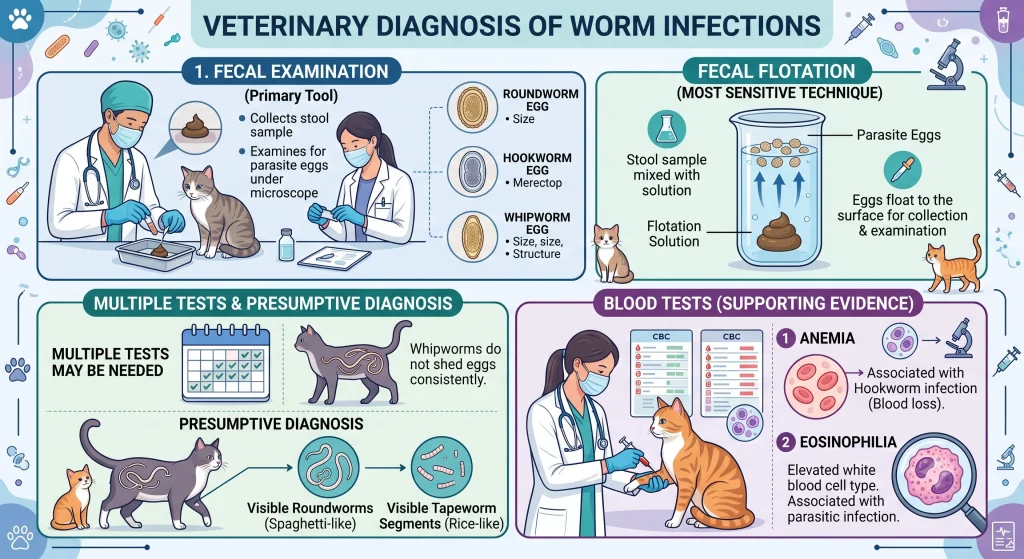
Fecal examination is the primary diagnostic tool for worm infections. Your veterinarian collects a stool sample and examines it under a microscope for parasite eggs. Different worm types produce distinctive eggs that can be identified by their shape, size, and internal structure. Fecal flotation, where the stool sample is mixed with a solution that causes parasite eggs to float to the surface for collection and examination, is the most sensitive technique.
Multiple fecal tests may be needed because some worms, particularly whipworms, do not shed eggs consistently. In some cases, adult worms or tapeworm segments are visible to the owner and provide a presumptive diagnosis. Blood tests may reveal anemia associated with hookworm infection or eosinophilia, which is an elevated white blood cell type associated with parasitic infection.
Treatment Options

Prescription Dewormers
Pyrantel pamoate is effective against roundworms and hookworms. It paralyzes the worms, which are then passed in the stool. This medication is safe for kittens as young as two weeks old and is commonly included in kitten deworming protocols.
Praziquantel is the treatment of choice for tapeworms. It dissolves the worms within the intestine, and they are digested rather than passed whole. This medication is highly effective and typically requires only a single dose. Fenbendazole is a broad spectrum dewormer effective against roundworms, hookworms, and whipworms. It is typically administered for three to five days to ensure complete elimination. Ivermectin is effective against several worm types and is sometimes used in combination protocols for heavy or resistant infections.
Combination Products
Many veterinary products combine multiple deworming agents to address several worm types simultaneously. These combination products simplify treatment and ensure comprehensive parasite elimination. Your veterinarian will recommend the most appropriate product based on your cat’s specific infection, age, and health status.
Zoonotic Risk to Humans

Several cat worms can infect humans, making prevention important for the entire family. Roundworm larvae can migrate through human tissues, causing a condition called visceral larva migrans, which can affect the liver, lungs, and other organs. In rare cases, larvae can reach the eyes, causing ocular larva migrans. Children are at highest risk because they are more likely to come into contact with contaminated soil and less likely to practice proper hand hygiene.
Hookworm larvae can penetrate human skin, causing cutaneous larva migrans, which presents as itchy, winding tracks under the skin. Tapeworm infection in humans is less common but can occur through flea ingestion, particularly in children. Practicing good hygiene, including handwashing after handling cats or cleaning litter boxes, promptly disposing of cat feces, preventing flea infestations, and keeping children away from contaminated areas, significantly reduces zoonotic risk.
Ongoing Prevention Strategy

Effective worm prevention requires a multi layered approach. Regular deworming according to veterinary guidelines is the foundation. Kittens typically receive deworming treatments at two, four, six, and eight weeks of age, then monthly until six months old. Adult indoor cats are typically dewormed at least twice yearly, while outdoor cats may need quarterly treatment depending on risk level. Flea prevention is essential because fleas are the primary transmission route for tapeworms.
Year round flea prevention protects against both fleas and tapeworms simultaneously. Regular fecal testing, at least annually for indoor cats and more frequently for outdoor cats, detects infections before symptoms develop. Prompt removal of feces from litter boxes and outdoor areas prevents environmental contamination and reinfection. Keeping cats indoors eliminates many worm exposure routes, though indoor cats still need preventive care.
Expert Tips From My Practice
The most common mistake I see with worm prevention is the all or nothing mentality. Owners either deworm their cat once and assume they are protected for life, or they assume their indoor cat does not need any deworming at all. Neither approach is correct. Worm prevention is an ongoing process, not a one time event.
Eggs can survive in the environment for months, fleas find their way into even the cleanest homes, and indoor cats still groom and ingest parasites. I recommend year round flea prevention for every cat, combined with fecal testing at least once a year and deworming based on your veterinarian’s risk assessment. It is inexpensive, easy, and protects both your cat and your family from preventable parasite infections.
- Roundworms are the most common worms in cats. Kittens are especially vulnerable and often infected through their mother’s milk.
- Tapeworms come from fleas. Year round flea prevention is the most effective tapeworm prevention strategy.
- Hookworms cause anemia. They feed on blood and can be dangerous for kittens and small cats.
- Indoor cats need prevention too. Worms can enter homes on shoes, clothing, and through flea exposure.
- Fecal testing catches hidden infections. Many worm infections show no visible symptoms until advanced.
- Cat worms can infect humans. Good hygiene and prompt feces removal protect your family.
- Follow veterinary deworming schedules. Kittens need frequent treatment, adults need ongoing prevention.
- Prompt litter box cleaning prevents reinfection. Remove feces daily to break the parasite life cycle.
FAQ
What are the most common worms in cats?
Roundworms are the most common, followed by tapeworms, hookworms, and whipworms. Roundworms are particularly prevalent in kittens.
Can indoor cats get worms?
Yes. Indoor cats can get worms from fleas, from contaminated soil on shoes, from hunting insects, and from contact with other animals. Prevention is important for all cats.
How do I know if my cat has worms?
Visible worms in vomit or stool, scooting, weight loss, poor coat quality, pot bellied appearance in kittens, and diarrhea are common signs. Fecal testing is the most reliable diagnosis method.
Are cat worms contagious to humans?
Yes. Roundworms and hookworms can infect humans, particularly children. Good hygiene, handwashing, and prompt feces removal reduce zoonotic risk significantly.
How are tapeworms different from other worms?
Tapeworms are flat and segmented, and their segments look like rice grains around the anus. They are almost always caused by flea ingestion, making flea prevention the key to tapeworm prevention.
How often should I deworm my cat?
Kittens need deworming every two weeks until eight weeks old, then monthly until six months. Adult indoor cats need treatment at least twice yearly. Outdoor cats may need quarterly treatment.
Can I see worms in my cat’s stool?
Roundworms may be visible as large spaghetti like worms. Tapeworm segments look like rice grains. Hookworms and whipworms are rarely visible because of their small size.
What is the best dewormer for cats?
Your veterinarian will recommend the most appropriate dewormer based on the specific worm type. Common options include pyrantel, praziquantel, and fenbendazole.
Can my cat get worms from hunting?
Yes. Hunting rodents and insects exposes cats to roundworm and tapeworm larvae. Indoor cats that hunt bugs in the house are also at risk.
How do I prevent my cat from getting worms?
Year round flea prevention, regular deworming according to veterinary guidelines, annual fecal testing, prompt feces removal, and keeping cats indoors are the most effective prevention strategies.