

TABLE OF CONTENTS
Table of Contents
Cat Dental Disease: The Symptoms, Stages, Treatment Cost, and Prevention Guide
Look, I get it. Nobody wakes up excited to talk about cat teeth. I mean, who wants to spend their Tuesday night Googling “why does my cat have bad breath?” or “can dental disease kill a cat?” But here’s the thing, and I cannot stress this enough, if you own a cat, you WILL deal with cat dental disease at some point. It’s not a question of if, it’s when. And the when part? That’s largely up to you.
I’ve spent years working alongside veterinary dentists, and I’ll be honest with you about something most articles won’t say: most cat owners have no idea what’s happening in their cat’s mouth. Zero. Nada. They assume that because their cat is eating, everything is fine. Spoiler alert: it’s often not fine. Cats will eat through broken teeth, fractured jaws, and infections that would have you curled up on the floor crying. They’re wired that way, their wild ancestors couldn’t afford to look weak, so hiding pain is literally in their DNA.
📚 Recommended Cat Guides
🐱 The Trainable Cat Book
Learn proven methods to train your cat and stop unwanted behaviors.
View Book →❤️ Complete Cat Care Manual
Your complete guide to cat nutrition, health, grooming, behavior, and daily care.
Get the Manual →So let’s fix that. Right now. This guide is going to break down everything about feline dental disease in plain English, no jargon walls, no scare tactics, just real information from someone who’s seen the before-and-after pictures and doesn’t want your cat to end up like the worst cases. Whether you’re searching for signs of dental disease in cats, trying to figure out cat dental cleaning cost, or just want to know how to prevent dental disease in cats, this is the only article you’ll need. For a complete feline health reference, check out the Complete Cat Care Manual.
Why This Problem Is Way Bigger Than You Think
Here’s a statistic that actually made me put down my coffee when I first heard it: over 70% of cats have some form of cat dental disease by the time they’re three years old. Three. Your cat is barely out of its awkward teenage phase and its teeth are already falling apart. The American Veterinary Medical Association backs this up, and honestly, the number might be higher in practice because so many cases of feline oral health problems go undiagnosed.
Why do they go undiagnosed? Two reasons. One, cats hide pain like pros. Two, owners don’t know the signs of dental disease in cats. It’s a perfect storm of suffering, and it’s completely preventable.
I had a friend, and this still makes me mad, who ignored her cat’s bad breath for two years. Two years! By the time she brought him in, he had six teeth that needed extraction and early signs of kidney damage from the chronic infection. The bill was over three thousand dollars, and more importantly, her cat had been in pain for God knows how long. Don’t be my friend. Please.
Do indoor cats get dental disease? Absolutely. In fact, indoor cats are just as susceptible, if not more so, because they don’t have access to anything that might mechanically clean their teeth. Dental disease doesn’t discriminate based on lifestyle.
The Four Stages of Cat Dental Disease Nobody Talks About (But Should)
Most people don’t realize that dental disease isn’t a single event. It’s a progression, a slow, sneaky deterioration that happens in stages. Understanding the cat dental disease stages is critical because the earlier you catch it, the cheaper and easier it is to fix. Way cheaper.
Stage 1: The “Oh, That’s Nothing” Stage
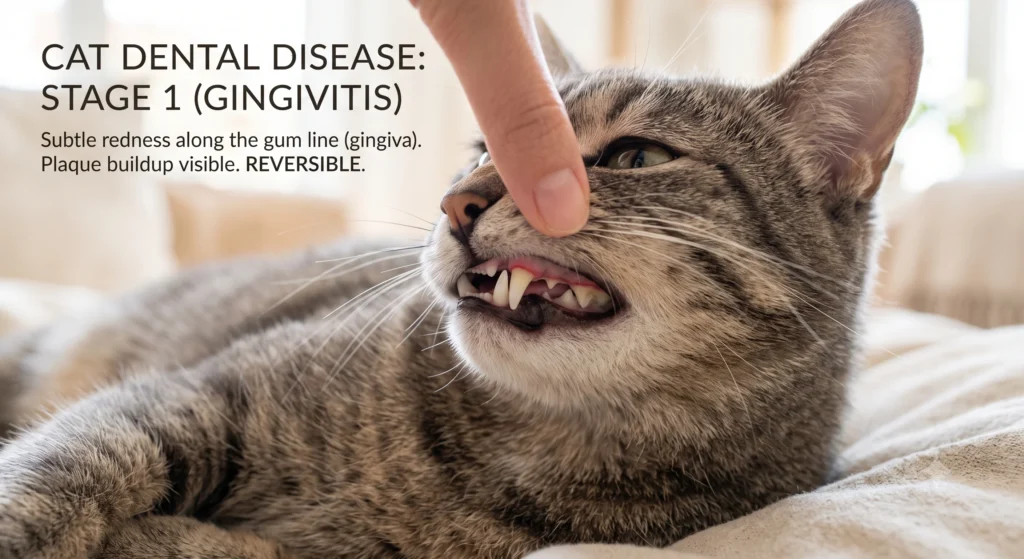
This is gingivitis. Cat gingivitis means your cat’s gums get a little red along the edges where they meet the teeth. There might be some mild bad breath. Maybe you notice a faint line of yellow near the back teeth. But your cat is eating fine, playing fine, acting totally normal.
Here’s what’s actually happening underneath: plaque, that sticky film of bacteria, is building up along the gumline. If you could somehow zap that plaque away right now, the gums would heal completely. It’s 100% reversible. But nobody notices it because it’s so subtle.
Can you reverse cat dental disease at home? At this stage, honestly, you’re close. You can’t remove existing plaque with home care alone, but you can absolutely prevent it from getting worse and let the gums heal. The key is catching it here.
Stage 2: The “Huh, That’s Weird” Stage
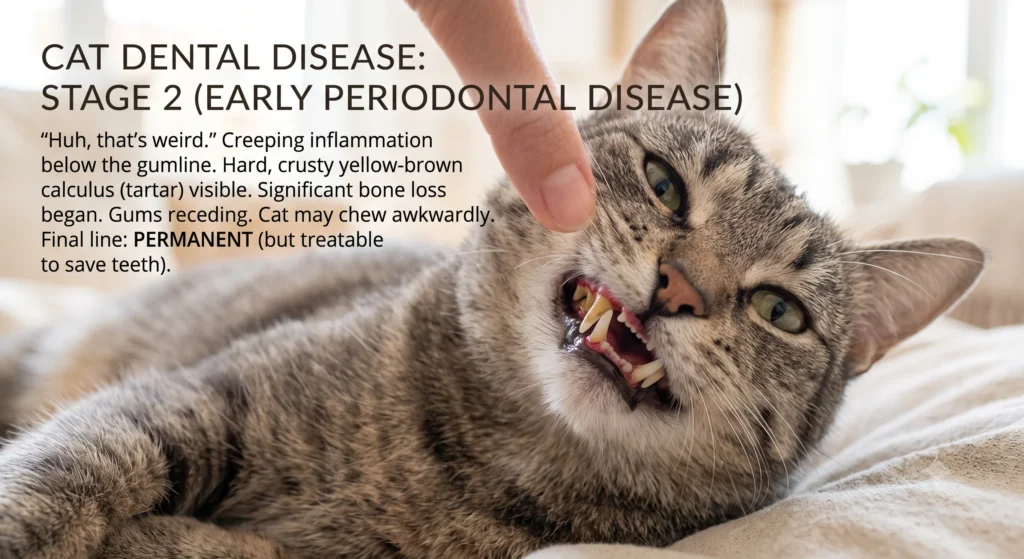
Now we’re into early periodontal disease in cats. The inflammation has crept below the gumline into the ligament that holds the tooth in place. You’ll start seeing actual tartar, that hard, crusty yellow stuff you can’t scrape off with your fingernail. Your cat might start chewing weirdly, kind of tilting their head to one side.
The damage here? It’s permanent. The bone loss that’s happened isn’t coming back. But you can still save most of the teeth if you act now.
Stage 3: The “Okay, Something Is Definitely Wrong” Stage
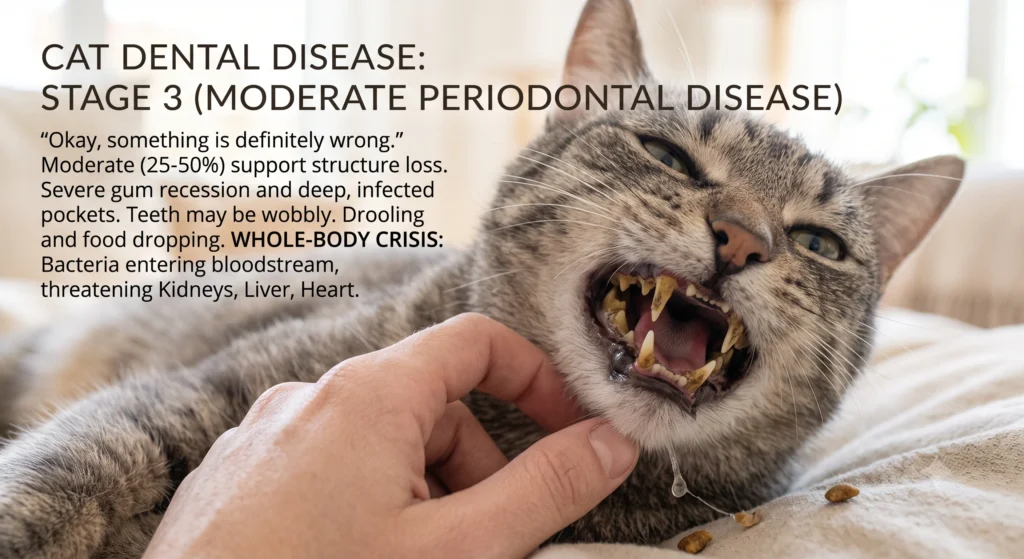
This is where things get ugly. Moderate cat periodontal disease means 25 to 50% of the tooth’s support structure is gone. The gums are pulling away from the teeth, creating pockets where bacteria are having a literal party. Teeth might be wobbly. Your cat is probably drooling more, maybe dropping food, maybe crying out during meals.
And here’s the scary part, bacteria from those pockets are getting into the bloodstream. They’re heading for the kidneys, the liver, the heart. This isn’t just a cat tooth decay problem anymore, it’s a whole-body crisis.
Stage 4: The “How Did It Get This Bad?” Stage
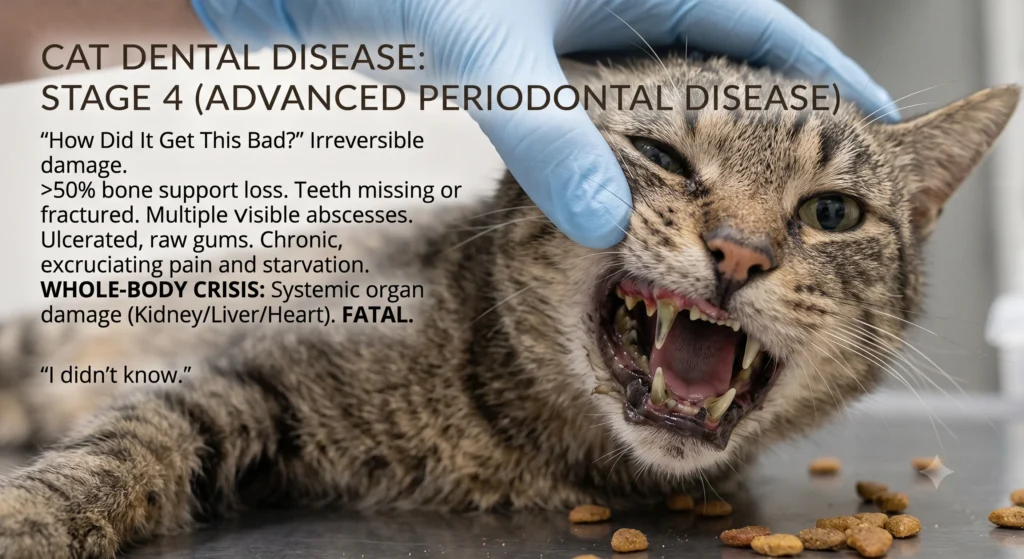
Advanced periodontal disease. More than half the tooth support is destroyed. Teeth are loose, abscessed, and causing constant pain. Facial swelling, extreme difficulty eating, weight loss, the whole nine yards. Treatment here involves extensive surgery, often pulling multiple teeth. And even after treatment, the systemic damage to organs may already be done.
How long can a cat live with dental disease? That’s the heartbreaking question. Some cats survive for years, but they’re not living, they’re enduring. The chronic infection and pain shorten lifespan significantly, and the organ damage from untreated feline dental disease can become fatal. I’ve seen cats come in at Stage 4 who were literally starving to death because they couldn’t eat. It breaks your heart. And every single time, the owner says the same thing: “I didn’t know.” And they genuinely didn’t. That’s why this guide exists.
The Signs of Dental Disease in Cats You’re Probably Missing
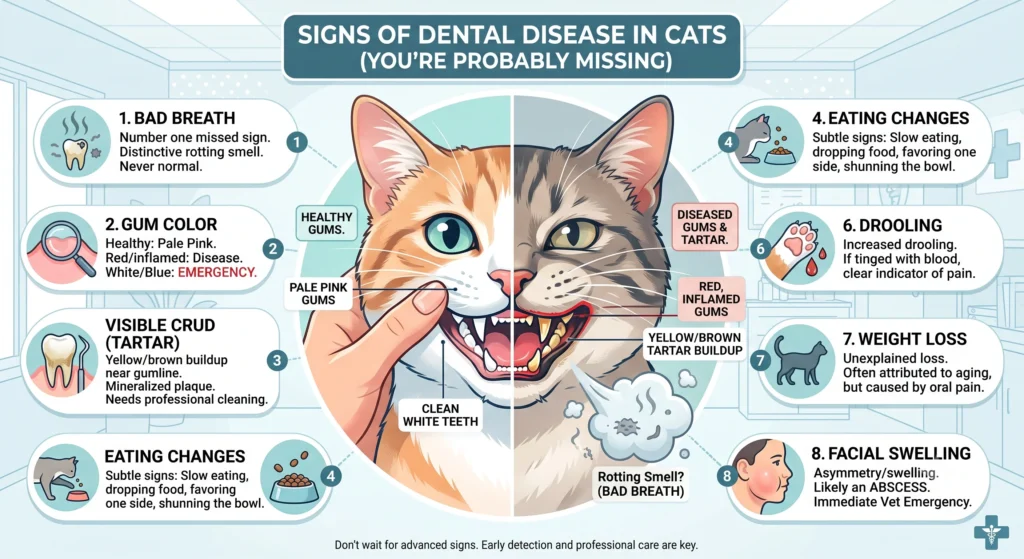
Okay, let’s get practical. Here’s how to tell if your cat has dental disease, in order from earliest to most obvious:
Bad breath. Yes, cat breath is never going to smell like minty fresh gum. But there’s a difference between “eh, cat breath” and “something is rotting in there.” If the smell changes or gets noticeably worse, that’s your first clue. Cat bad breath is never normal, it always means something is going on, whether it’s dental disease, kidney problems, or diabetes. This is the number one sign of dental disease in cats that owners notice, and it’s the one they most often dismiss.
Gum color. Pull back your cat’s lip gently (when they’re calm, not while they’re in “don’t touch me” mode) and look. Healthy gums are pale pink. If they’re red, especially in a line right along the teeth, that’s inflammation. If they’re white or blue, that’s an emergency, get to a vet immediately. Cat gum disease is one of the earliest indicators of feline oral health problems.
Visible crud on the teeth. Yellow or brown buildup near the gumline is tartar, and it means plaque has been sitting there long enough to mineralize. You can’t brush tartar off, it requires professional cleaning. This is a clear sign of cat tooth decay progressing.
Eating changes. This one is tricky because cats are so subtle about it. Maybe they’re eating slower. Maybe they’re picking up food and dropping it. Maybe they’re favoring one side of their mouth. Maybe they approach the bowl and then walk away. All of these are red flags for dental disease in cats. A cat not eating dental disease is one of the most common reasons owners finally bring them in, and by then the problem is usually advanced.
Pawing at the mouth. Cats don’t usually do this unless something is really bothering them. If you see your cat scratching at their face or rubbing it obsessively against furniture, pay attention. This is a classic sign of dental pain in cats.
Drooling. A little drool when your cat is happy is normal. Increased drooling, especially if it’s tinged with blood, is not. Cat drooling dental pain is a clear indicator that something is wrong inside the mouth.
Weight loss. If your cat is losing weight and you haven’t changed anything about their diet or exercise, dental pain is one of the first things to rule out. Old cat dental disease is especially sneaky because owners often attribute weight loss to aging rather than oral pain.
Facial swelling. If you notice swelling on one side of your cat’s face, that’s usually an abscess from a diseased tooth. This requires immediate veterinary attention. Cat facial swelling dental issues are emergencies, not wait-and-see situations.
What’s Actually Causing All This?
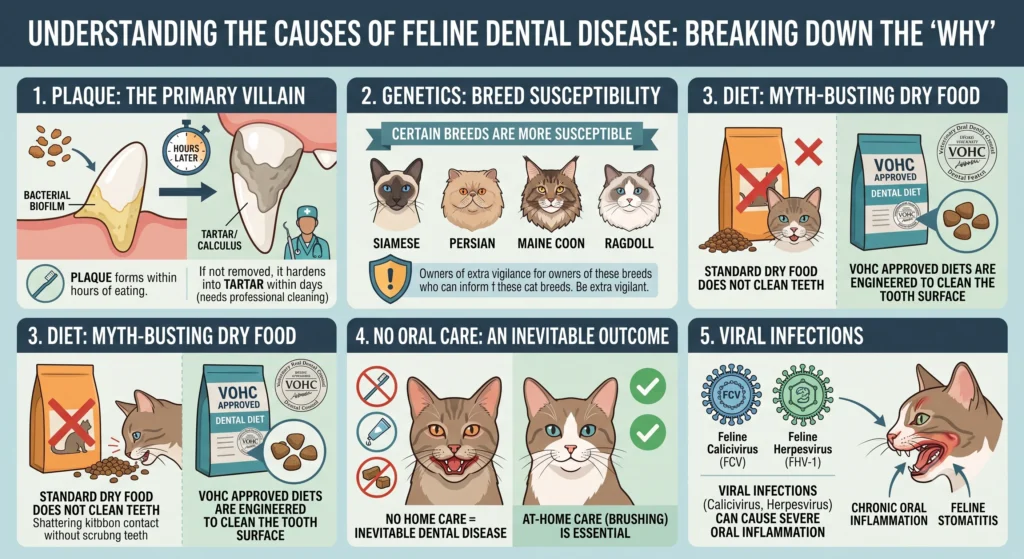
Let’s break down the “why” because understanding the cause helps you prevent it.
Plaque and tartar in cats. Plaque is the number one villain. Plaque forms within hours of eating, literally hours. It’s a biofilm of bacteria that sticks to the tooth surface. If you don’t remove it (through brushing or mechanical action), it hardens into tartar within a couple of days. And once it’s tartar, you can’t deal with it at home. It requires professional tools. Plaque and tartar in cats are the foundation of all dental disease, and understanding this is the first step in prevention.
Genetics. Some cats are just more susceptible. Siamese, Persians, Maine Coons, and Ragdolls tend to have worse feline dental health. If you have one of these breeds, you need to be extra vigilant.
Diet. Okay, I’m going to bust a myth right here. Dry food does NOT effectively clean your cat’s teeth. I know, I know, you’ve heard it a million times. But studies show most cats don’t chew kibble in a way that actually scrubs their teeth.
They basically shatter it on contact. The only exception is dental-specific diets that have been clinically tested and approved by the Veterinary Oral Health Council. VOHC approved products like prescription dental cat food are engineered differently, the kibble is designed to be chewed in a specific way that cleans the tooth surface. Standard dry food does not do this, despite what you may have read.
No oral care. If you never brush your cat’s teeth, never use dental products, and never address plaque buildup, feline dental disease is inevitable. It’s like never brushing your own teeth and being surprised when you get cavities. The math just doesn’t work in your favor. At home cat dental care is not optional, it’s essential.
Viral infections. Feline calicivirus and herpesvirus, those upper respiratory bugs that most cats get at some point, can directly inflame oral tissues. Cats who are chronic carriers of these viruses tend to have worse feline periodontal disease, even with good home care. Feline stomatitis, a severe form of oral inflammation, is often linked to these viral infections.
The Organ Damage Connection (This Part Is Scary)
Here’s where cat dental disease stops being “just a mouth thing” and becomes a whole-body problem.
Your cat’s mouth is connected to the rest of their body through blood vessels. When you have infected, diseased teeth and gums, bacteria are constantly seeping into the bloodstream. It’s a slow drip, not a flood, which is why the damage happens gradually and silently.
Kidneys first. The kidneys are particularly vulnerable because they filter blood. Those oral bacteria are essentially being pumped directly into the kidney tissue, day after day, year after year. Research has shown a clear correlation between the severity of cat dental disease and elevated kidney markers in cats. And since kidney disease is already the number one killer of older cats… you see where this is going.
Heart second. Bacteria can colonize damaged heart valves, causing endocarditis. This one’s harder to catch and harder to treat. Prevention through feline dental care is really the best option here.
Liver third. The liver is the body’s detox center, and it takes a beating when oral bacteria are constantly entering circulation.
Immune system overall. Chronic pain and chronic infection suppress immune function. Your cat becomes more susceptible to everything, upper respiratory infections, skin problems, you name it.
I cannot overstate this: cat dental disease is a systemic disease that starts in the mouth. Taking care of your cat’s teeth isn’t cosmetic. It’s lifesaving.
What Happens at the Vet: Feline Dental Anesthesia and the Procedure
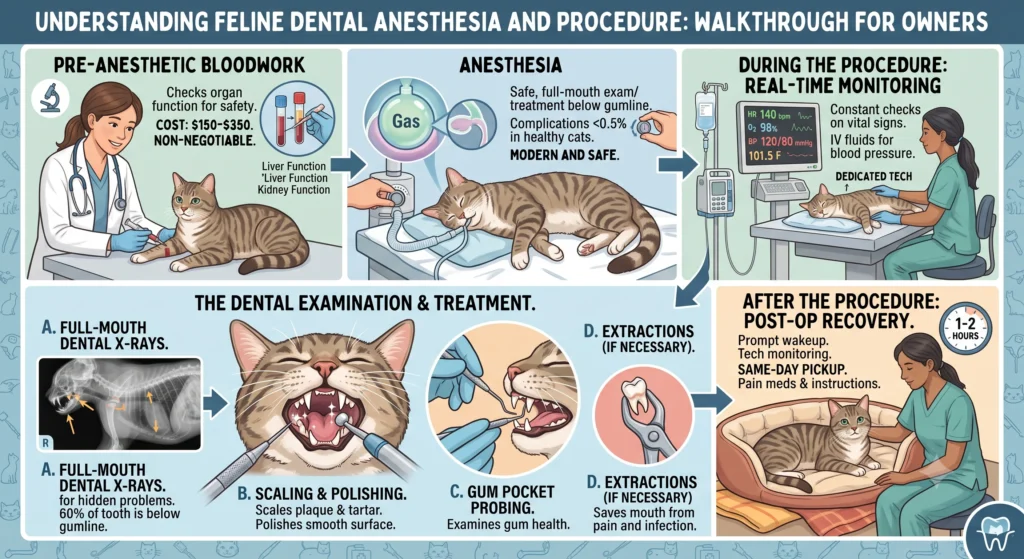
Let me walk you through what a professional dental procedure actually looks like, because I think the unknown is what freaks people out the most.
First: Pre-anesthetic bloodwork. Your vet draws blood to check organ function. This is non-negotiable. It tells them whether your cat can safely process feline dental anesthesia. Costs $150 to $350 typically.
Then: Anesthesia. Yes, your cat needs to be fully under. There’s no such thing as a “safe” cat dental cleaning without anesthesia, that’s considered inhumane by every major veterinary dental organization because you simply cannot properly examine and treat below the gumline without it. Modern feline dental anesthesia is very safe, complication rates are under half a percent in healthy cats. The fear around cat dental cleaning anesthesia is one of the biggest reasons owners delay treatment, and it’s based on outdated information.
During the procedure: Your cat is on monitoring equipment the entire time, heart rate, oxygen levels, blood pressure, temperature. A dedicated technician watches them the whole time. They get IV fluids to maintain blood pressure. It’s nothing like what dental anesthesia was twenty years ago.
The vet does full-mouth cat dental x-rays (this is crucial, about 60% of each tooth is hidden below the gumline and invisible without radiographs), scales and polishes every tooth, probes the gums to check pocket depths, and extracts any teeth that can’t be saved. Cat dental x-rays are the gold standard for diagnosing hidden problems, and any dental cleaning that skips them is incomplete.
After: Your cat wakes up in a recovery area with warm blankets and a tech sitting with them. Most cats are alert within an hour or two. You pick them up the same day with pain medication and instructions. Cat dental cleaning recovery is usually straightforward, most cats bounce back within a day or two.
How Much Does Cat Dental Cleaning Cost?
I’m not going to sugarcoat this, cat dental surgery cost isn’t cheap. But compared to the cost of untreated dental disease (ongoing organ damage, emergency visits, shortened lifespan), it’s a bargain.
Here’s a rough breakdown based on typical U.S. veterinary pricing for cat dental cleaning cost:
| What You’re Paying For | Typical Cost |
|---|---|
| Bloodwork before anesthesia | $150 – $350 |
| Anesthesia and monitoring | $200 – $500 |
| Cat dental x-rays | $150 – $400 |
| Professional cleaning | $200 – $500 |
| Each simple tooth extraction | $100 – $250 |
| Each surgical extraction | $200 – $600 |
| Pain meds to take home | $30 – $80 |
| Antibiotics if needed | $30 – $60 |
| Total, basic cleaning, no extractions | $500 – $1,500 |
| Total, cleaning with several extractions | $1,000 – $3,500 |
These numbers vary a lot depending on where you live. Big city vet clinics charge more. Specialty practices charge more. But that’s the ballpark for cat dental cleaning cost.
Why is cat dental surgery so expensive? Because you’re paying for anesthesia, monitoring, specialized equipment, x-rays, and expertise. It’s surgery, not a spa day. Skimping on any of these steps puts your cat at risk.
Cat dental insurance can help offset these costs if you plan ahead. Many pet insurance plans now cover dental procedures, including cleanings and extractions. Look into dental wellness plans as well. A lot of vet clinics now offer monthly payment plans that cover annual dental cleanings and associated costs. It turns a scary lump sum into a manageable monthly expense. Ask your vet about affordable cat dental care options.
Cat dental cleaning without anesthesia? You’ll see this marketed as “anesthesia-free dental cleaning” or “cat dental cleaning without sedation.” Here’s the truth: it’s considered inhumane by the American Veterinary Dental College and every major feline dental organization. You simply cannot properly examine below the gumline, take x-rays, or treat disease without anesthesia. Anesthesia-free cleanings only address the visible tartar above the gumline, missing the 60% of the tooth that’s hidden. It’s cosmetic at best, dangerous at worst because it gives owners a false sense of security.
The At-Home Cat Dental Care Playbook
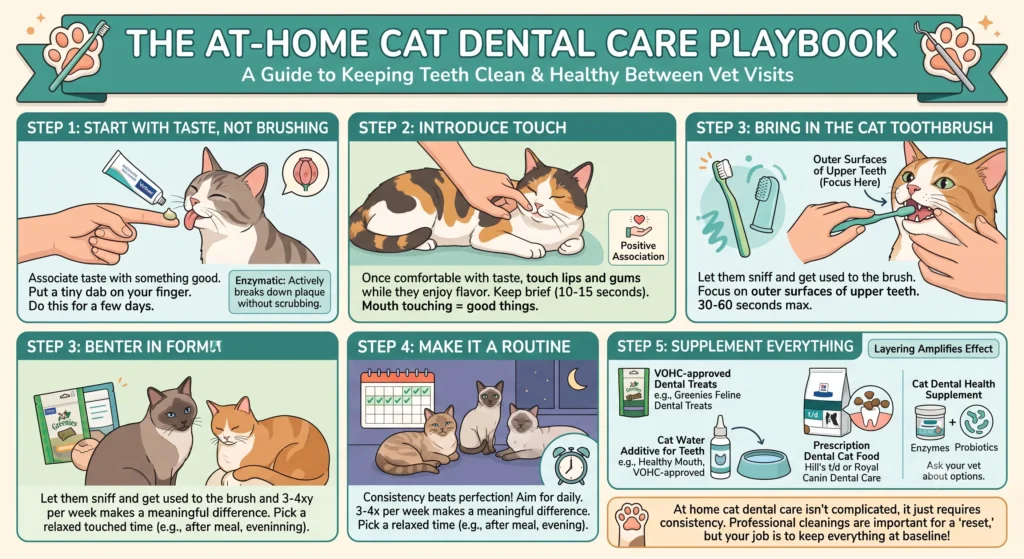
Professional cleanings are important, but what you do between appointments matters just as much. Honestly? It matters more. Because professional cleanings are essentially a reset, they get everything back to baseline. Your job is to keep it there. This is your at home cat dental care guide.
Step 1: Start With Taste, Not Brushing
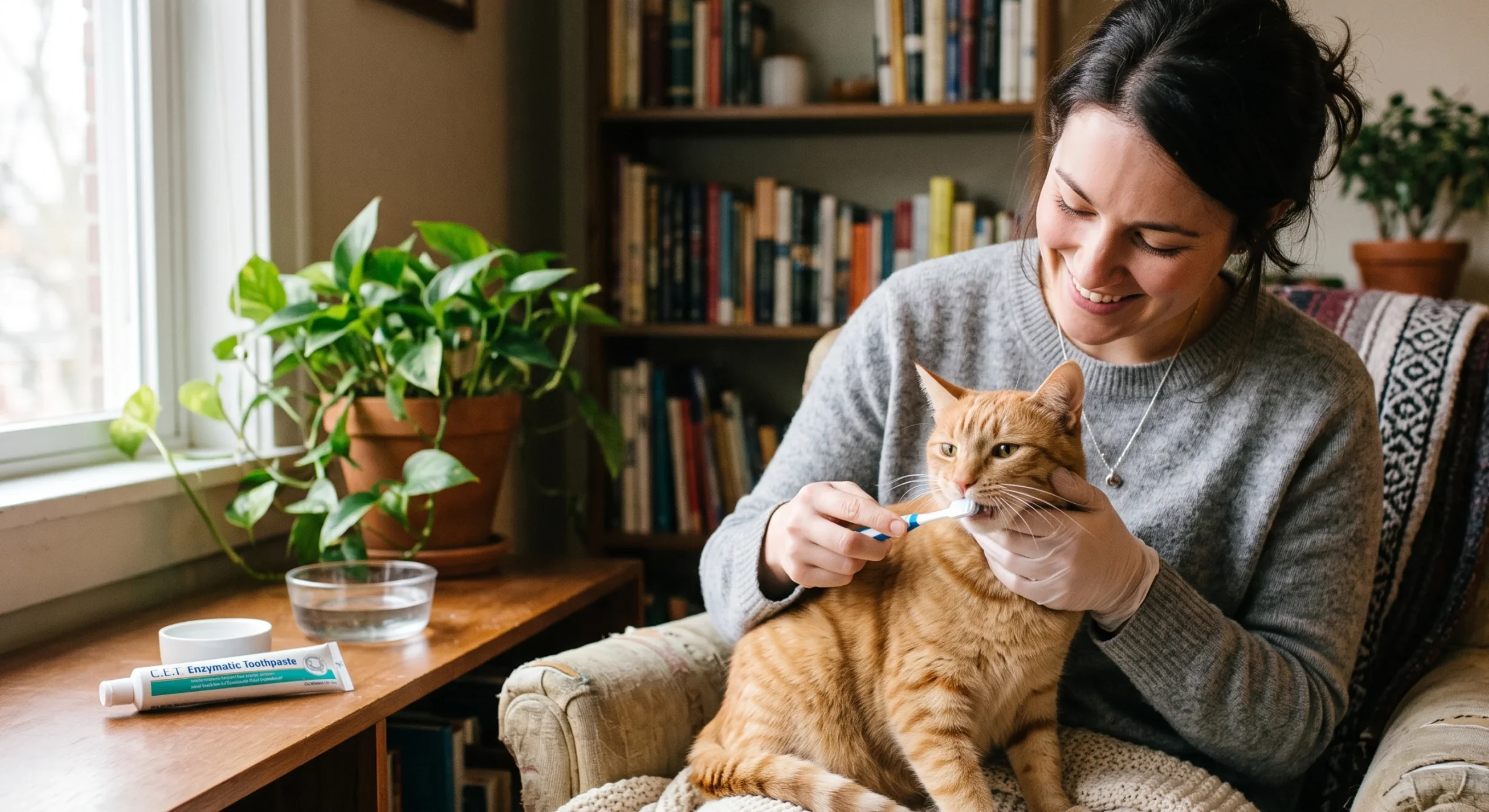
Get some veterinary enzymatic toothpaste, Virbac C.E.T. comes in poultry flavor and most cats think it’s a treat. Put a tiny dab on your finger and let your cat lick it off. Do this for a few days. Let them associate the taste with something good. Don’t try to brush yet. Just build positive associations. The best toothpaste for cats is enzymatic, meaning it actively breaks down plaque even without scrubbing.
Step 2: Introduce Touch
Once your cat is cool with the toothpaste, start touching their lips and gums with your finger while they’re enjoying the flavor. Lift the lip gently. Touch the teeth. Keep it brief, ten seconds, fifteen seconds max. Then give them a treat and walk away.
The goal here isn’t to clean anything. It’s to teach your cat that mouth touching = good things. This takes patience. Some cats take a week, some take a month. It’s fine. Rushing this step sets you back.
Step 3: Bring In the Cat Toothbrush
After your cat is comfortable with finger-touching, introduce a cat toothbrush or finger brush. Same deal, let them sniff it, lick toothpaste off it, get used to it being near their face. Then try actual brushing. How to brush cat teeth step by step: focus on the outer surfaces of the upper teeth, that’s where tartar builds up fastest. Don’t worry about the inside surfaces; your cat’s tongue handles most of that. Thirty seconds to a minute is plenty for a session.
Step 4: Make It a Routine
Ideally, brush daily. Realistically, three to four times a week makes a meaningful difference. Pick a time when your cat is relaxed, after a meal, during a calm evening, whenever. Consistency beats perfection when it comes to feline dental care at home.
Step 5: Supplement Everything
Brushing is the gold standard, but layering other cat dental health products amplifies the effect:
- Cat dental treats. Look for the VOHC seal, that’s the Veterinary Oral Health Council product list. VOHC approved products like Greenies Feline Dental Treats are widely available and clinically tested for reducing plaque and tartar in cats.
- Cat water additive for teeth. Healthy Mouth Water Additive is VOHC-approved and reduces bacterial load in the mouth. You just add it to their water bowl. Cat water additive for teeth is one of the easiest feline dental care products to incorporate into your routine.
- Prescription dental cat food. If your vet recommends them, prescription dental cat food like Hill’s Prescription Diet t/d or Royal Canin Dental Care have kibble specifically designed to clean teeth during chewing. These are the only cat dental diet options that have been clinically proven to work.
- Cat dental health supplement. Some supplements contain enzymes or probiotics that support oral health from the inside out. Ask your vet about a cat dental health supplement that might work alongside brushing and dental products.
At home cat dental care isn’t complicated, it just requires consistency. Fifteen seconds a few times a week can save you thousands in cat dental cleaning cost down the road.
Senior Cat Dental Disease: A Whole Different Ballgame
If your cat is seven or older, congratulations, they’re a senior, dental care becomes even more critical and a bit more complicated.
Why more critical? Because disease progresses faster in older cats. Their immune systems aren’t as robust, their tissues don’t heal as quickly, and they’re more likely to have concurrent health conditions that complicate treatment. A problem that might take a year to develop in a three-year-old cat can advance in months in a thirteen-year-old. Old cat dental disease is one of the most common health issues in senior felines.
Why more complicated? Because anesthesia carries slightly more risk in older cats. Not dramatically more, we’re talking a small increase, but it means thorough pre-anesthetic workup is absolutely essential. Your vet may want chest X-rays, a cardiac evaluation, or additional bloodwork beyond the standard panel. This is not your vet trying to upsell you. This is your vet being appropriately careful with your aging cat and feline dental anesthesia.
Also, and this is important, older cats are more prone to oral cancer. Squamous cell carcinoma, fibrosarcoma, and other tumors become more common with age. Regular dental exams give your vet opportunities to catch these early, when treatment is most effective. Any non-healing sore in your cat’s mouth, any unexplained tooth loss, any facial asymmetry in an older cat needs immediate veterinary attention.
What does advanced dental disease look like in cats? In seniors, it often presents as severe weight loss, refusal to eat even soft food, excessive drooling, pawing at the face, and visible loose or missing teeth. But don’t wait for these signs. Senior cats should have dental exams twice a year.
One more thing about seniors: cats who finally get dental treatment after years of silent pain often undergo what I call the “personality transplant.” Owners bring them in thinking they’re just “slowing down with age,” and after dental surgery, the cat is suddenly playful, affectionate, eating enthusiastically, and acting years younger. It’s because the chronic pain that was suppressing their personality is finally gone. It’s one of the most rewarding things in feline veterinary medicine.
What Age Do Cats Start Losing Teeth?
People ask this a lot, and the answer depends on what we’re talking about. Kittens lose their baby teeth, just like human kids do, typically between three and six months of age. That’s normal and nothing to worry about.
But adult cats losing teeth? That’s never normal. If your adult cat is losing teeth, that’s a sign of advanced periodontal disease, tooth resorption, or trauma. Cat tooth resorption, formerly called feline odontoclastic resorptive lesions (FORL), affects an estimated 28 to 67% of cats.
It’s a painful condition where the tooth structure literally dissolves, and the only treatment is extraction. Cat tooth resorption is one of the most common reasons for tooth loss in adult cats, and it’s not something you can prevent with brushing, though regular dental exams catch it early.
Kitten dental disease is less common but not unheard of. Congenital tooth abnormalities, retained baby teeth, and early plaque buildup can all cause problems in young cats. This is why the first dental check should happen around six to twelve months.
The Mistakes I See Over and Over
After years of working in this space, I’ve seen the same errors trip up well-meaning cat owners again and again:
“My cat’s breath has always been bad.” No, it hasn’t. You’ve just gotten used to it. Cat bad breath is the most common early sign of feline dental disease, and it’s never, NEVER, normal in cats. If you’re wondering “can you reverse cat dental disease at home,” the answer is only if you catch it extremely early and are incredibly consistent with care. But bad breath means you’re already past that point.
“I’m waiting until it gets really bad before I do anything.” This makes me want to scream into a pillow. Cat dental disease is ALWAYS easier and cheaper to treat early. Waiting doesn’t save money, it costs more, both financially and in your cat’s suffering. How long can a cat live with dental disease? Technically, years. But they’re miserable years filled with pain and progressive organ damage.
“I don’t want to put my cat through feline dental anesthesia.” I understand the concern, but the risk of feline dental anesthesia is tiny compared to the risk of letting dental disease progress. It’s like refusing to fix a small leak in your roof because you’re afraid of heights, the water damage will eventually collapse the whole ceiling. For more on feline dental anesthesia safety, this veterinary study breaks down the actual risk profile. Modern cat dental cleaning anesthesia is safer than ever.
“I tried brushing once and my cat freaked out.” One attempt is not a failure. It’s data. It tells you where your cat is in the desensitization process and what you need to work on. Go back to Step 1 and take it slower. Every cat can learn to tolerate toothbrushing, some just need more time.
For more on understanding your cat’s behavior during care routines, Cat Behavior Decoded is an excellent resource, and this book is genuinely one of the best investments you can make as a cat owner because it breaks down why your cat reacts the way they do to handling, restraint, and anything that feels threatening to them. Once you understand the “why” behind the freakout, you can work with their instincts instead of against them. I recommend it to every cat owner I meet.
“I’m just going to get the cheapest dental cleaning.” I get that money is tight. But a cat dental cleaning without x-rays is like going to the dentist and having them skip the bitewings. You’re treating what you can see and missing what you can’t. And what you can’t see, the roots, the bone, the hidden abscesses, is often where the real problem lives.
For comprehensive guidance on all aspects of cat care including dental decisions, the Complete Cat Care Manual walks you through every scenario, and this book is basically the bible I wish existed when I first started learning about feline health. It covers everything from kittenhood through senior years, and the feline dental care section alone is worth the price. It explains the science without making your eyes glaze over, and it gives you practical steps you can actually follow. I keep a copy on my desk and still reference it regularly.
“My cat is too old for dental work.” There is no age limit on feline dental care. I’ve seen cats in their early twenties undergo successful dental procedures. Age alone is not a reason to skip treatment. What matters is overall health, organ function, and anesthetic risk assessment. Your vet can determine whether your senior cat is a good candidate. Don’t write off cat dental health just because your cat is older.
What the Veterinary Experts Actually Say
“I tell every cat owner the same thing: imperfect brushing is infinitely better than no brushing. If you can get thirty seconds on the outside of the upper teeth a few times a week, you’re already ahead of 90% of cat owners. Don’t let perfect be the enemy of done.”
“The biggest misconception in feline dentistry is that you can assess a cat’s oral health by looking at their mouth during a wellness exam. You can’t. You need feline dental anesthesia and radiographs to see what’s really going on. Anything less is guessing.”
“People worry about their cat not being able to eat after extractions. I’ve never seen a cat who couldn’t adapt. Most of them are eating within hours. Cats without teeth live perfectly normal, comfortable lives. Cats with painful, diseased teeth do not.”
“Full-mouth extractions sound dramatic, and in the moment it feels like a big decision. But owners consistently tell me afterward that their cat is like a different animal, more active, more social, more themselves. The chronic pain was suppressing everything.”
“Affordable cat dental care starts at home. Brushing your cat’s teeth three times a week costs nothing after the initial investment in a toothbrush and paste, and it can prevent thousands in professional treatment down the road.”
The Lifelong Feline Dental Care Prevention Plan
Here’s the cheat sheet for every life stage, your complete feline dental care roadmap:
Kittens (under 1 year): Start handling their mouth early and often. Introduce toothpaste as a treat. Get them used to having their lips lifted and teeth touched. Schedule the first dental check around six to twelve months to catch any congenital issues. Training your kitten to accept handling early pays dividends for their entire life, The Trainable Cat covers cooperative care techniques that make every aspect of health management easier, and this book is specifically designed for owners who struggle with cats that won’t sit still for grooming, medication, or any kind of handling.
The clicker training chapter alone will change how you interact with your cat. It teaches you how to turn stressful vet visits and dental care into something your cat actually cooperates with, which is worth its weight in gold when you’re trying to brush teeth twice a week for the next fifteen years. Even kitten dental disease can be mitigated with early intervention and proper training.
Adults (1-7 years): Brush as often as possible, daily is ideal, three to four times a week minimum. Use VOHC approved dental products consistently. Get professional feline dental exams annually. Catch things early. This is the prime window for establishing at home cat dental care routines that will last a lifetime.
Seniors (7+ years): Increase professional exams to twice a year. Never skip at-home feline dental care because “they’re old anyway.” Discuss comprehensive treatment at the first sign of disease. Consider bloodwork every six months to catch organ changes early. Senior cat dental disease requires vigilant monitoring.
If you want a complete resource that covers feline dental care alongside every other aspect of keeping your cat healthy for life, the Complete Cat Care collection is where I’d start. It brings together everything, health, behavior, nutrition, and daily care, in one place so you’re not jumping between twenty different websites trying to piece together what your cat actually needs. The feline dental care chapters integrate with the nutrition and behavior sections in a way that makes the whole picture click.
Where to Find More Resources on Cat Dental Health
If you’re looking for more information on cat dental health, here are some trusted starting points:
The Complete Cat Care collection covers feline dental disease from every angle, prevention, treatment, home care, and senior cat dental disease. It’s the comprehensive resource I recommend to every cat owner who wants to stay ahead of dental problems.
For understanding why your cat resists dental care and how to work with their behavior rather than against it, Cat Behavior Decoded is essential reading. It explains the psychology behind your cat’s reactions to handling and restraint, which makes feline dental care at home infinitely easier.
And if you’re starting from scratch with a kitten and want to build cooperative care skills early, The Trainable Cat gives you the step-by-step techniques for teaching your cat to accept toothbrushing, medication, and veterinary handling without the battle.
The Bottom Line on Cat Dental Disease
I’m going to end with something that might sting a little, but it needs to be said: your cat’s dental health is your responsibility, and neglecting cat dental disease has consequences that extend far beyond their mouth. Every day that dental disease goes untreated is a day of silent pain for your cat and a day of advancing organ damage that may not be reversible.
The good news? This is one of the most preventable and treatable conditions in feline medicine. A toothbrush costs five bucks. Cat dental treats are fifteen. Even professional cat dental cleanings, while not cheap, are manageable with planning. What’s NOT manageable is the cost, emotional and financial, of advanced disease that could have been prevented.
Can dental disease be cured? The early stages, yes. Gingivitis is fully reversible. Advanced periodontal disease can’t be reversed, but it can be managed and your cat can live comfortably with proper treatment. The key is early intervention and consistent feline dental care.
So here’s my challenge to you: this week, look in your cat’s mouth. Really look. Lift the lip, check the gumline, sniff the breath. If anything seems off, call your vet. If everything looks fine, schedule a feline dental exam anyway, because “fine” on the surface often means something different underneath.
Your cat can’t advocate for themselves. You have to do it for them.