

Table of Contents
Cat Dental Disease Complete Guide to Prevention and Treatment at Home
You notice your cat’s breath smells bad. Not the usual food breath but something sharper, almost rotten. You glimpse their teeth and see yellow buildup near the gum line. Maybe their gums look red or swollen. Your cat may still be eating, or maybe they have started dropping food while chewing. You think about brushing their teeth but you are not sure how, and the idea of wrestling a cat with a toothbrush does not sound appealing. Bad breath in cats is never normal.
It is the most obvious sign of dental disease, and dental disease is the most common health problem affecting cats. By the time most cats reach three years old, approximately seventy percent already have some form of dental disease. The good news is that dental disease is preventable and treatable, and your cat does not have to suffer in silence.
As a certified veterinary expert and professional cat behaviorist, I have treated thousands of cats with dental problems ranging from mild gingivitis to severe periodontal disease requiring multiple extractions. The most painful part of my job is seeing cats whose dental disease has been ignored for years, leaving them in constant pain that owners mistook for normal aging or picky eating. Cats are masters at hiding pain, and dental pain is no exception.
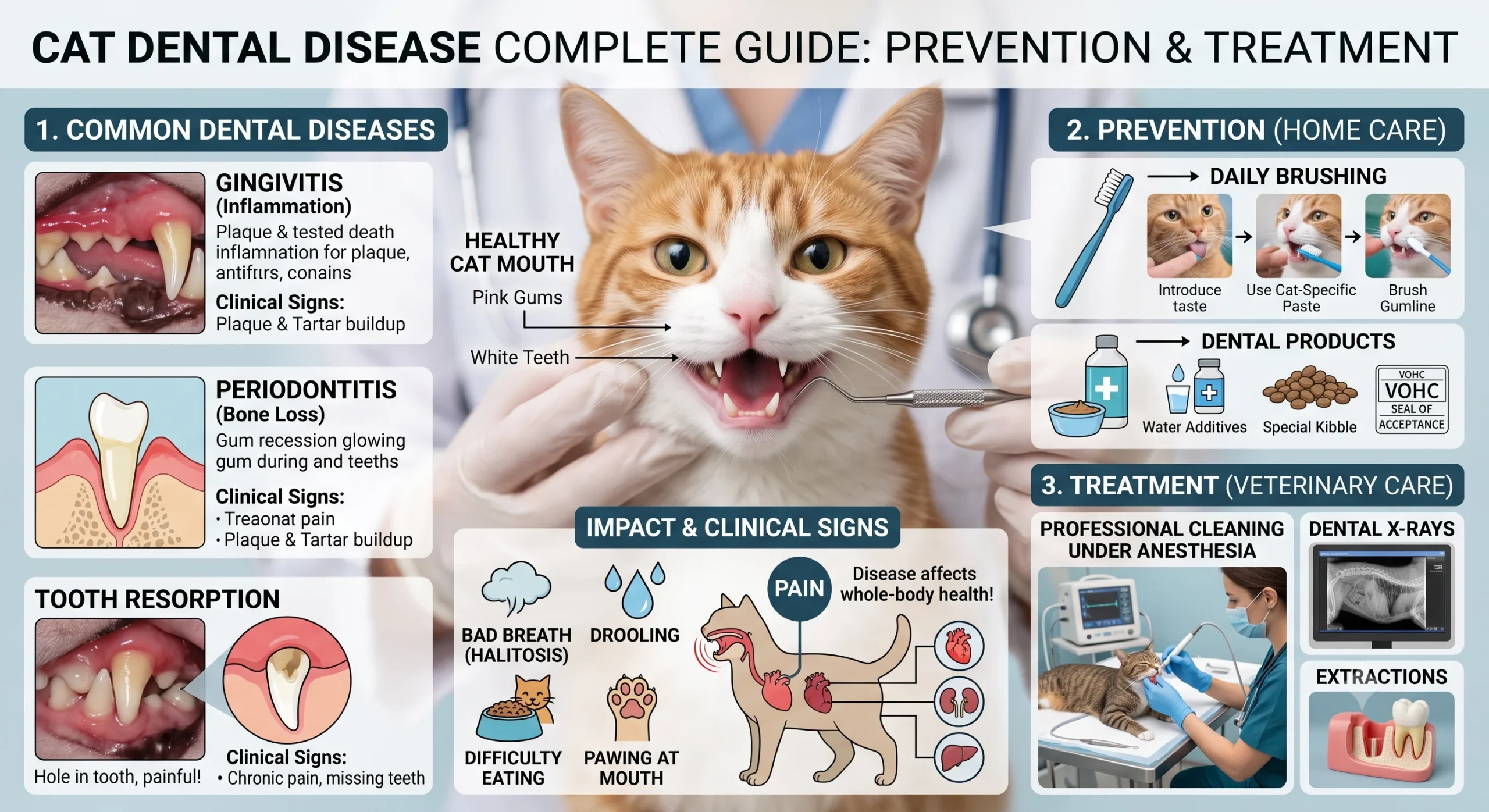
A cat with a rotting tooth and infected gums will still eat because survival instinct overrides pain, but they eat differently, they eat less, and they suffer in silence. This guide covers why dental disease is so common in cats, the stages from mild gingivitis to advanced periodontal disease, the signs that indicate your cat is in dental pain, how veterinarians diagnose and treat dental disease, at-home dental care techniques that actually work, and the long term health consequences of ignoring your cat’s teeth.
📚 Recommended Cat Guides
🐱 The Trainable Cat Book
Learn proven methods to train your cat and stop unwanted behaviors.
View Book →❤️ Complete Cat Care Manual
Your complete guide to cat nutrition, health, grooming, behavior, and daily care.
Get the Manual →Why Dental Disease Is So Common in Cats
Several factors make cats uniquely susceptible to dental disease. Their teeth are designed for tearing meat rather than chewing thoroughly, which means less natural cleaning through mechanical action. Cat saliva contains different enzymes than dog or human saliva, creating an environment where plaque accumulates more rapidly. The shape of cat teeth, particularly the premolars and molars, creates tight spaces where food particles and bacteria become trapped.
Many cats have crowded teeth or misalignment that prevents normal cleaning. And most importantly, cats do not receive regular dental care from their owners because tooth brushing is difficult, expensive professional cleanings are often skipped, and dental disease develops silently over months and years without obvious symptoms.
Plaque is the starting point for all dental disease. Plaque is a sticky film of bacteria, food particles, and saliva that accumulates on teeth within hours of eating. If plaque is not removed through brushing or chewing, it mineralizes into tartar within days. Tartar is hard, yellow or brown, and cannot be removed by brushing once it has formed. Only professional scaling can remove tartar. The bacteria in plaque and tartar produce toxins that irritate the gums, causing inflammation called gingivitis.
As gingivitis progresses, the gum tissue pulls away from the teeth, creating pockets where more bacteria accumulate. These pockets deepen over time, destroying the connective tissue and bone that hold teeth in place, leading to periodontal disease, tooth root abscesses, and eventual tooth loss.
Stages of Dental Disease in Cats
Stage One: Gingivitis
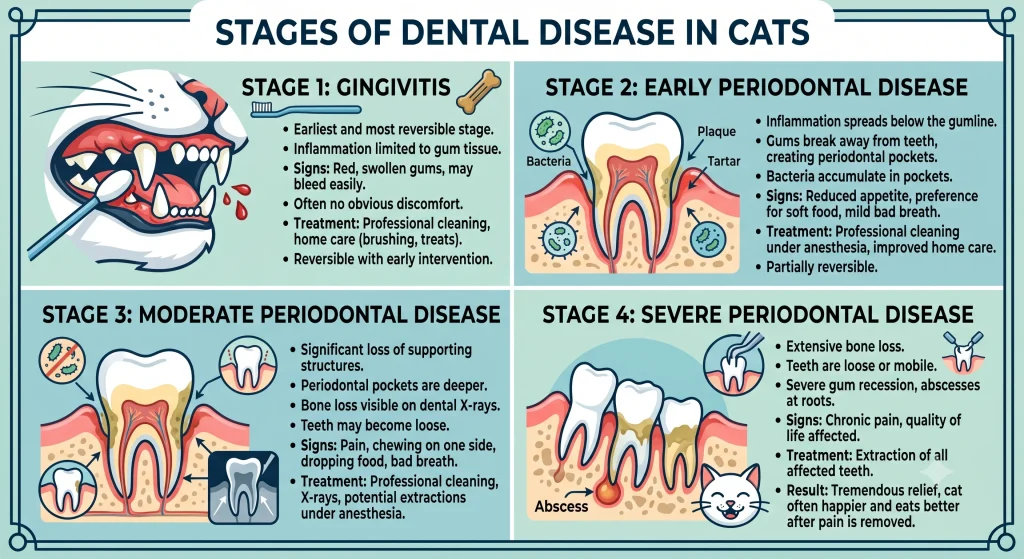
Gingivitis is the earliest and most reversible stage of dental disease. The gums appear red, swollen, and may bleed easily when touched or brushed. At this stage, the inflammation is limited to the gum tissue and has not affected the underlying bone or tooth attachments. Gingivitis can be reversed with professional cleaning and consistent home care including tooth brushing and dental treats. Cats with gingivitis often show no obvious signs of discomfort because the inflammation is mild. A thorough oral examination during routine veterinary visits catches gingivitis before it progresses.
Stage Two: Early Periodontal Disease
Periodontal disease begins when the inflammation spreads below the gum line. The attachment between the gum and tooth starts to break down, creating periodontal pockets. Bacteria accumulate in these pockets, causing further destruction of the connective tissue. At this stage, the damage is partially reversible but requires professional dental cleaning under anesthesia along with improved home care. Cats may show subtle signs including slightly reduced appetite, preference for soft food, or mild bad breath. The progression from gingivitis to periodontal disease is preventable with early intervention.
Stage Three: Moderate Periodontal Disease
Moderate periodontal disease involves significant loss of the supporting structures around the teeth. Periodontal pockets are deeper, bone loss is visible on dental X-rays, and the teeth may become slightly loose. Cats at this stage are in pain, though they rarely show it in obvious ways. They may chew on one side of the mouth, drop food while eating, show reduced interest in hard treats, or develop increasingly bad breath. Treatment at this stage requires professional cleaning and X-rays under anesthesia, and some teeth may need extraction if the supporting bone is too damaged to save the tooth.
Stage Four: Severe Periodontal Disease
Severe periodontal disease involves extensive bone loss. Teeth are loose or mobile, gum recession is significant, and abscesses may develop at the tooth roots. Cats in stage four are in significant chronic pain that affects their quality of life, appetite, and behavior. Treatment involves extraction of all affected teeth, which sounds extreme but actually provides tremendous relief for the cat. Most cats adapt well to life without teeth, particularly when the diseased teeth that caused chronic pain are removed. Many owners report that their cat becomes more playful, eats better, and seems happier after dental extractions because they are finally free from pain.
Common Signs of Dental Pain in Cats
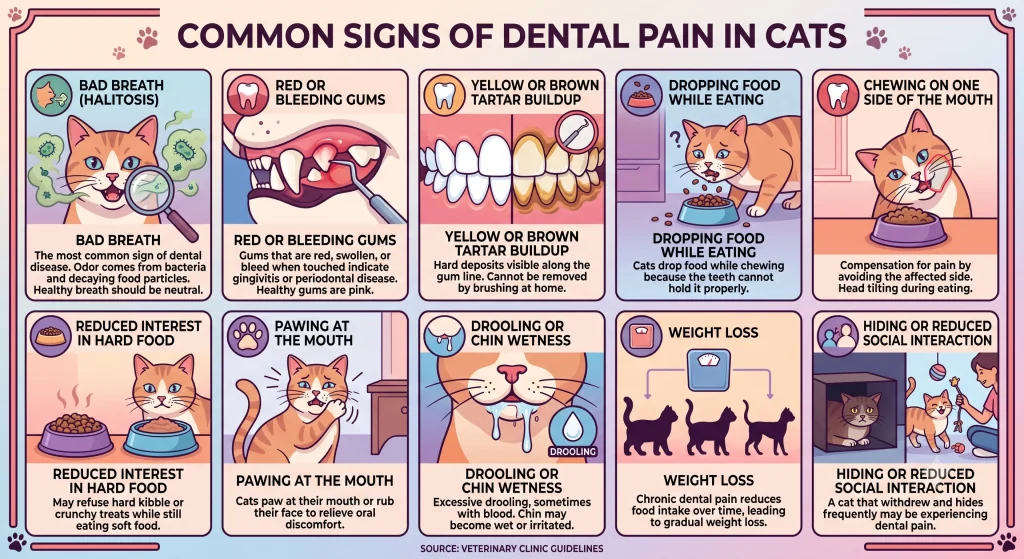
- Bad breath that does not go away. Halitosis is the most common sign of dental disease. The odor comes from bacteria and decaying food particles in the mouth. Healthy cat breath should be neutral, not offensive.
- Red or bleeding gums. Gums that are red, swollen, or bleed when touched indicate gingivitis or periodontal disease. Healthy gums should be pink and firm with no bleeding.
- Yellow or brown tartar buildup on teeth. Tartar is easily visible as hard yellow or brown deposits on the teeth, particularly along the gum line. Tartar cannot be removed by brushing at home.
- Dropping food while eating. Cats with painful teeth may drop kibble or wet food from their mouth while attempting to chew. Food may fall out because the teeth cannot hold it properly.
- Chewing on one side of the mouth. Cats compensate for dental pain by chewing on the less painful side. Watch for head tilting during eating or food falling from one side of the mouth.
- Reduced interest in hard food or treats. Cats with dental pain may refuse hard kibble or crunchy treats while still eating soft food. They may approach their food bowl but back away when they realize it hurts to eat.
- Pawing at the mouth. Cats may paw at their mouth or rub their face on furniture to dislodge painful teeth or relieve gum discomfort. This is a sign of significant oral discomfort.
- Drooling or chin wetness. Dental disease can cause excessive drooling, sometimes tinged with blood. The chin may become wet, irritated, or develop acne from chronic moisture.
- Weight loss. Chronic dental pain reduces food intake over time, leading to gradual weight loss. This is often mistaken for other medical conditions in senior cats.
- Hiding or reduced social interaction. Cats in pain withdraw and hide more. A cat that was previously social but now hides frequently may be experiencing dental discomfort.
How Veterinarians Diagnose Dental Disease
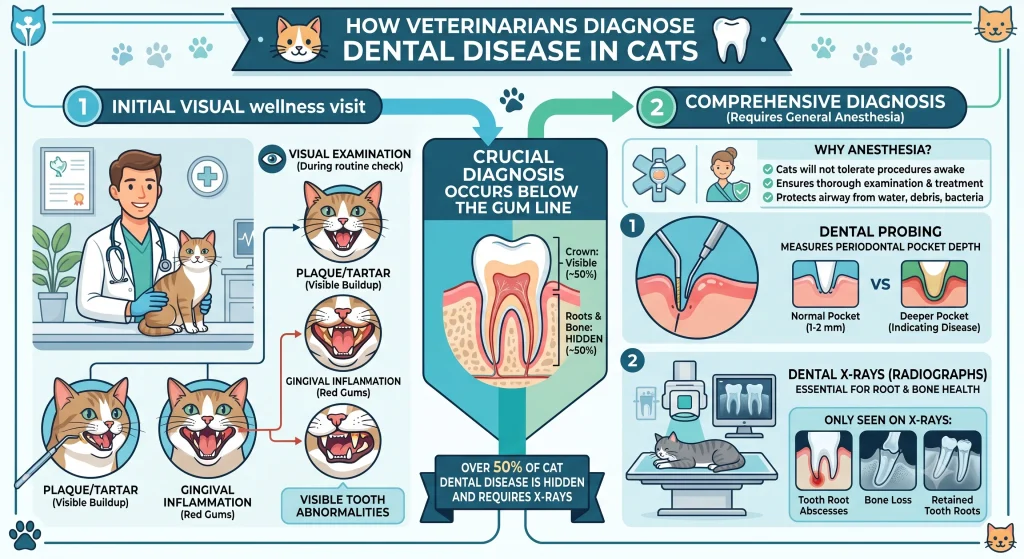
Diagnosing dental disease begins with a visual examination of the mouth during a routine wellness visit. Your vet looks for plaque, tartar, gingival inflammation, and visible tooth abnormalities. However, the visible portion of the tooth is only about half of the story. The most important part of dental diagnosis happens below the gum line. Dental probing measures the depth of periodontal pockets around each tooth using a small probe inserted gently between the tooth and gum.
Normal pocket depth in cats is one to two millimeters. Deeper pockets indicate periodontal disease. Dental X-rays are essential for evaluating the health of the tooth roots and surrounding bone. Over half of dental disease in cats is hidden below the gum line and cannot be seen without X-rays. Tooth root abscesses, bone loss, and retained tooth roots from previous extractions are only visible on X-rays. General anesthesia is required for thorough dental examination, probing, X-rays, and treatment because cats will not tolerate these procedures while awake. Anesthesia also protects the airway from water, debris, and bacteria during dental cleaning.
Treatment Options for Cat Dental Disease
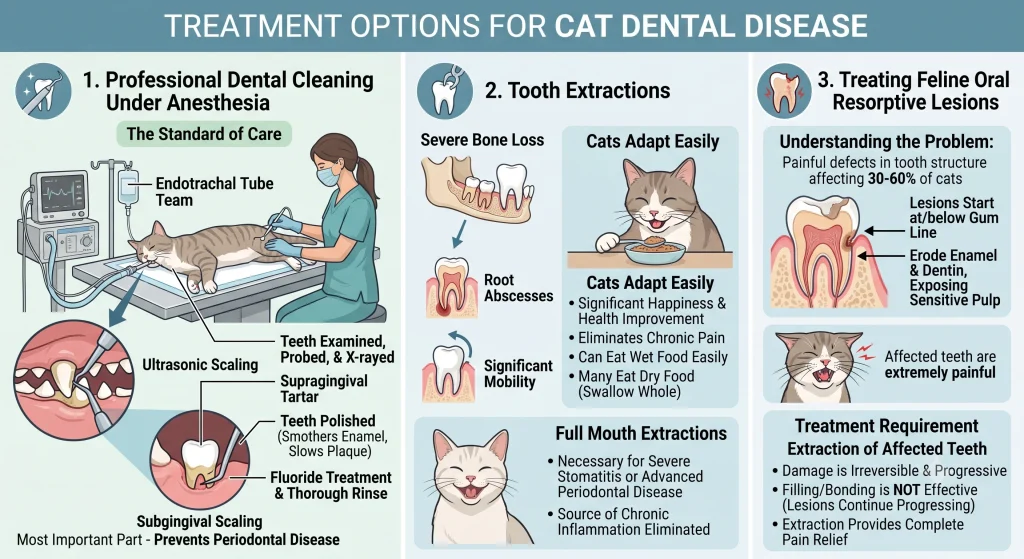
Professional Dental Cleaning Under Anesthesia
Professional dental cleaning is the standard of care for treating dental disease. The procedure requires general anesthesia for the safety and comfort of the cat as well as the quality of the cleaning. The teeth are examined, probed, and X-rayed. Supragingival tartar above the gum line is removed with ultrasonic scaling. Subgingival scaling below the gum line is the most important part of the cleaning because this is where periodontal disease develops. The teeth are polished to smooth the enamel surface and slow plaque reaccumulation. A fluoride treatment may be applied to strengthen enamel and reduce sensitivity. The mouth is rinsed thoroughly to remove all debris.
Tooth Extractions
Teeth that are too damaged to save need extraction. This includes teeth with severe bone loss, root abscesses, significant mobility, or advanced resorptive lesions. Extraction sounds concerning to many owners, but cats adapt very well to life with fewer teeth. In fact, most cats are significantly happier and healthier after diseased teeth are removed because they are no longer in chronic pain. Cats eat wet food easily without teeth, and many cats continue eating dry food as well by swallowing it whole. Full mouth extractions are sometimes necessary for cats with severe stomatitis or advanced periodontal disease throughout the mouth. These cats thrive after all teeth are removed because the source of chronic inflammation and pain is eliminated.
Treating Feline Oral Resorptive Lesions
Feline oral resorptive lesions are painful defects in the tooth structure that affect approximately thirty to sixty percent of cats. These lesions start at the gum line or below and erode the tooth enamel and dentin, eventually exposing the sensitive pulp. The cause of resorptive lesions is unknown, though theories include dietary factors, inflammation, and genetic predisposition. Affected teeth are extremely painful. Treatment requires extraction of the affected teeth because the damage is irreversible and progressive. Filling or bonding is not effective in cats because the lesions continue to progress under the filling material. Extraction provides complete relief from the pain of resorptive lesions.
Home Dental Care Techniques
Brushing your cat’s teeth is the most effective home dental care method, but it requires patience and consistent training. Start by letting your cat taste the veterinary toothpaste, which comes in flavors like poultry or seafood that cats find appealing. Never use human toothpaste, which contains ingredients toxic to cats. Once your cat accepts the taste, introduce a finger brush or soft bristle toothbrush. Brush in small circular motions along the gum line, focusing on the outer surfaces of the teeth where plaque accumulates most. Start with just a few seconds per session and gradually increase. Even brushing every other day provides significant benefits compared to no brushing.
If brushing is not possible, alternative methods provide partial benefits. Dental wipes or pads can be rubbed along the teeth and gums to reduce plaque bacteria. Dental treats approved by the Veterinary Oral Health Council contain ingredients or textures that reduce plaque and tartar accumulation. Water additives with enzymes or antibacterial agents can be added to the water bowl to reduce oral bacteria. Dental diets are formulated with kibble texture and size that encourage chewing and provide some mechanical cleaning. Dental sprays and gels applied to the gums provide antibacterial benefits. None of these alternatives are as effective as brushing, but they are better than doing nothing and can be used in combination for cats that will not tolerate brushing.
Expert Tips From My Practice
I have seen too many senior cats whose owners thought they were just slowing down with age, only to discover that the cat had severe dental disease causing constant pain for years. These cats would refuse hard food, drop kibble while eating, and hide more often. Owners attributed it to old age. After dental treatment and extractions, these same cats often become playful again, eat enthusiastically, and return to social interaction. The transformation is remarkable. Dental pain is not a normal part of aging, and it is completely treatable. If your senior cat has bad breath, is losing weight, or seems less interested in food, do not dismiss it as old age. Get their teeth checked.
- Start dental care early. Kittens and young cats are easier to train for tooth brushing than seniors. Start early for the best long term results.
- Never use human toothpaste. Human toothpaste contains xylitol and fluoride that are toxic to cats. Only use veterinary approved toothpaste.
- Do not wait for obvious symptoms. Most dental disease is advanced before obvious signs appear. Annual veterinary dental examinations are essential.
- X-rays are not optional. Over half of dental disease is hidden below the gum line. Dental cleanings without X-rays miss significant disease.
- Anesthesia-free dental cleanings are dangerous. They do not clean below the gum line, cannot diagnose hidden disease, and stress the cat tremendously. They provide no meaningful benefit.
- Extractions improve quality of life. Cats with painful teeth feel better after extraction, not worse. Do not avoid necessary extractions out of concern for your cat.
- Monitor eating behavior closely. Changes in how your cat eats often indicate dental pain before other signs appear. Watch for dropping food or chewing on one side.
- Combine multiple home care methods. Brushing plus dental treats plus dental diet provides better protection than any single method alone.
FAQ
How common is dental disease in cats?
Dental disease is the most common health problem in cats. Approximately seventy percent of cats over three years old have some form of dental disease, and the prevalence increases with age. Regular dental care is essential for prevention.
Can cat dental disease be reversed?
Gingivitis, the earliest stage, can be reversed with professional cleaning and consistent home care. Once periodontal disease develops and the supporting structures of the teeth are damaged, the changes are not reversible but can be managed to prevent further progression.
Do cats need their teeth cleaned by a vet?
Yes. Professional dental cleaning under anesthesia is necessary to remove tartar below the gum line, evaluate tooth roots through X-rays, and treat periodontal disease. At-home care maintains the results of professional cleaning but cannot replace it.
How often should I brush my cat’s teeth?
Daily brushing is ideal, but even brushing every other day provides significant benefits compared to less frequent brushing. Start gradually and build up to a consistent routine that works for both you and your cat.
What happens if dental disease is left untreated?
Untreated dental disease progresses from gingivitis to periodontal disease, causing irreversible damage to the tooth supporting structures. Bacteria from dental disease can enter the bloodstream and damage the heart, kidneys, and liver. Chronic pain reduces quality of life and appetite.
Is anesthesia safe for senior cats during dental cleaning?
Modern veterinary anesthesia is safe for senior cats when appropriate precautions are taken including pre-anesthetic blood work, cardiac evaluation, intravenous fluids, and careful monitoring throughout the procedure. Age alone is not a reason to deny dental care.
What are resorptive lesions in cats?
Feline oral resorptive lesions are painful defects in the tooth structure that erode enamel and dentin. They affect approximately thirty to sixty percent of cats. The cause is unknown, and treatment requires extraction of the affected teeth because the damage is progressive.
Can cats eat without teeth?
Yes, cats adapt very well to life without teeth. Most cats eat wet food easily, and many continue eating dry food by swallowing it whole. Cats with dental extractions often eat better than they did with painful diseased teeth because they are no longer in pain.
What is stomatitis in cats?
Stomatitis is severe, chronic inflammation of the entire mouth including the gums, cheeks, and tongue. It is believed to be an immune mediated condition where the cat’s immune system overreacts to dental plaque. Treatment often requires full mouth extractions to remove the source of immune stimulation.
How much does cat dental cleaning cost?
The cost of professional dental cleaning varies widely depending on geographic location, the complexity of the case, and whether extractions are needed. Basic cleaning typically ranges from three hundred to eight hundred dollars, while cases requiring multiple extractions may cost more.