

Table of Contents
Cat Arthritis Complete Guide to Symptoms Treatment and Pain Relief Options
Your twelve year old cat used to leap onto the kitchen counter without hesitation, but now they circle the counter three times before attempting a small jump that ends with their back legs slipping off the edge. They used to sprint up the stairs to their favorite window perch, but now they sit at the bottom and meow until you carry them. They stopped using the scratching post six months ago because it requires stretching their front legs above their head, and something about that motion clearly hurts. You assumed your cat was simply getting old and slowing down with age.
📚 Recommended Cat Guides
🐱 The Trainable Cat Book
Learn proven methods to train your cat and stop unwanted behaviors.
View Book →❤️ Complete Cat Care Manual
Your complete guide to cat nutrition, health, grooming, behavior, and daily care.
Get the Manual →The truth is that your cat is likely suffering from arthritis, and they have been suffering in silence for years. Studies show that approximately ninety percent of cats over the age of twelve have radiographic evidence of arthritis in at least one joint. Despite this staggering prevalence, arthritis in cats remains dramatically underdiagnosed and undertreated because cats are exceptionally good at hiding pain. Unlike dogs who may whine, limp, or seek attention when in discomfort, cats evolved to conceal weakness as a survival mechanism. A cat in pain will adapt their behavior to avoid triggering that pain rather than showing obvious signs of distress.
As a certified veterinary expert and professional cat behaviorist, I have diagnosed arthritis in countless cats whose owners had no idea their cat was in pain. The behavioral changes are subtle, and most owners attribute them to normal aging rather than recognizing them as pain indicators.
This guide covers the hidden signs of arthritis that most owners miss, why cats are so stoic about pain, the joints most commonly affected, diagnostic methods that confirm arthritis, treatment options including medications, supplements, and environmental modifications, physical therapy techniques that help at home, and how to make your arthritic cat comfortable for the rest of their life. Arthritis cannot be cured, but it can be managed effectively, and the quality of life improvement from proper treatment is dramatic.
Why Cats Hide Arthritis Pain
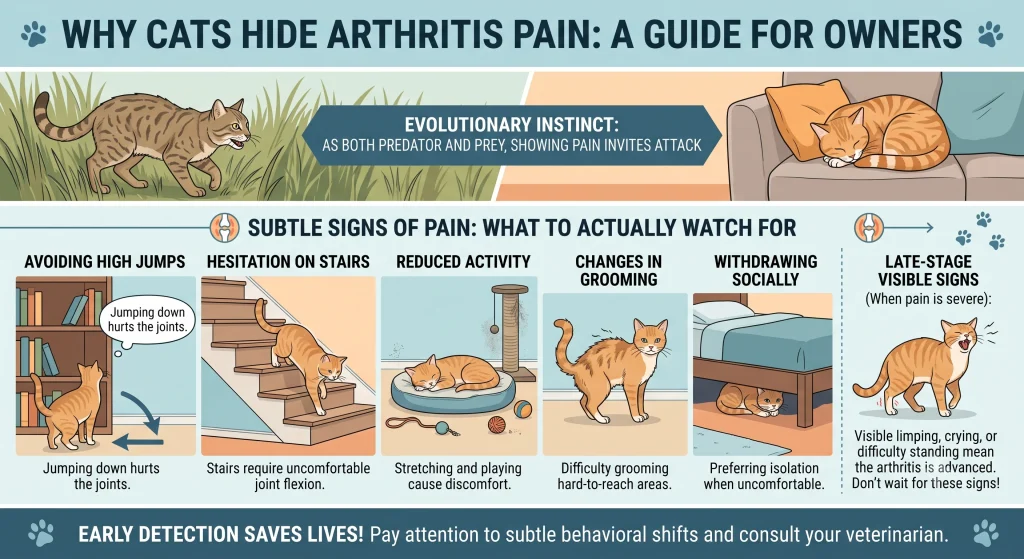
Cats are predators and prey in the wild, and showing pain or weakness invites attack from larger predators. This evolutionary programming makes cats masters at concealing discomfort. A cat with arthritis will not limp visibly the way a dog does. Instead, they make subtle adjustments to their movement patterns that avoid triggering pain. They stop jumping onto high surfaces, not because they cannot, but because the impact of landing hurts.
They avoid stairs, not because they are lazy, but because the climbing motion strains arthritic joints. They stop using the scratching post, not because they lost interest, but because the stretching motion causes pain. These behavioral changes are so gradual that owners often do not notice them until the arthritis has progressed significantly. By the time most cats are diagnosed, the disease is already advanced.
The stoic nature of cats means that visible pain signs like crying, vocalizing, or obvious limping are late stage indicators. By the time your cat is meowing in pain, the arthritis is severe. Early detection requires paying attention to the subtle behavioral shifts that indicate your cat is avoiding pain rather than expressing it. Understanding these hidden signs is the key to catching arthritis early and starting treatment before the disease progresses beyond effective management.
Hidden Signs of Arthritis in Cats
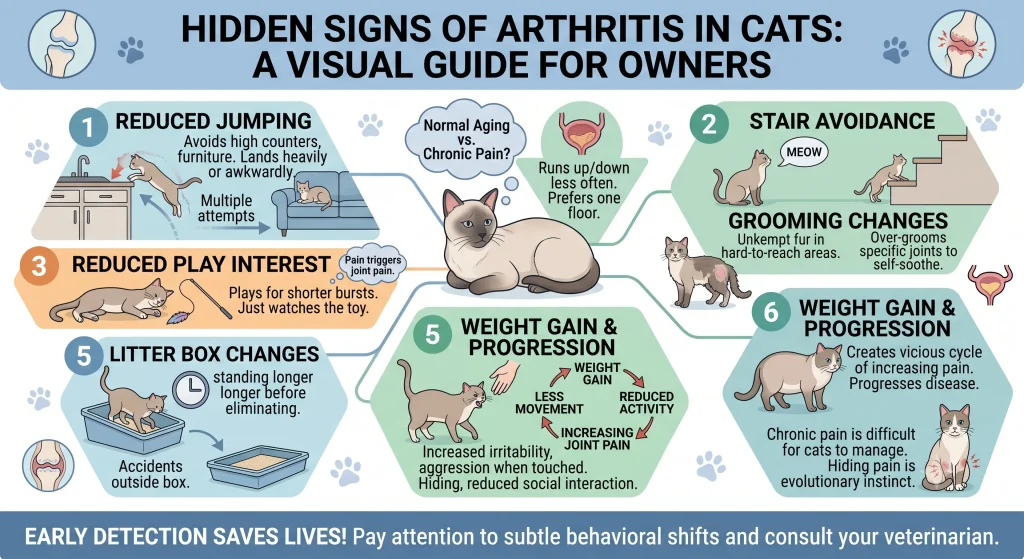
The earliest signs of arthritis in cats are behavioral changes that owners frequently misinterpret as normal aging. Reduced jumping is the most common early sign. Your cat stops jumping onto counters, beds, furniture, or window perches that they used to access easily. When they do jump, they land heavily or awkwardly, and they may make multiple attempts before succeeding.
They begin using lower furniture exclusively, choosing the couch instead of the chair that requires a higher jump. Stair avoidance is another hallmark sign. Cats that used to run up and down stairs now hesitate at the bottom, meow for assistance, or use only the ground floor. Reduced play interest occurs because interactive play requires movements that trigger joint pain. Your cat may watch the toy with interest but refuse to chase, pounce, or bat at it. They may start a play session and quit within seconds.
Grooming changes are a critical but often missed sign. Arthritic cats cannot reach their lower back, hindquarters, or tail base to groom, leading to matted fur, dandruff, and an unkempt appearance in areas they used to keep immaculate. Conversely, some cats over groom the specific joints that hurt, creating bald patches over arthritic areas as a self soothing behavior.
Litter box changes include difficulty getting into high sided boxes, standing in the box longer before eliminating, and accidents outside the box when they cannot get in or out quickly enough. Weight gain from reduced activity accelerates arthritis progression and creates a vicious cycle of increasing pain and decreasing movement. Personality changes, including increased irritability, aggression when touched in certain areas, hiding more than usual, and reduced social interaction, indicate chronic pain that your cat is struggling to manage.
Commonly Affected Joints
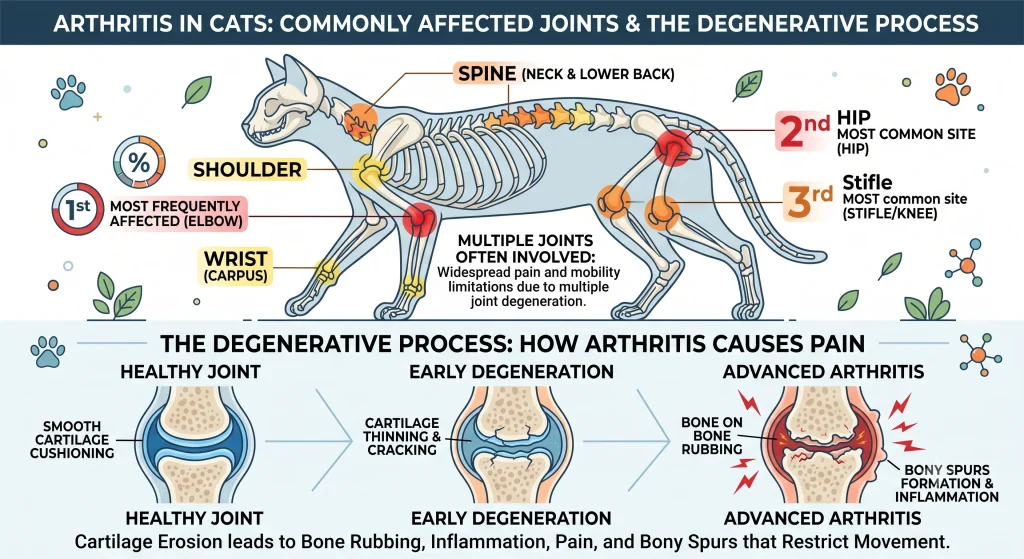
Arthritis in cats most commonly affects the joints that bear the most weight and undergo the most repetitive stress. The elbow joint is the most frequently affected, followed closely by the hip. The stifle, which is the knee equivalent in cats, is the third most common site. The spine, particularly the lower back and neck, develops arthritis as cartilage between vertebrae wears down.
The shoulder and wrist joints are less commonly affected but still occur. Most arthritic cats have multiple joints involved rather than a single joint, which is why the pain and mobility limitations are often widespread rather than localized to one specific area. The degenerative process affects the cartilage that cushions joint surfaces, causing it to thin, crack, and eventually erode. Without this cushioning, bone rubs against bone, creating inflammation, pain, and the formation of bony spurs that further restrict movement.
Diagnosing Arthritis in Cats
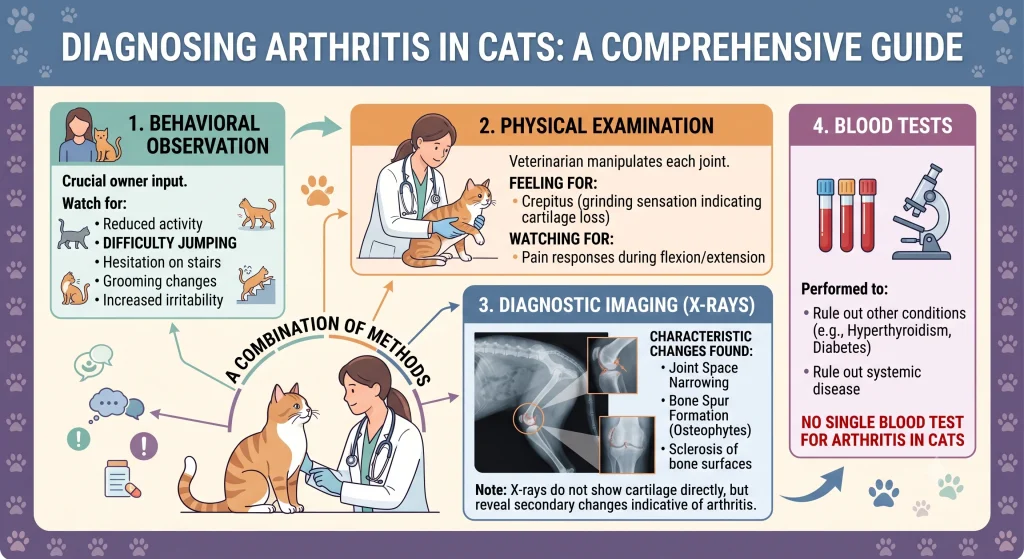
Diagnosing arthritis requires a combination of physical examination, behavioral observation from the owner, and diagnostic imaging. During the physical exam, your veterinarian will manipulate each joint through its range of motion, feeling for crepitus, which is a grinding sensation that indicates cartilage loss, and watching for pain responses when specific joints are flexed or extended.
X rays of the affected joints reveal characteristic changes including joint space narrowing, bone spur formation, and sclerosis of the bone surfaces. While x rays cannot show cartilage directly, the secondary changes they reveal are highly indicative of arthritis. In some cases, blood tests are performed to rule out other conditions that can cause similar symptoms, such as hyperthyroidism or diabetes. There is no single blood test for arthritis in cats.
Medication Options for Arthritis Pain
Non Steroidal Anti Inflammatory Drugs
NSAIDs are the cornerstone of arthritis pain management in cats. Solensia, which is frunevetmab, is the first FDA approved monoclonal antibody specifically for feline osteoarthritis pain. It works by targeting nerve growth factor, a protein that transmits pain signals, and is given as a monthly injection at the veterinary office. Meloxicam is another commonly prescribed NSAID that reduces inflammation and pain. It must be used with caution in cats due to potential kidney side effects, and regular blood monitoring is required. Your veterinarian will determine which medication is appropriate based on your cat’s age, kidney function, and overall health.
Joint Supplements
Glucosamine and chondroitin sulfate support cartilage health and may slow the progression of arthritis. Omega three fatty acids, particularly EPA and DHA from fish oil, have natural anti inflammatory properties that complement pharmaceutical pain management. Green lipped mussel extract contains a unique combination of omega three fatty acids and glycosaminoglycans that support joint health. These supplements are most effective when started early and used consistently as part of a long term management plan.
Adjunctive Medications
Gabapentin is a neuropathic pain medication that is sometimes used for cats with severe arthritis pain that is not adequately controlled by NSAIDs alone. It works by blocking pain signals in the nervous system and has a mild sedative effect that can help anxious arthritic cats. Amantadine is another adjunctive medication that addresses central sensitization, which is when the nervous system becomes hypersensitive to pain signals over time.
Environmental Modifications
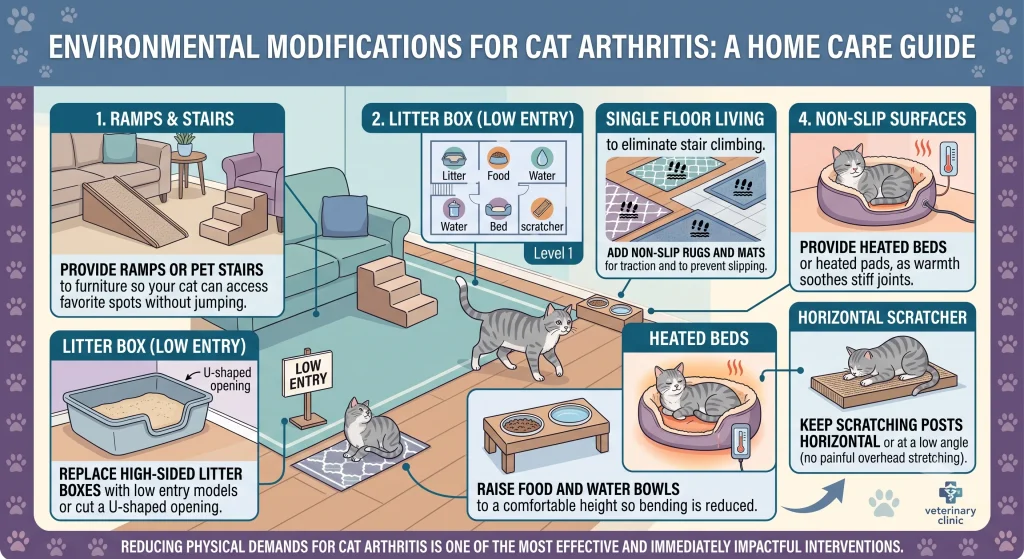
Modifying your cat’s environment to reduce the physical demands of daily life is one of the most effective and immediately impactful arthritis interventions. Provide ramps or pet stairs to furniture so your cat can access favorite spots without jumping. Replace high sided litter boxes with low entry models or cut a U shaped opening in the side to eliminate the need to step over a high wall.
Place litter boxes, food, water, and bedding on a single floor to eliminate the need for stair climbing. Add non slip rugs and mats to hardwood and tile floors to provide traction and prevent slipping that stresses arthritic joints. Raise food and water bowls to a comfortable height so your cat does not need to bend deeply to eat. Provide heated beds or heated pads, as warmth soothes stiff joints and encourages resting in comfortable positions. Keep scratching posts horizontal or at a low angle instead of vertical, allowing your cat to sharpen claws without painful overhead stretching.
Physical Therapy and Home Exercise
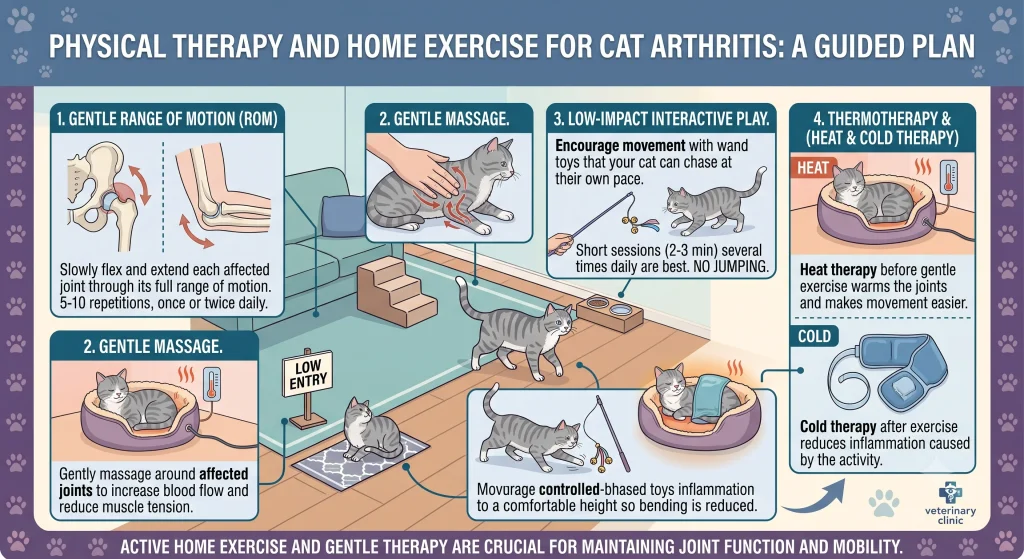
Gentle range of motion exercises performed at home help maintain joint flexibility and reduce stiffness. Slowly flex and extend each affected joint through its full range of motion for five to ten repetitions once or twice daily. Gentle massage around arthritic joints increases blood flow and reduces muscle tension that develops when muscles compensate for painful joints.
Encourage low impact movement through interactive play with wand toys that your cat can chase at their own pace without jumping or high impact movements. Short play sessions of two to three minutes several times a day are better than one long session. Heat therapy before gentle exercise warms the joints and makes movement easier. Cold therapy after exercise reduces any inflammation that the activity may have caused.
Expert Tips From My Practice
The most important message I want cat owners to understand is that old age is not a disease. When an owner tells me their cat is slowing down because they are old, my first question is always whether the cat has been evaluated for arthritis. More often than not, the answer is no, and after examination and treatment, the cat returns to a level of activity that the owner thought was lost forever.
I have had owners bring their arthritic cats in for euthanasia because they thought the cat was suffering and had no quality of life left. After starting pain management and making environmental modifications, those same cats were jumping, playing, and interacting like they had years earlier. Do not assume your cat is just old. Get them checked for arthritis, and you may be amazed at how much their quality of life improves with proper treatment.
- Ninety percent of cats over twelve have arthritis. It is extremely common and frequently undiagnosed.
- Cats hide pain by adapting behavior. Stopping jumping or playing is not laziness. It is pain avoidance.
- Early signs are subtle. Watch for reduced jumping, stair avoidance, grooming changes, and personality shifts.
- Treatment works dramatically. Medications, supplements, and environmental changes make a huge difference.
- Heated beds help immediately. Warmth soothes stiff joints and encourages comfortable resting positions.
- Low entry litter boxes prevent accidents. Eliminating the step over barrier reduces pain and litter box avoidance.
- Gentle exercise maintains flexibility. Short daily sessions of range of motion and gentle play help more than you expect.
- Old age is not a disease. Get your senior cat evaluated for arthritis before assuming slowing down is normal.
FAQ
How common is arthritis in cats?
Approximately ninety percent of cats over the age of twelve have radiographic evidence of arthritis. It is one of the most common conditions in senior cats but remains dramatically underdiagnosed.
Why doesn’t my cat limp if they have arthritis?
Cats evolved to hide pain as a survival mechanism. Instead of limping, they adapt their behavior to avoid movements that trigger pain, such as jumping or climbing stairs.
What are the early signs of arthritis in cats?
Reduced jumping, stair avoidance, decreased play interest, grooming changes, litter box difficulties, and personality changes like increased irritability are the most common early signs.
Can arthritis be cured in cats?
No. Arthritis is a progressive degenerative condition that cannot be reversed. However, it can be managed effectively with medications, supplements, and environmental modifications.
What is the best medication for cat arthritis?
Solensia is the first FDA approved treatment specifically for feline osteoarthritis. Your veterinarian will determine the best option based on your cat’s individual health needs.
Do joint supplements really help?
Yes. Glucosamine, chondroitin, and omega three fatty acids support joint health and reduce inflammation. They work best when used consistently as part of a long term management plan.
How can I help my arthritic cat at home?
Provide ramps to furniture, use low entry litter boxes, add non slip rugs, offer heated beds, and keep food water and bedding on one floor to eliminate stair climbing.
Should I restrict my arthritic cat’s activity?
Encourage gentle low impact activity rather than restricting movement completely. Short play sessions and gentle range of motion exercises maintain flexibility without overexertion.
Is weight management important for arthritis?
Yes. Extra weight puts additional stress on arthritic joints. Maintaining a healthy body weight significantly reduces pain and slows disease progression.
When should I take my cat to the vet for arthritis?
If you notice any reduction in jumping, stair avoidance, grooming changes, or personality shifts, schedule a veterinary examination. Early diagnosis and treatment provide the best outcomes.