

Table of Contents
Why Does My Cat Bite While Being Petted? The Truth Nobody Tells You
Why Does My Cat Bite While Being Petted:
You are sitting on the couch. Your cat jumps up. Plops down next to you. Starts purring. You reach over and start petting them. Everything is perfect. For about 30 seconds. Then. Without warning. CHOMP. Your cat bites your hand. And you are sitting there thinking. What just happened.
Trust me. You are not alone. This happens to almost every cat owner at some point. And it is one of the most confusing cat behaviors out there. One minute they love it. The next minute they are biting you. It makes no sense. Until you understand what is really going on.
As a certified veterinary expert and professional cat behaviorist. I have dealt with this exact problem hundreds of times. And the answer is simpler than you think. Your cat is not being mean. Your cat is not broken. Your cat is doing exactly what cats are designed to do. You just need to understand why.
📚 Recommended Cat Guides
🐱 The Trainable Cat Book
Learn proven methods to train your cat and stop unwanted behaviors.
View Book →❤️ Complete Cat Care Manual
Your complete guide to cat nutrition, health, grooming, behavior, and daily care.
Get the Manual →The Short Answer
Your cat bites while being petted because of overstimulation. That is it. Most of the time. Your cat has a threshold. A point where petting goes from feeling good to feeling too much. And when that threshold is crossed. Biting is their way of saying enough. Stop. I am done.
Think of it like this. Imagine someone scratching your back. It feels great. For a while. Then it starts to feel like too much. And you want them to stop. You say stop. But what if you could not speak. What if the only way to communicate was to swat their hand away. That is what your cat is doing. Except their version of swatting is biting.
Why Cats Get Overstimulated
Cats have sensitive skin. Way more sensitive than humans. Their bodies are covered in nerve endings. Especially along their back. Base of tail. Belly. And behind the ears. When you pet these areas repeatedly. The sensation builds up. And eventually it becomes uncomfortable.
This is not your fault. You are not doing anything wrong. You are just petting your cat the way you would pet a dog. And dogs have different thresholds. Dogs can handle much more petting before they get overstimulated. Cats cannot. Their wiring is different.
Here is the thing about cats. They are ambush predators. Their bodies are designed to be on high alert. To react quickly. To go from relaxed to defensive in a split second. That is survival. And it is hardwired into their brains. Even your lazy house cat who sleeps 16 hours a day has this wiring.
So when you pet them past their threshold. Their body switches from relax mode to defend mode. Fast. And biting is a defensive response. Not aggression. Not meanness. Just a reflex.
The Petting Aggression Cycle
Here is what usually happens. Step by step. Sound familiar?
- Your cat comes to you and solicits attention
- You start petting them and they purr
- Everything is great for 20 to 30 seconds
- They start twitching their skin or flipping their tail
- You do not notice the signs
- They bite or scratch you
- You pull your hand away surprised
- Your cat walks away like nothing happened
This is the classic petting aggression cycle. And it follows a predictable pattern. Once you learn to recognize the warning signs. You can stop the bite before it happens.
Warning Signs Your Cat Is About to Bite
Cats always give warning signs before they bite. Always. The problem is. Most humans do not notice them. Here is what to watch for.
- Skin twitching. Watch your cat’s skin while you pet them. If you see the skin rippling or twitching under your hand. That is a warning sign. The nerve endings are becoming overstimulated.
- Tail flipping or lashing. A tail that starts swishing back and forth quickly means agitation. A tail that flips or thumps means they are close to their limit.
- Ears flattening. Ears that go from upright to sideways or flat against the head indicate discomfort. This is a clear warning.
- Dilated pupils. When pupils go big and round. The cat is in defense mode. They are preparing to react.
- Skin crawling. If you see the fur along the back standing up or rippling. The cat is overstimulated.
- Head turning toward your hand. If your cat turns their head toward your hand while you are petting. They might be about to bite. They are tracking your hand.
- Stopping purring. If the purring suddenly stops. Pay attention. Something changed.
- Crouching or tensing. A body that suddenly becomes tense or crouched means the cat is preparing to react.
- Moving away. If your cat shifts their body away from your hand. They are telling you they want less contact.
- Biting the air. Sometimes cats do a gentle air bite first. A little mouth opening without actually biting. This is a warning. Next time they will make contact.
The key to preventing petting bites is learning to read these signals. Once you see them. Stop petting immediately. Give your cat space. Let them re-engage when they are ready. This builds trust and prevents future bites.
Cat Biting at Base of Tail
This is a specific and very common type of petting aggression. You pet your cat along the back. Everything is fine. But the second you reach the base of the tail. They bite or swat.
The base of the tail is one of the most sensitive areas on a cat. It has a high concentration of nerve endings. What feels good for the first few strokes quickly becomes overwhelming. This is why many cats love having their back scratched up to a certain point. Then suddenly turn on you.
Solution. Avoid petting the base of the tail unless your cat specifically leans into it. Stop before you reach that area. Let your cat move away if they want more. Do not chase them with your hand.
Cat Bites When You Stop Petting
This is the opposite problem. You stop petting your cat. And they bite you. Usually gently. Sometimes not so gently.
This is usually a demand bite. Your cat is saying hey. I did not say you could stop. Keep going. It is not aggression. It is frustration. Your cat wanted more petting. And you stopped. So they are asking for more in the only way they know how.
Solution. Do not respond to demand bites by continuing to pet. That teaches your cat that biting gets them what they want. Instead. Stop all interaction for a moment. Then resume petting only when they are calm.
Why Some Cats Are More Aggressive Than Others
Not all cats have the same petting tolerance. Some cats can be petted for minutes. Others can only handle a few strokes. Here is why.
Socialization
Cats who were handled frequently as kittens tend to have higher petting tolerance. They learned early that human touch is safe. Kittens who were not socialized properly may be more reactive to touch.
Past Trauma
Cats who were abused or handled roughly may associate petting with negative experiences. They bite to protect themselves. Even gentle petting can trigger fear responses in traumatized cats.
Pain
If your cat suddenly starts biting when they never did before. They might be in pain. Arthritis. Back pain. Skin conditions. All can make petting uncomfortable. A cat who loved being petted yesterday but bites today might have a medical problem. See your vet. For example. Dental disease can cause facial pain that makes head petting unbearable.
Personality
Some cats are just more sensitive than others. It is personality. Not a problem. A sensitive cat is not a bad cat. They just have lower thresholds. Respect that.
Health Issues
Hyperthyroidism. Kidney disease. Neurological problems. All can increase irritability. And make petting aggression worse. If your cat’s behavior changes suddenly. Always consider health first. Stress from health problems like anxiety can also increase sensitivity to touch.
How to Pet Your Cat Without Getting Bitten
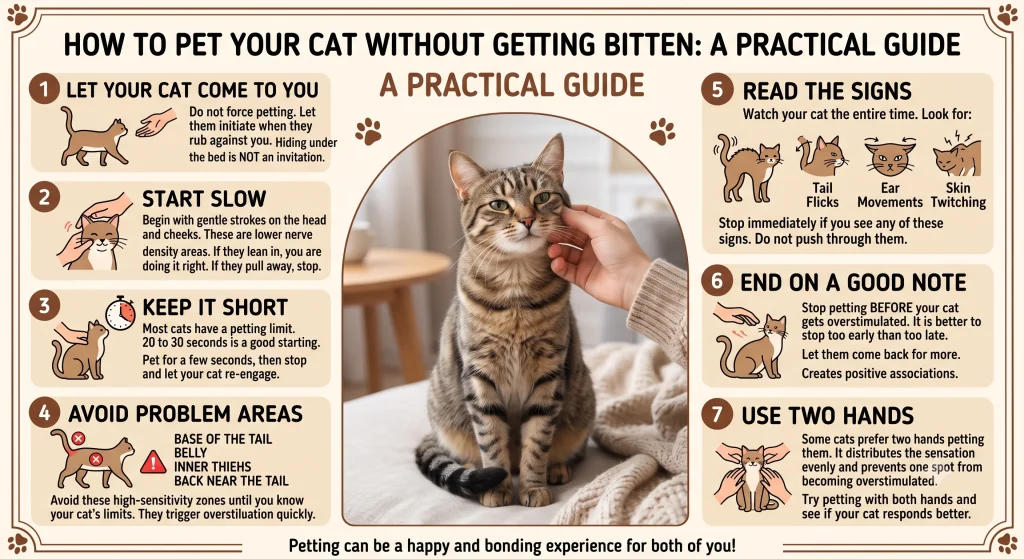
Here is the practical stuff. What you actually do to prevent petting bites.
Rule 1: Let Your Cat Come to You
Do not force petting on your cat. Let them initiate. When they walk up to you and rub against you. That is an invitation. When they are hiding under the bed. That is not an invitation.
Rule 2: Start Slow
Begin with gentle strokes on the head and cheeks. These areas have lower nerve density. They are less likely to become overstimulated. Watch your cat’s reaction. If they lean in. You are doing it right. If they pull away. Stop.
Rule 3: Keep It Short
Most cats have a petting limit of about 20 to 30 seconds. Some less. Some more. But 20 to 30 seconds is a good starting point. Pet for a few seconds. Then stop. Let your cat re-engage if they want more.
Rule 4: Avoid Problem Areas
Until you know your cat’s limits. Avoid these areas. Base of the tail. Belly. Inner thighs. Back near the tail. These are high-sensitivity zones. They trigger overstimulation faster than other areas.
Rule 5: Read the Signs
Watch your cat the entire time you are petting them. Look for tail flicks. Ear movements. Skin twitching. If you see any of these signs. Stop immediately. Do not push through them. That is how you get bitten.
Rule 6: End on a Good Note
Stop petting before your cat gets overstimulated. It is better to stop too early than too late. Let your cat come back for more. This creates positive associations with petting.
Rule 7: Use Two Hands
Some cats prefer having two hands petting them. It distributes the sensation more evenly. And prevents one spot from becoming overstimulated. Try petting with both hands simultaneously. And see if your cat responds better.
How to Train Your Cat to Tolerate More Petting
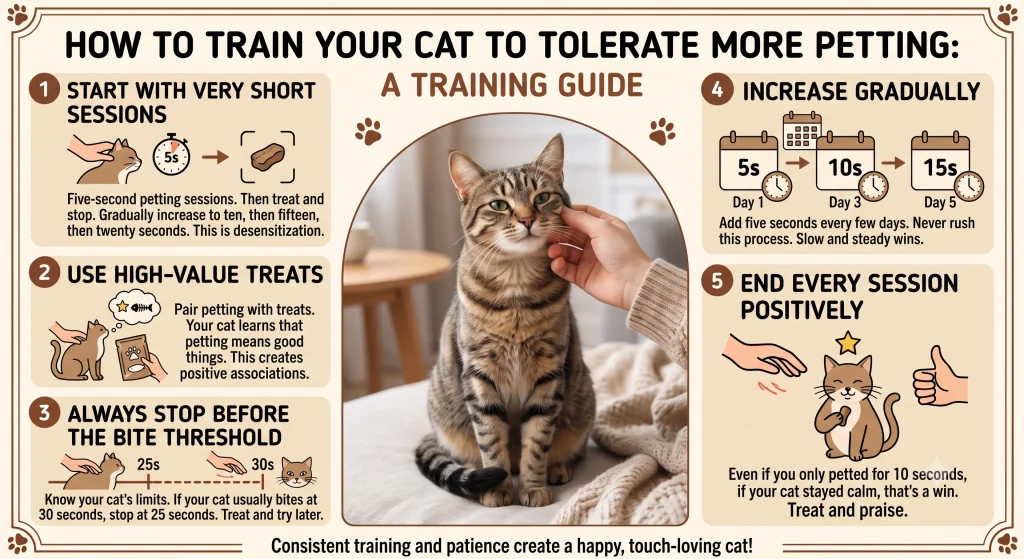
You can actually increase your cat’s petting tolerance over time. Here is how.
- Start with very short sessions. Five seconds of petting. Then treat. Then stop. Gradually increase to ten seconds. Then fifteen. Then twenty. This is called desensitization.
- Use high-value treats. Pair petting with treats. Your cat learns that petting means good things. This creates positive associations.
- Always stop before the bite threshold. If your cat usually bites at 30 seconds. Stop at 25 seconds. Give treats. Then try again later.
- Increase gradually. Add five seconds every few days. Never rush this process. Slow and steady wins.
- End every session positively. Even if you only petted for 10 seconds. If your cat stayed calm. That is a win. Treat and praise.
Cat Biting vs Cat Kicking
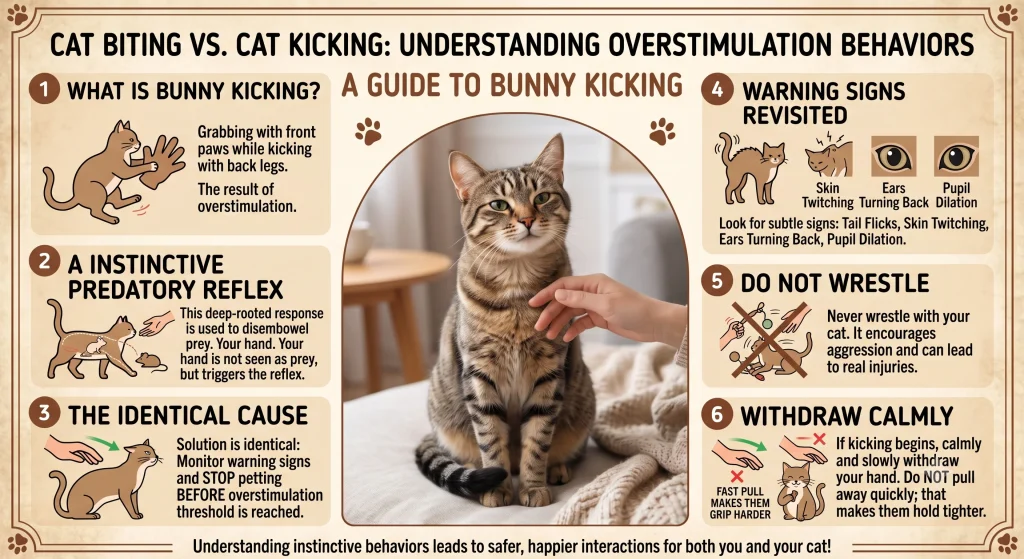
Some cats do not bite when overstimulated. They kick. They grab your hand with their front paws and kick with their back legs. This is called bunny kicking. And it comes from the same overstimulation trigger.
Bunny kicking is a predatory reflex. Cats use this move to disembowel prey. When they grab your hand and kick. They are treating your hand like prey. Not because they see you as prey. But because the sensation triggers that instinctive response.
Solution is the same. Watch for warning signs. Stop petting before the threshold. Do not wrestle with your cat. If they start kicking. Calmly withdraw your hand. Do not pull away quickly. That makes them hold on tighter.
When to Worry About Aggressive Biting
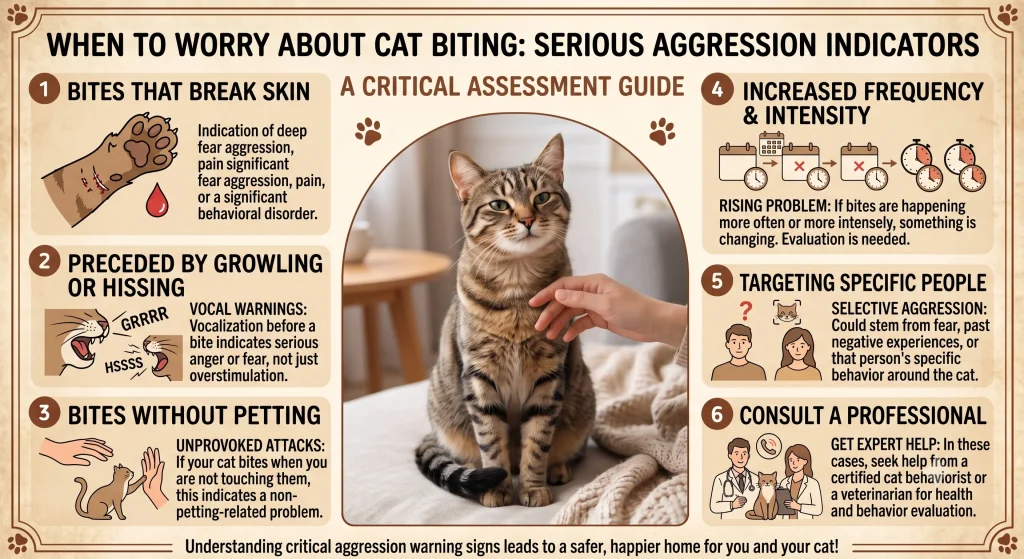
Most petting bites are gentle warning nips. They do not break skin. They do not cause injury. But sometimes biting is more serious. Here is when to worry.
- Bites that break skin. This goes beyond normal petting aggression. This could indicate fear aggression. Pain. Or a behavioral disorder.
- Bites that are preceded by growling or hissing. Vocalization before biting indicates real anger or fear. Not just overstimulation.
- Bites that happen without petting. If your cat bites you when you are not even touching them. That is a different problem entirely.
- Increased frequency. If the biting is happening more often. And more intensely. Something is changing. Health or behavior needs evaluation.
- Targeting specific people. If your cat only bites one person. There might be a reason. Fear. Past experience. Or that person’s behavior around the cat.
In these cases. Consult a certified cat behaviorist. Or talk to your vet. Aggressive behavior sometimes has medical causes. Like dental pain or neurological issues.
Expert Tips From My Practice
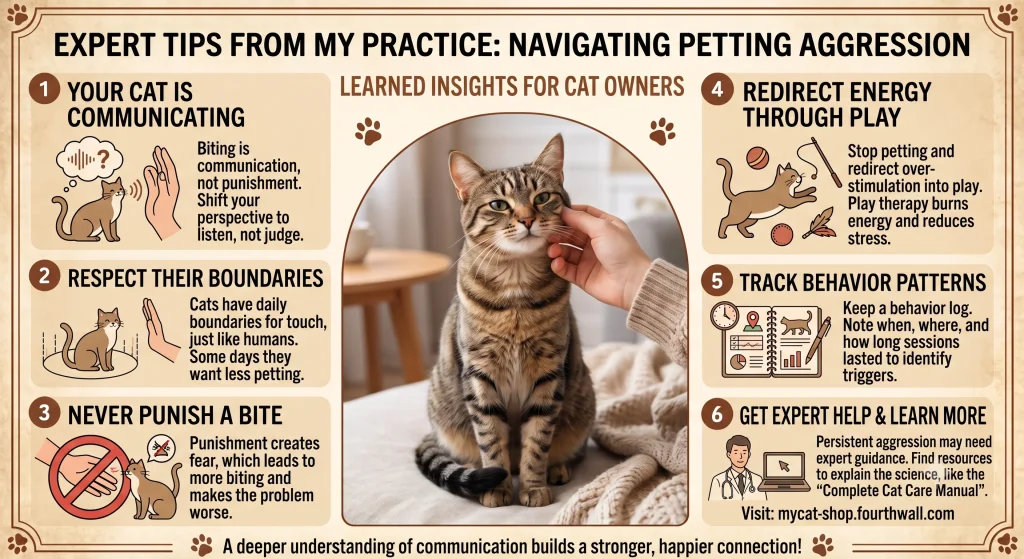
Here is what I have learned from years of dealing with petting aggression.
The most important thing I tell cat owners is this. Your cat is not being bad. They are communicating. Biting is communication. Not punishment. Once you shift your perspective from my cat is attacking me to my cat is telling me something. Everything changes. You start listening. And your relationship improves.
- Respect your cat’s boundaries. Just like humans. Cats have boundaries. Some days they want more petting. Some days less. That is normal.
- Never punish a petting bite. Punishment creates fear. Fear creates more biting. This makes the problem worse. Not better.
- Redirect with toys. If your cat starts getting overstimulated. Stop petting. Pick up a wand toy. Redirect their energy. This ends the interaction on a positive note.
- Consider play therapy. Cats who play regularly are often less reactive to touch. Play burns energy. Reduces stress. And provides an outlet for predatory instincts.
- Keep a behavior log. Note when your cat bites. Where they were petted. How long the session lasted. This helps you identify patterns.
- Consult professionals when needed. Persistent aggression may need professional help. Behavior modification takes time. And sometimes requires expert guidance. Understanding your cat’s behavior is key. Resources like the Complete Cat Care Manual explain the science behind these behaviors in simple terms. Find it at mycat-shop.fourthwall.com.
Areas of the Body Cats Prefer to Be Petted
Not all petting is created equal. Here is a breakdown of what most cats prefer.
| Body Area | Most Cats Enjoy | Risk of Biting |
|---|---|---|
| Top of head | Yes | Low |
| Between ears | Yes | Low |
| Cheeks | Yes | Low |
| Under chin | Maybe | Low to Medium |
| Neck | Maybe | Low to Medium |
| Upper back | Maybe | Medium |
| Lower back | Depends | Medium to High |
| Base of tail | Usually No | High |
| Belly | Rarely | Very High |
| Paws | No | Very High |
Common Mistakes That Trigger Biting
Here are things cat owners do that accidentally trigger petting bites.
- Petting too hard. Cats prefer lighter touch than dogs. Heavy petting overstimulates faster.
- Petting too fast. Quick repetitive strokes increase stimulation. Slow gentle strokes are better.
- Ignoring warning signs. The biggest mistake. Your cat tells you they are uncomfortable. You do not listen. Then you get bitten.
- Chasing with your hand. When your cat moves away. Do not follow them with your hand. That is threatening.
- Petting after biting. If you continue petting after a warning nip. You teach your cat that biting does not work. So they bite harder next time.
- Petting when cat is not in the mood. Not every moment is a petting moment. Read your cat’s body language first.
- Overstimulating belly rubs. The belly is a trap. Most cats show their belly as a sign of trust. Not an invitation to rub it.
FAQ
Why does my cat bite me when I pet him?
Your cat bites when petted because of overstimulation. Cat skin is extremely sensitive. Repeated petting builds up nerve stimulation until it becomes uncomfortable. Biting is their way of saying enough. Watch for warning signs like tail flipping. Skin twitching. And ear flattening. Stop petting before these signs appear.
Is it normal for cats to bite while being petted?
Yes. Petting aggression is extremely common in cats. It is not a behavior problem. It is a normal feline response to overstimulation. Most cats have a limited tolerance for petting. Usually around 20 to 30 seconds. Learning your cat’s threshold prevents bites.
How do I stop my cat from biting when petted?
Learn to read your cat’s warning signs. Stop petting before they reach their threshold. Keep petting sessions short. Focus on areas they enjoy like the head and cheeks. Avoid sensitive areas like the base of tail and belly. Never punish biting as this makes it worse.
Why does my cat bite the base of my hand when I pet her?
The base of the tail and lower back are extremely sensitive areas. Many cats find petting in this area overstimulating very quickly. This is normal. Avoid petting these areas unless your cat specifically leans into it. Focus on head and cheek petting instead.
Why does my cat bite me gently when I stop petting?
Gentle bites when you stop petting are usually demand bites. Your cat is saying they want more. It is frustration. Not aggression. Do not resume petting after a demand bite. That teaches them biting works. Instead. Pause. Then restart only when they are calm.
Can I train my cat to like being petted more?
Yes. You can increase your cat’s petting tolerance through desensitization. Start with very short petting sessions paired with treats. Gradually increase the duration. Always stop before your cat reaches their bite threshold. Over time. They can learn to tolerate longer sessions.
Should I punish my cat for biting?
Never punish a cat for petting bites. Punishment creates fear and anxiety. Which makes petting aggression worse. Instead. Calmly withdraw. Give your cat space. And resume interaction when they are calm. Positive reinforcement works. Punishment never does.
Why does my cat bite only me and not my partner?
Cats may bite one person more than another for several reasons. Different petting styles. Different energy levels. Past experiences with that person. Or the cat simply feels more comfortable expressing boundaries with you. That is actually a sign of trust.
Is petting aggression the same as regular aggression?
No. Petting aggression is a normal response to overstimulation. It is not the same as fear aggression. Predatory aggression. Or redirected aggression. Petting bites are usually gentle warning nips. Not full attacks. Understanding the difference helps you respond appropriately.
Why does my cat bite after being petted for a long time?
Most cats have a petting limit. Usually 20 to 30 seconds of continuous petting. After that. The stimulation becomes uncomfortable. Your cat tolerates it as long as they can. Then they bite to make it stop. Try shorter petting sessions and see if the biting decreases.
My cat bites out of nowhere while being petted. Why?
Cat bites rarely come out of nowhere. There are always warning signs. You just might not be seeing them. Watch for subtle cues like ear position changes. Tail movements. And skin twitching. These happen before the bite. Learning these signs prevents future bites.
Can health problems cause petting aggression?
Yes. Sudden onset petting aggression can indicate pain or illness. Arthritis. Back problems. Skin conditions. Dental disease. All can make petting uncomfortable. If your cat suddenly starts biting when they never did before. See your vet to rule out medical causes.
Why does my cat bite my hands but not my face?
Hands are what pet the cat. So hands are what gets bitten when petting becomes uncomfortable. Cats do not usually bite faces during petting because the face is not doing the petting. The hands are the source of the stimulation. So they target the hands.