


Table of Contents
Cat Body Language Guide
Here is something most cat owners do not realize. Your cat talks to you all the time. Not with words. With their body. Their ears. Their tail. Their eyes. Their posture. Every single part of your cat is sending you messages. Constantly. The problem is. Most people have no idea what those messages mean.
As a certified veterinary expert and professional cat behaviorist. I spend my days reading cat body language. And I can tell you. Once you learn to speak cat. Everything changes. You understand why your cat bites sometimes. Why they hide. Why they rub against your legs. Why they bring you dead birds. It all makes sense. Once you know the language.
This guide breaks down every signal your cat sends. From head to tail. From ears to paws. By the end. You will know exactly what your cat is feeling at any given moment. And that knowledge will make you a better cat owner. Period.
📚 Recommended Cat Guides
🐱 The Trainable Cat Book
Learn proven methods to train your cat and stop unwanted behaviors.
View Book →❤️ Complete Cat Care Manual
Your complete guide to cat nutrition, health, grooming, behavior, and daily care.
Get the Manual →Why Cat Body Language Matters
Cats are not like dogs. Dogs are obvious. A wagging tail means happy. A growl means back off. Simple. Cats are subtle. Their signals are quiet. Easy to miss. Easy to misinterpret. And when you misread your cat. Bad things happen. You get bitten. Your cat gets stressed. Your relationship suffers.
According to the ASPCA. Misunderstanding cat body language is one of the top reasons cats end up in shelters. Owners who cannot read their cats get frustrated. They think the cat is being mean. Or bad. When really. The cat is just communicating. And nobody is listening.
Learning cat body language is not optional. If you own a cat. You need to know this stuff. It keeps you safe. It keeps your cat happy. And it builds a bond that lasts years.
Tail Language: What Your Cat’s Tail Tells You
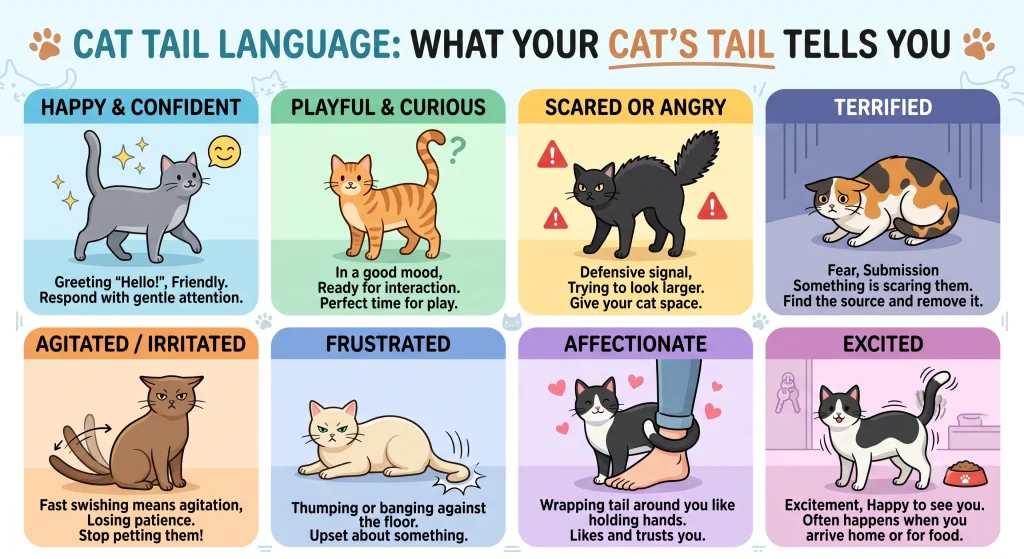
The tail is the most expressive part of your cat’s body. It tells you more than any other signal. Here is what different tail positions mean.
Tail Straight Up
A tail held straight up means your cat is happy. Confident. Friendly. When your cat walks toward you with their tail straight up. They are saying hello. I am glad to see you. This is a positive signal. Respond with gentle attention.
Tail Straight Up with a Curve at the Tip
This is like a question mark. Your cat is playful. Curious. Ready for interaction. When you see this tail. Your cat is in a good mood. Perfect time for play or petting. If the tail curves like a hook. Your cat wants to play.
Tail Puffed Up
A puffed up tail means your cat is scared. Or angry. Or both. This is a defensive signal. The cat is trying to look bigger. More intimidating. If you see this. Give your cat space. Do not approach. Let them calm down.
Tail Tucked Between Legs
This means fear. Submission. Your cat is terrified. Something is scaring them. This could be a loud noise. A new animal. A stranger. Or something you cannot see. Find the source of fear and remove it if possible.
Tail Swishing Back and Forth
A slowly swishing tail means your cat is focused. Watching something. Probably a bird outside the window. A fast swishing tail means agitation. Irritation. Your cat is losing patience. If you are petting them and the tail starts swishing. Stop. You are about to get bitten.
Tail Thumping
A tail that thumps or bangs against the floor means frustration. Or anger. Your cat is upset about something. Maybe they cannot catch a toy. Maybe another cat is nearby. Maybe they want something they cannot have. This is a warning signal.
Tail Wrapped Around You
When your cat wraps their tail around your legs or arm. This is affection. It is the cat equivalent of holding hands. Your cat likes you. Trusts you. This is a positive signal.
Tail Vibrating or Quivering
A vibrating tail that does not fully puff up is excitement. Your cat is happy to see you. This often happens when you come home. Or when you open a can of food. It is a good signal.
Ear Language: What Your Cat’s Ears Tell You
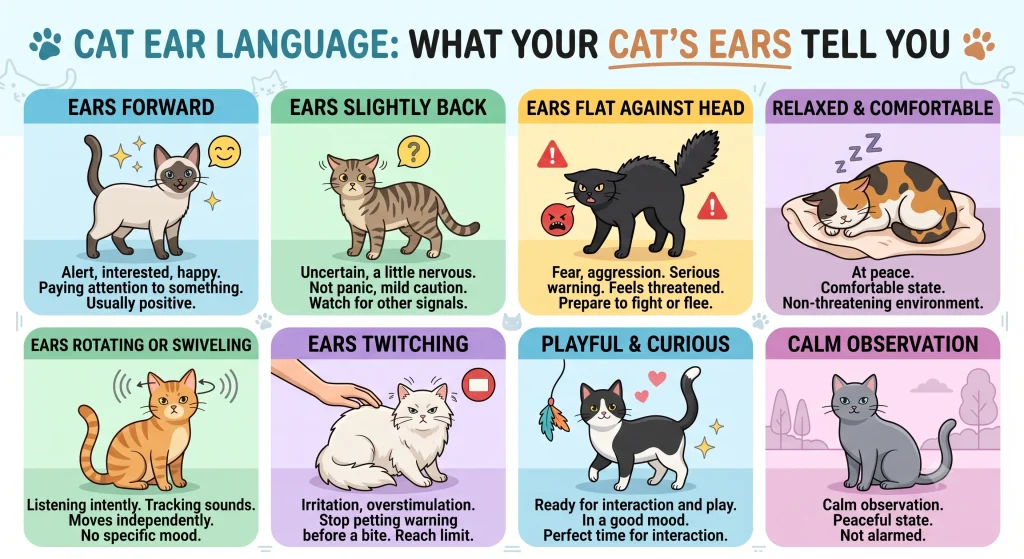
Ears are quick indicators of mood. They change faster than any other body part. Here is what ear positions mean.
Ears Forward
Ears facing forward mean your cat is alert. Interested. Happy. They are paying attention to something. This is usually a positive signal. Your cat is engaged with their environment.
Ears Slightly Back
Ears tilted slightly back mean your cat is uncertain. Maybe a little nervous. They are not sure about something. This is not a panic signal. Just mild caution. Watch for other signals to understand the full picture.
Ears Flat Against Head
Flat ears mean fear. Aggression. Or both. This is a serious warning. Your cat feels threatened. They are preparing to fight or flee. Do not approach a cat with flat ears. Give them space. Remove the threat if you can identify it.
Ears Rotating or Swiveling
Ears that rotate or swivel mean your cat is listening intently. They are tracking sounds. This is normal. Cats have incredible hearing. Their ears move independently to locate sounds. This does not indicate any specific mood. Just alertness.
Ears Twitching
Quick ear twitches can mean irritation. Or overstimulation. If you are petting your cat and their ears start twitching. Stop. They are reaching their limit. This is one of the earliest warning signs before a bite.
Eye Language: What Your Cat’s Eyes Tell You
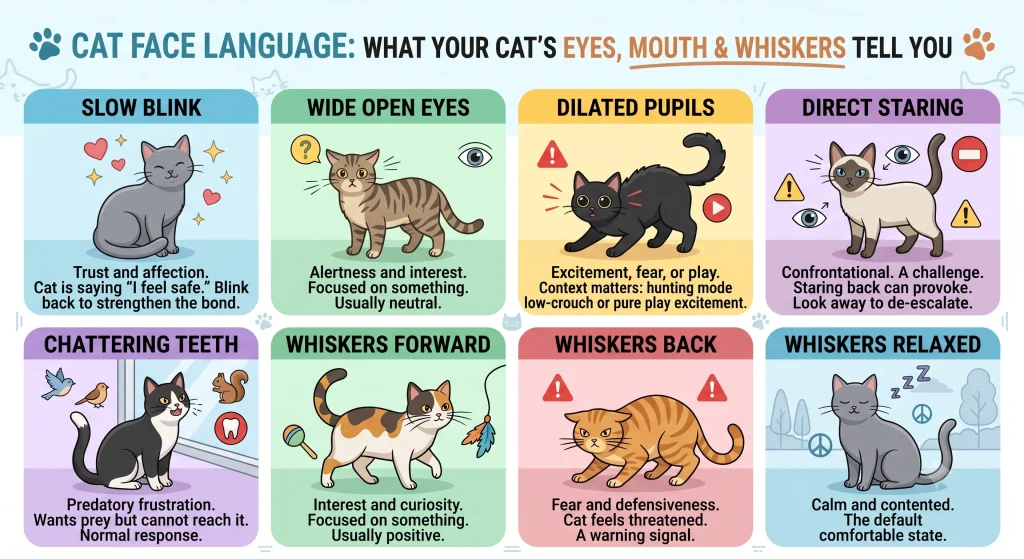
Cat eyes are expressive. Once you know what to look for.
Slow Blink
This is the big one. A slow blink from your cat means trust. Love. Affection. When your cat looks at you and slowly closes their eyes. They are saying I trust you. I feel safe with you. You can slow blink back. It strengthens your bond.
Wide Open Eyes
Wide open eyes mean alertness. Interest. Your cat is focused on something. This is usually neutral. Neither positive nor negative. Just attentive.
Narrowed Eyes or Squinting
Squinting can mean relaxation. Contentment. A cat who squints at you is comfortable. Happy. It can also mean the cat is in pain. If the squinting is sudden and one-eyed. See a vet. That could be an eye infection or injury.
Dilated Pupils
Big round pupils mean excitement. Fear. Aggression. Or playfulness. Context matters here. If your cat has dilated pupils and is crouched low. They are in hunting or defense mode. If they have dilated pupils and are playing. That is just excitement.
Constricted Pupils
Slit pupils mean your cat is feeling aggressive. Defensive. Or is in bright light. If the lighting is normal and pupils are very narrow. Your cat may be agitated. Watch for other warning signs.
Direct Staring
Direct prolonged eye contact from a cat is confrontational. It is a challenge. If a cat stares at you without blinking. They are saying I am not afraid of you. Do not stare back. Look away to de-escalate. This is important to know. Staring at a strange cat can provoke an attack.
Averting Gaze
When your cat looks away from you. They are showing respect. Deferring. Saying I am not a threat. This is a friendly signal. Not rejection.
Mouth and Whisker Language
The mouth and whiskers also communicate important information.
Chattering Teeth
When your cat chatters their teeth while watching birds or squirrels. They are frustrated. Excited. They want to catch that prey but cannot reach it. This is a normal predatory response.
Lip Licking
Excessive lip licking means nausea. Anxiety. Or anticipation of food. If your cat is not about to eat. And they keep licking their lips. They might feel sick. Watch for other signs of illness.
Yawning
A cat yawns when they are tired. Bored. Or stressed. Yawning is a displacement behavior. Your cat does it when they are conflicted about something. If your cat yawns during a stressful situation. They are trying to calm themselves down.
Whiskers Forward
Whiskers pushed forward mean interest. Curiosity. Your cat is focused on something. This is usually positive.
Whiskers Back Against Face
Whiskers pulled back flat against the face mean fear. Defensiveness. Your cat feels threatened. This is a warning signal.
Whiskers Relaxed to the Side
Whiskers in a neutral position mean your cat is calm. Relaxed. Content. This is the default when your cat is comfortable.
Body Posture: What Your Cat’s Posture Tells You
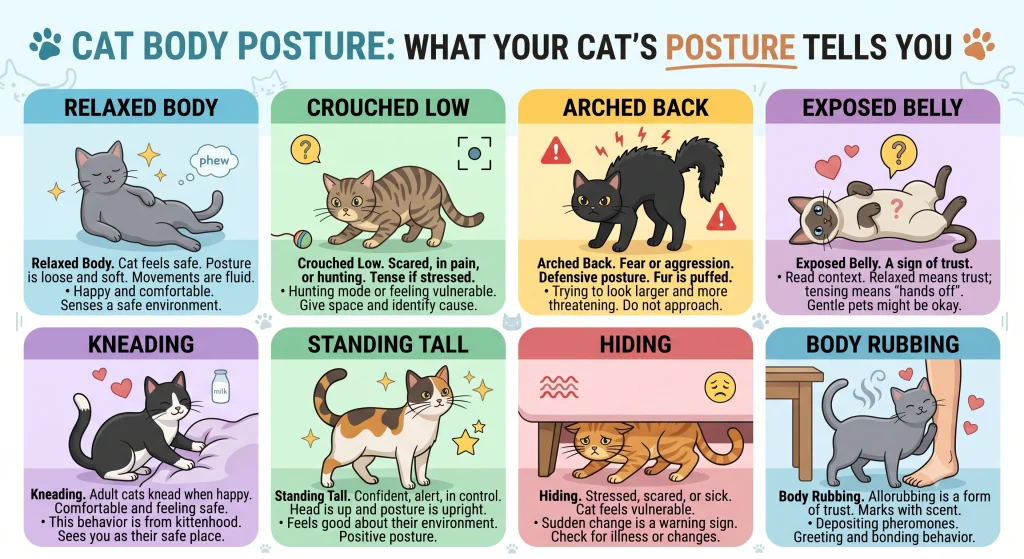
The way your cat holds their body reveals a lot about their emotional state.
Relaxed Body
A relaxed cat has a loose. Soft posture. Their body is not tense. Their movements are fluid. This means your cat feels safe. Comfortable. Happy.
Crouched Low
A crouched cat is either scared. In pain. Or hunting. If the body is tense. The cat is stressed. If they are crouched and watching something intently. They are in hunting mode. If they are crouched and hiding. They are afraid.
Arched Back
An arched back with puffed fur means fear or aggression. Your cat is trying to look bigger. More threatening. This is a defensive posture. Give space. Do not approach.
Exposed Belly
A cat rolling over and showing their belly is a sign of trust. They are exposing their most vulnerable area. But. This is NOT always an invitation to rub the belly. Sometimes it means I trust you. But do not touch my belly. Read the context. If the cat is relaxed and floppy. A gentle belly rub might be okay. If they tense up when you reach. Stop immediately.
Kneading
Kneading is when your cat pushes their paws in and out against a soft surface. This comes from kittenhood. When they kneaded their mother to stimulate milk flow. Adult cats knead when they are happy. Comfortable. Feeling safe. It is a compliment. Your cat sees you as their safe place.
Standing Tall
A cat standing tall with their head up is confident. Alert. In control. This is a positive posture. Your cat feels good about their environment.
Hiding
A cat that hides is stressed. Scared. Or sick. Cats hide when they feel vulnerable. If your cat suddenly starts hiding. Something is wrong. Check for environmental changes. Check for signs of illness. Check for other animals causing fear.
Sound Language: What Your Cat’s Vocalizations Mean
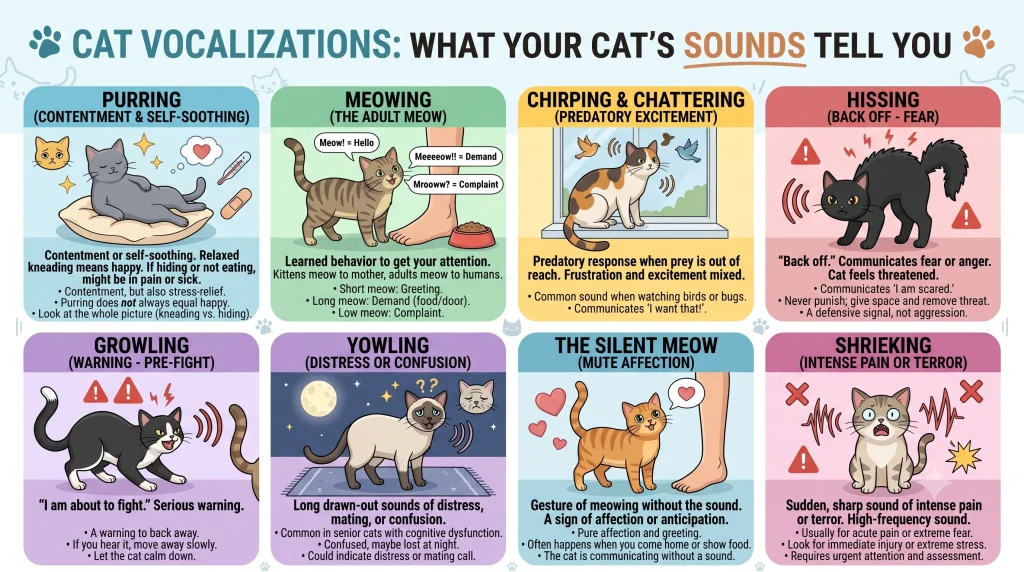
Cats use different sounds to communicate different things. Here is a quick guide.
Purring
Purring usually means contentment. But not always. Cats also purr when they are in pain. Or stressed. Or dying. Yes. Really. Cats purr to self-soothe. So look at the whole picture. A cat who is purring. Relaxed. And kneading. Is happy. A cat who is purring. Hiding. And not eating. Might be sick.
Meowing
Adult cats meow primarily at humans. Not at other cats. This is a learned behavior. Kittens meow to get their mother’s attention. Adult cats meow to get your attention. Different meows mean different things. A short meow is a greeting. A long meow is a demand. A low meow is a complaint.
Chirping and Chattering
This is the sound cats make when they see prey they cannot reach. Birds outside the window. Bugs on the ceiling. It is excitement mixed with frustration. A predatory response.
Hissing
Hissing means back off. I feel threatened. Your cat is scared or angry. Never punish a hissing cat. They are communicating fear. Not aggression. Give them space. Remove the threat.
Growling
Growling is a warning. Your cat is saying I am about to fight. If you hear growling. Back away slowly. Do not make direct eye contact. Do not try to touch the cat. Let them calm down.
Yowling
Long drawn out yowls can mean distress. Mating calls. Or cognitive dysfunction in senior cats. If your senior cat yowls at night. They might be confused. Or have hearing loss. See your vet.
Common Cat Body Language Combinations
Individual signals are useful. But combinations tell the real story. Here are common combinations and what they mean.
| Combination | What It Means | Your Response |
|---|---|---|
| Tail up + ears forward + slow blink | Happy. Friendly. Trusting | Engage positively. Pet gently |
| Tail swishing + ears back + dilated pupils | Irritated. Approaching threshold | Stop what you are doing. Give space |
| Arched back + puffed tail + flat ears | Scared. Defensive. May attack | Back away slowly. Remove threat |
| Kneading + purring + relaxed body | Content. Safe. Happy | Enjoy the moment. Gentle attention |
| Hiding + flattened ears + tucked tail | Terrified. Needs safety | Remove stressor. Do not force interaction |
| Exposed belly + relaxed body + slow blink | Trust. Might accept belly rub | Try gentle touch. Watch reaction |
| Chattering + wide eyes + tail twitching | Excited. Frustrated. Predatory drive | Let them watch. Offer play after |
| Lip licking + squinting + hiding | Nausea. Pain. Illness | See veterinarian |
How to Use Body Language to Prevent Biting
This is where body language knowledge becomes practical. Real life application. Preventing bites.
Most cat bites happen because the owner missed the warning signs. Your cat told you they were uncomfortable. You did not see it. And you got bitten. Here is how to prevent that.
When petting your cat. Watch for these signals in this order. Ear twitch means stop soon. Tail swishing means stop now. Skin rippling means stop immediately. Head turning toward your hand means bite is coming. Flat ears means you pushed too far.
The key is stopping before the bite. Not after. If you see the first warning sign. An ear twitch. Stop petting. Give your cat a break. Let them re-engage if they want more. This prevents the escalation that leads to biting.
Understanding why cats bite when petted is directly connected to reading body language. The same signals apply in many situations. Not just petting.
Reading Body Language in Different Situations
Context matters. The same signal can mean different things in different situations. Here is how to read common scenarios.
Meeting a New Cat
When introducing cats to each other. Watch for. Tail straight up means friendly. Hissing means defensive. Slow approach means cautious. Quick retreat means scared. Flat ears means aggressive. Let the cats set the pace. Do not force interactions.
Learning how to reduce cat anxiety helps when introducing new cats. A calm cat reads body language better than a stressed one.
Vet Visits
At the vet. Cats show stress signals. Dilated pupils. Flattened ears. Tucked tail. Hissing. Growling. These are normal responses to a scary environment. Talk to your cat softly. Move slowly. Let the vet approach calmly. A carrier with a familiar blanket helps.
Multi-Cat Households
In homes with multiple cats. Body language is how cats negotiate territory. Cats who respect each other will avert gaze. Share space peacefully. Cats who conflict will stare. Swat. And posture. Provide separate resources. Litter boxes. Food bowls. Beds. To reduce conflict.
With Children
If you have kids. Teaching them to read cat body language is essential. A cat with a swishing tail and flattened ears is not having fun. A cat hiding under the bed does not want to be pulled out. A cat showing belly is not always inviting a hug. Children who understand these signals are safer around cats.
Expert Tips From My Practice
Here is what I have learned from decades of reading cat body language.
The most important thing I tell cat owners is this. When in doubt. Do nothing. If you are not sure what your cat is feeling. Do not pet them. Do not pick them up. Do not force interaction. Wait. Watch. Let the cat come to you. This simple rule prevents most problems.
- Always watch the whole picture. One signal alone does not tell the full story. Look at ears. Tail. Eyes. Body posture. All together. This gives you the accurate read.
- Learn your own cat first. Every cat is different. Some cats have different baseline behaviors. Learn what is normal for YOUR cat. Then you can spot when something is off.
- Watch from a distance. You do not need to be right next to your cat to read their body language. Observe from across the room. This gives you a better view of the full body.
- Video record your cat. Sometimes you miss signals in real time. Record your cat and watch it back. You will see things you missed live.
- Trust the subtle signals. The earliest warning signs are the most important. Ear twitches. Whisker changes. Slight posture shifts. These happen before the obvious signals. Learn to catch them early.
- Teach everyone in the house. Everyone who interacts with your cat should know basic body language. This keeps everyone safe.
- Use body language to bond. Slow blinking. Soft approach. Respecting boundaries. All build trust. Your cat will love you more when you understand them.
FAQ
What does it mean when a cat slow blinks at you?
A slow blink means trust and affection. Your cat is saying they feel safe with you. It is the cat equivalent of I love you. You can slow blink back to strengthen your bond. This is one of the most positive signals a cat can give.
Why does my cat wag her tail when I pet her?
A wagging or swishing tail during petting usually means overstimulation. Your cat is approaching their limit. Stop petting soon. A slowly swishing tail means mild irritation. A fast swishing tail means they are about to bite. Watch for this signal.
What does it mean when a cat shows you their belly?
An exposed belly usually means trust. Your cat feels safe enough to expose their most vulnerable area. But it is not always an invitation to rub the belly. Many cats show their belly as a sign of trust but do not want it touched. Watch their reaction when you reach.
Why does my cat stare at me without blinking?
Prolonged direct eye contact from a cat is confrontational. They are challenging you. Or feeling threatened. Do not stare back. Look away slowly. This de-escalates the situation. If your cat does this often. They might feel insecure or threatened by something.
What does a puffed up tail mean on a cat?
A puffed up tail means fear or aggression. Your cat is trying to look bigger and more intimidating. This is a defensive response. Give your cat space. Do not approach. Remove whatever is scaring them if possible.
Why does my cat knead me with their paws?
Kneading comes from kittenhood. Kittens knead their mother to stimulate milk flow. Adult cats knead when they are happy. Comfortable. And feel safe. If your cat kneads you. It is a compliment. They see you as their safe place.
What does it mean when a cat flattens their ears?
Flat ears mean fear. Aggression. Or both. Your cat feels threatened. This is a warning signal. Back away. Do not make direct eye contact. Remove the source of fear if possible. Never approach a cat with flat ears.
Why does my cat chirp at birds?
Chirping or chattering at birds is a predatory response. Your cat is excited and frustrated. They want to catch the prey but cannot reach it. This is normal behavior. Let them watch. Then redirect with a toy to satisfy the hunting instinct.
What does it mean when a cat wraps their tail around you?
A tail wrapped around your legs or arm is affection. It is the cat version of holding hands. Your cat likes you and trusts you. This is a positive signal. Respond with gentle attention.
How can I tell if my cat is in pain?
Pain signals include hiding. Squinting. Flattened ears. Tucked tail. Decreased movement. Not eating. And changes in grooming. Cats hide pain well. So subtle changes matter. If your cat’s behavior changes suddenly. See a vet.
What does it mean when a cat rubs against you?
Head rubbing or bunting is marking behavior. Your cat is leaving their scent on you. It means you belong to them. This is affectionate. Your cat is claiming you as theirs. It is a compliment.
Why does my cat bite me gently?
Gentle bites are usually play bites. Or love bites. Or demand bites. Play bites happen during play. Love bites happen during petting as affection. Demand bites happen when your cat wants something. All are normal. But discourage hard biting. Redirect with toys.
What does it mean when a cat hisses?
Hissing means back off. I am scared. It is a warning. Your cat feels threatened. Never punish a hissing cat. Give them space. Remove the threat. Let them calm down. Hissing is communication. Not aggression.