

Table of Contents
Cat Anxiety: The Complete Guide to Signs, Causes, Treatment, and How to Calm Your Stressed Cat
Your cat is hiding under the bed again. Or maybe they’re peeing on your pillow. Or perhaps they’ve started grooming themselves until bald patches appear. You’re standing there wondering what you did wrong, and the truth is, you probably didn’t do anything wrong at all.
Cat anxiety is one of the most common problems cat owners face. It’s also one of the most misunderstood. Most people don’t even realize their cat is anxious until the behavior gets really bad. By that point, the cat has been struggling for weeks or months.
This guide explains everything in plain language. What cat anxiety looks like. What causes it. How to fix it. And how to prevent it from coming back. If your cat is stressed, this is the only article you’ll need. For a complete reference on all aspects of cat care, check out the Complete Cat Care Manual.
📚 Recommended Cat Guides
🐱 The Trainable Cat Book
Learn proven methods to train your cat and stop unwanted behaviors.
View Book →❤️ Complete Cat Care Manual
Your complete guide to cat nutrition, health, grooming, behavior, and daily care.
Get the Manual →What Is Cat Anxiety?
Cat anxiety is a condition where your cat feels fear, stress, or worry on a regular basis. It’s not just being nervous during a thunderstorm. It’s a lasting state of unease that affects how your cat behaves, eats, sleeps, and interacts with you.
Think of it like this. You know that feeling you get before a big presentation or a job interview? That knot in your stomach, that racing heart? Imagine feeling that way all the time, even when you’re sitting on your own couch in your own house. That’s what chronic cat anxiety is like for your cat.
The American Association of Feline Practitioners officially recognizes feline anxiety as a medical condition. It’s not a behavioral quirk. It’s not your cat being difficult. It’s a real health issue that causes real suffering. And like any health issue, it responds to treatment when you know what you’re doing.
Cats can develop anxiety at any age. Kittens, adults, and senior cats all experience feline stress. Some cats are naturally more anxious than others. Rescue cats and rehomed cats often carry extra anxiety from past experiences. But any cat can develop anxiety at any point in their life.
Why Do Cats Get Anxious?
Cats get anxious for many different reasons. Understanding the cause is the first step to fixing the problem. Here are the most common triggers for feline anxiety.
Loud Noises and Environmental Changes
Loud noises are one of the biggest anxiety triggers for cats. Fireworks, thunderstorms, vacuum cleaners, construction work, hairdryers, and even loud music can stress a cat out. Cats hear sounds at much higher frequencies than humans do. A noise that seems moderate to you can sound overwhelming to your cat.
Changes in the home environment also cause feline stress. Moving to a new house, rearranging furniture, getting new carpet, renovating a room, or even adding a new piece of furniture can trigger anxiety. Cats rely on predictability. When their environment changes, their sense of safety disappears.
Smart home devices are another overlooked trigger. Motion-activated lights, ultrasonic pest deterrents, and some Wi-Fi routers emit sounds in the 20 to 60 kHz range. Cats can hear these sounds. You can’t. Your cat might be getting stressed by something you don’t even know is there.
New People and Pets
Any new addition to the household can trigger cat anxiety. A new baby, a new partner, a new roommate, a new pet. Your cat had the house mapped out. They knew every sound, every smell, every routine. Now there’s a stranger in their territory, and they have no idea what’s happening.
This is one of the most common reasons for anxiety in cats after a household change. The cat isn’t being difficult. They’re overwhelmed.
Separation From Their Owner
Some cats develop separation anxiety when their owner is away. This is especially common in cats who were bottle-fed, hand-raised, or who spent extended time with their owner, like during pandemic lockdowns. When the owner suddenly returns to a normal work schedule, the cat experiences real distress at being left alone.
Separation anxiety in cats is more common than most people think. Signs include vocalizing when you leave, peeing on your bed or clothes, destructive behavior only when you’re gone, and excessive greeting when you return.
Poor Socialization as a Kitten
Kittens have a critical socialization window between 2 and 7 weeks of age. During this time, they need exposure to different people, animals, surfaces, sounds, and experiences. Kittens who miss this window often develop anxiety later in life. They’re scared of things that don’t bother well-socialized cats.
This doesn’t mean the cat is broken. It means they didn’t get the early experiences they needed. With patience and proper techniques, many poorly socialized cats can learn to feel safer.
Past Trauma
Rescued cats and rehomed cats often carry anxiety from previous experiences. Abuse, neglect, abandonment, or even just a single frightening event can create lasting fear responses. These cats might flinch at raised hands, hide from strangers, or panic during car rides.
Past trauma is a common cause of feline anxiety, and it requires patience and understanding. These cats need extra time to feel safe.
Pain and Medical Conditions
This is the trigger that gets missed most often. Pain causes anxiety. Dental disease causes anxiety. Urinary tract infections cause anxiety. Arthritis causes anxiety. Hyperthyroidism causes anxiety. Kidney disease causes anxiety.
If your cat suddenly seems anxious, there’s a good chance something hurts. A cat with dental disease might stop eating and start hiding. A cat with a urinary infection might pee outside the litter box. The anxiety is a symptom. The real problem is the medical condition underneath.
This is why a veterinary exam is always the first step when dealing with cat anxiety. Always.
Multi-Cat Household Conflict
Having more than one cat can create stress between the cats. Competition for resources, incompatible personalities, or a rushed introduction can create chronic tension. Some cats live in a state of low-level conflict that the owner barely notices because there are no obvious fights.
Signs of inter-cat stress include one cat always watching the other, cats who won’t eat near each other, resource guarding, and one cat spending all their time in one room to avoid the other.
Signs of Cat Anxiety You Should Know
Cat anxiety doesn’t always look obvious. Many anxious cats become quiet and withdrawn instead of loud and destructive. Learning to recognize the signs of feline anxiety helps you catch it early.
Early Warning Signs of Cat Stress
These are the subtle signs most owners miss:
- Avoiding eye contact. A cat who looks away when you make eye contact might be feeling anxious. In cat language, direct staring can feel threatening. Looking away is a calming signal.
- Body shifting away from you. If your cat shifts their body or head away during petting, they’re telling you they’re uncomfortable. Most people think the cat is just done being petted. It can be a stress signal.
- Tail held lower than normal. Not tucked between the legs. Just held a bit lower or pressed closer to the body. This is a baseline anxiety indicator.
- Small tail flicks. Not a full tail swish. Just the tip moving. This is your cat’s early warning that they’re getting irritated or overstimulated.
- Slightly dilated pupils. Pupils that are a bit larger than normal in average lighting suggest arousal. This can be anxiety.
- Ears tilted backward slightly. Not flat against the head. Just angled back instead of forward. Your cat is watching for threats behind them while pretending to relax.
Moderate Signs of Feline Anxiety
- Hiding more than usual. A cat who starts spending more time under beds, in closets, or behind furniture is telling you something is wrong. Cats hide when they feel unsafe.
- Loss of appetite. A cat who walks up to their food, sniffs it, and walks away might be too anxious to eat. This is serious. Cats who don’t eat for more than 24 to 48 hours can develop hepatic lipidosis, a dangerous liver condition.
- Excessive vocalization. Meowing, yowling, or crying, especially at night or when you’re not in the room. This is often a distress call, not attention-seeking.
- Over-grooming. Cats groom to calm themselves down. When grooming goes into overdrive, especially on the belly, inner thighs, or flanks, you’ll see bald patches. Excessive grooming in cats is a classic sign of feline stress.
- Restlessness. Pacing, inability to settle, moving from spot to spot. An anxious cat’s nervous system won’t let them relax.
- Hypervigilance. Wide eyes, scanning the room, easily startled by normal sounds. An anxious cat is constantly on alert.
Severe Signs of Cat Anxiety
- Complete withdrawal. A cat who stops interacting entirely. Won’t come out for food. Retreats to one spot and refuses to move. This cat is in serious distress.
- Aggression. Hissing, swatting, biting, especially at family members the cat previously tolerated. Aggression in cats is almost always fear expressed outward.
- Litter box avoidance. Urinating or defecating outside the box, especially on your bed or clothes. This is a stress response. The cat is seeking your scent for comfort.
- Self-harm. Over-grooming so severe it causes open wounds, hair loss, or skin infections. Some cats literally groom themselves raw when stressed.
- Trembling. Visible shaking without an obvious cause like cold. This is extreme fear or anxiety.
- Drooling. Excessive salivation, especially with other signs, indicates severe stress.
How Cat Anxiety Affects Physical Health
Chronic feline stress doesn’t just affect behavior. It affects the whole body. Here’s what happens when a cat lives with ongoing anxiety:
| Body System | What Stress Does | Health Problems That Can Develop |
|---|---|---|
| Urinary tract | Inflammation and irritation | Feline idiopathic cystitis, urinary blockages, bladder stones |
| Immune system | Becomes weaker and less effective | More infections, slower healing, upper respiratory problems |
| Digestive system | Motility changes and disruption | Vomiting, diarrhea, appetite changes, inflammatory bowel disease |
| Heart | Increased heart rate and blood pressure changes | Stress-related heart problems |
| Skin and coat | Excessive grooming response | Psychogenic alopecia, bald patches, self-inflicted wounds |
| Brain | Neurochemical changes | Aggression, withdrawal, compulsive behaviors |
| Overall health | Constant cortisol elevation | Weight gain, diabetes risk, shorter lifespan |
Cornell University’s veterinary school specifically names stress as a primary trigger for feline idiopathic cystitis, one of the most common urinary conditions in cats. The link between feline anxiety and physical illness is proven, measurable, and clinically important.
This is why treating cat anxiety isn’t optional. It’s necessary medical care. Chronic stress makes your cat physically sick.
How to Treat Cat Anxiety
Treating cat anxiety requires a step-by-step approach. The method depends on how severe the anxiety is, what’s causing it, and how your individual cat responds. Here’s the treatment hierarchy that veterinary behaviorists follow.
Step 1: Visit the Vet First
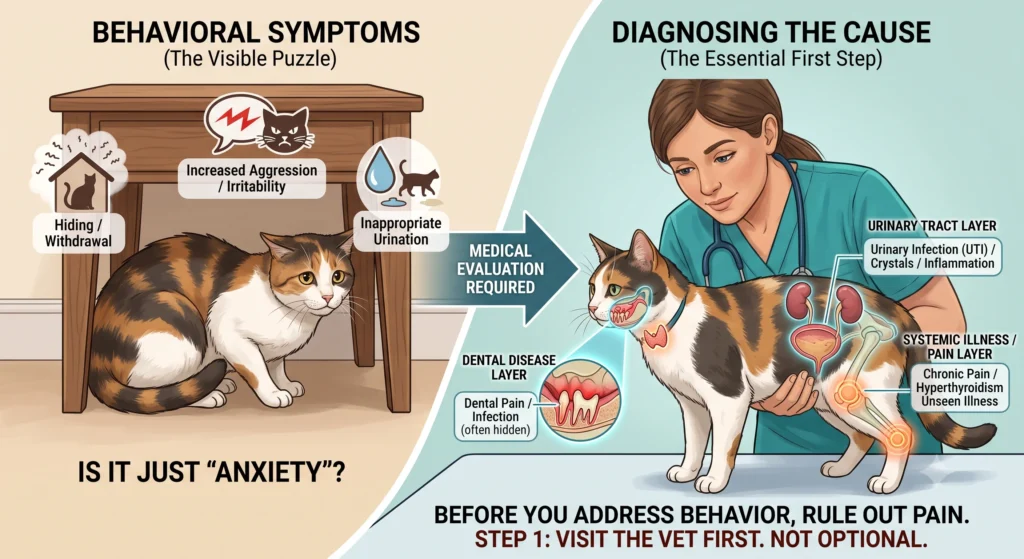
Before you try anything else, take your cat to the vet. Get a full exam, bloodwork, urinalysis, and pain screening. This is not optional. It’s the most important step.
Here’s why. Pain causes anxiety. Dental disease causes anxiety. Urinary infections cause anxiety. Thyroid problems cause anxiety. If you try to fix anxiety behaviorally while your cat has an undiagnosed medical condition, you’re treating the symptom while the cause gets worse.
I know someone whose cat developed severe anxiety. Hiding, aggression, peeing everywhere. She spent months trying Feliway, calming supplements, behavior modification. Nothing worked. When she finally brought the cat in, it was a urinary tract infection. One course of antibiotics and the anxiety disappeared. Months of stress that a single vet visit could have solved.
Always start with the vet. Always.
Step 2: Fix the Environment
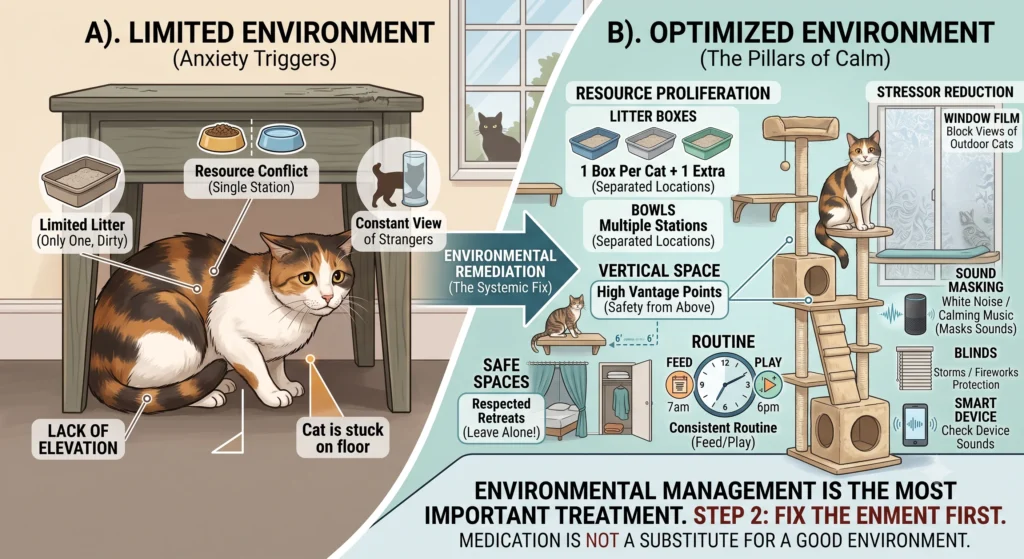
Environmental management is the most important treatment for cat anxiety. You cannot medicate your way out of a bad environment. The environment has to be right first.
Give your cat enough resources:
- One litter box per cat, plus one extra, in different locations
- Multiple food bowls, separated by at least six feet
- Water bowls in different rooms
- Multiple beds and resting spots, including high ones
- Scratching posts in different areas
Add vertical space:
Cats feel safer when they can look down on everything from above. Cat trees, wall shelves, window perches. In multi-cat households, vertical space helps anxious cats feel more in control because they can climb away from perceived threats.
Create safe spaces:
Every cat needs a spot where they can disappear and feel safe. A high cat tree. A covered bed in a quiet room. A closet with a soft blanket. When your cat retreats to their safe space, leave them alone. Don’t follow. Don’t coax them out. Respect the retreat.
Keep a consistent routine:
Feed at the same times. Play at the same times. Cats thrive on routine. Changing schedules is one of the biggest anxiety triggers. If your schedule is changing, transition gradually if possible.
Reduce stressors:
- Block the view of outdoor cats with window film
- Use white noise or calming music to mask startling sounds
- Close blinds during storms or fireworks
- Check if any smart home devices emit sounds cats can hear
Step 3: Add Environmental Enrichment
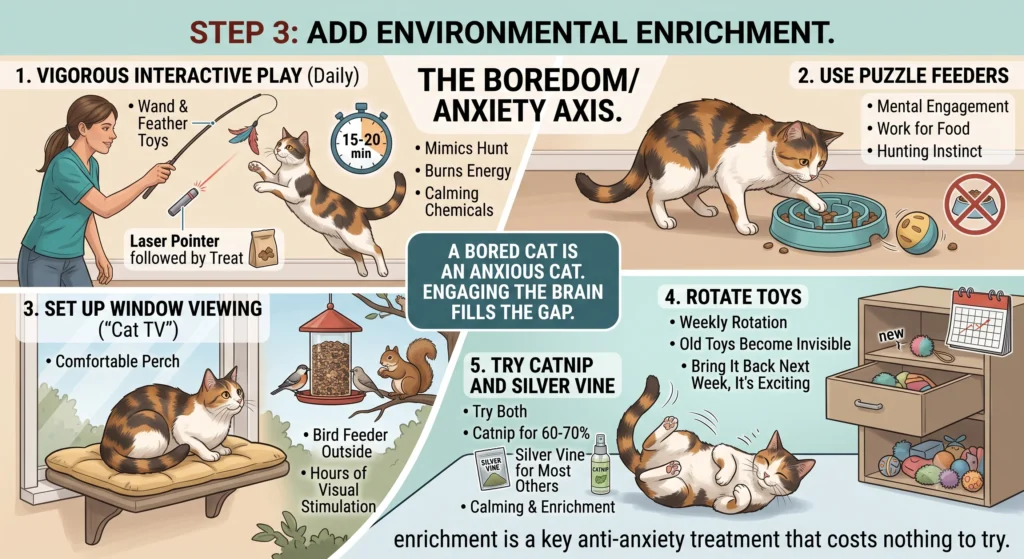
A bored cat is an anxious cat. When a cat’s brain isn’t engaged, anxiety fills the gap. Environmental enrichment is one of the most effective treatments for feline anxiety.
Play with your cat every day:
At least 15 to 20 minutes of vigorous interactive play daily. Use wand toys, feather toys, or laser pointers followed by a treat. Get your cat running, jumping, and pouncing. This mimics hunting, burns energy, and releases calming chemicals in the brain. Play is the most effective anti-anxiety tool that costs nothing.
Use puzzle feeders:
Instead of putting food in a bowl, make your cat work for it. Puzzle feeders and treat-dispensing toys engage the hunting instinct and keep cats mentally occupied instead of anxious.
Set up window viewing stations:
Put a comfortable perch near a window with a bird feeder outside. This is cat TV. It provides hours of visual stimulation. For indoor cats especially, window access is crucial enrichment.
Rotate toys:
Don’t leave the same toys out all the time. Rotate them weekly. A toy that’s been sitting on the floor for three months is invisible. Put it away, bring it back next week, and suddenly it’s exciting again.
Try catnip and silver vine:
About 30 to 40% of cats don’t respond to catnip. But silver vine works for most cats. Both can provide temporary calming and enrichment. Worth trying.
Step 4: Try Pheromone Products
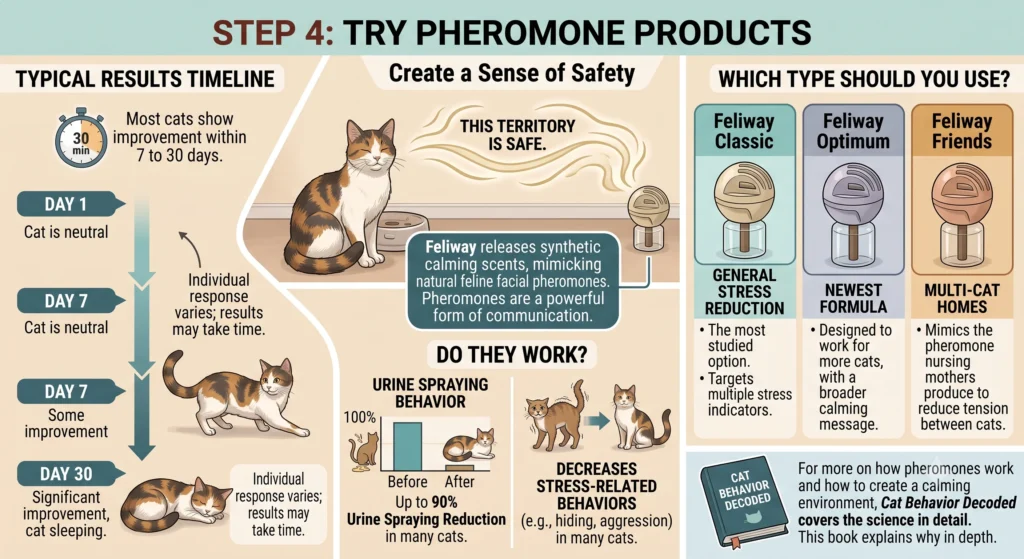
Feliway and similar pheromone products release synthetic versions of the calming scents cats produce naturally. These products tell your cat’s brain “this territory is safe.”
Do they work? Research shows Feliway reduces urine spraying in up to 90% of cats and decreases stress-related behaviors in many cats. Results typically take 7 to 30 days. Not all cats respond equally, but most show improvement.
Which type should you use?
- Feliway Classic: General stress reduction. The most studied option.
- Feliway Optimum: Newest formula. Designed to work for more cats.
- Feliway Friends: Mimics the pheromone nursing mothers produce. Good for multi-cat homes.
For more on how pheromones work and how to create a calming environment, Cat Behavior Decoded covers the science in detail. This book explains why certain scents calm cats while others cause stress, which helps you choose the right products.
Step 5: Use Calming Supplements
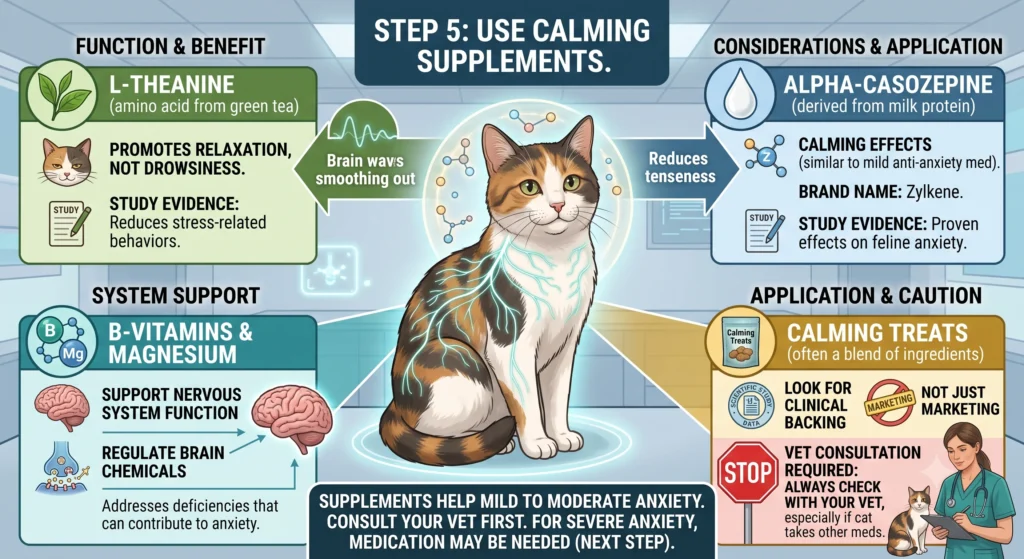
Several supplements have evidence supporting their use for mild to moderate cat anxiety:
- L-theanine. An amino acid from green tea. Promotes relaxation without drowsiness. Studies show it reduces stress-related behaviors in cats.
- Alpha-casozepine. Derived from milk protein. Has calming effects similar to mild anti-anxiety medication. Brand name is Zylkene.
- B-vitamins. B1, B6, and B12 support nervous system function and may reduce anxiety.
- Magnesium. Involved in brain chemical regulation. Deficiency can contribute to anxiety.
- Calming treats. Many products combine these ingredients. Look for clinical backing, not just marketing.
Always check with your vet before starting supplements, especially if your cat takes other medications.
Step 6: Behavior Modification
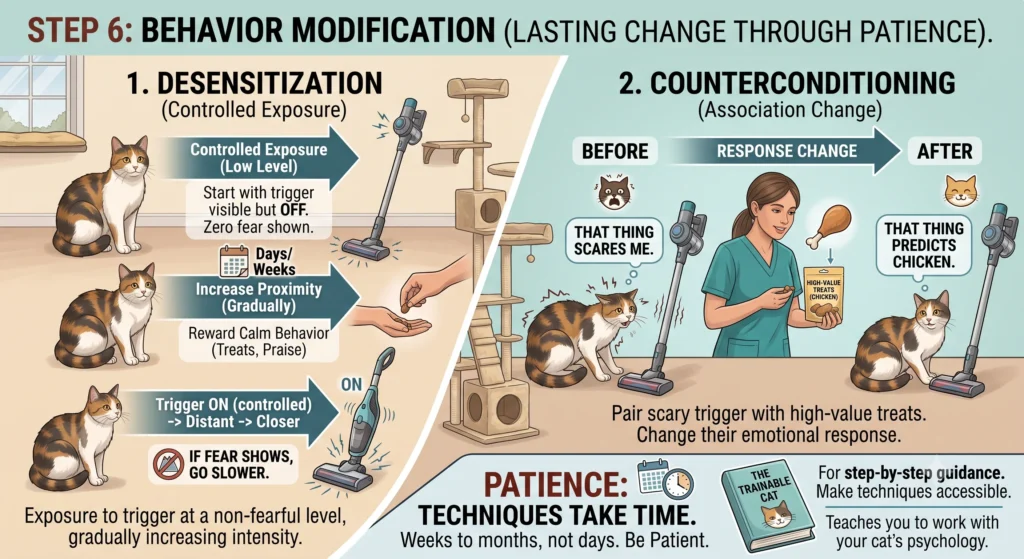
For anxiety with specific triggers, two techniques can produce lasting change:
Desensitization:
Controlled exposure to the trigger at a level so low your cat shows zero fear. If your cat panics around vacuum cleaners, start with the vacuum visible but turned off. Reward calm behavior. Gradually increase proximity over days or weeks. If your cat shows fear, go slower.
Counterconditioning:
Pair the scary trigger with something your cat loves, usually high-value treats. Change their response from “that thing scares me” to “that thing predicts chicken.” This takes patience, but it creates real change.
These techniques work, but they take time. Weeks to months, not days. For step-by-step guidance, The Trainable Cat provides protocols that make these techniques accessible to non-professionals. This book teaches you how to work with your cat’s psychology instead of against it.
Step 7: Prescription Medication
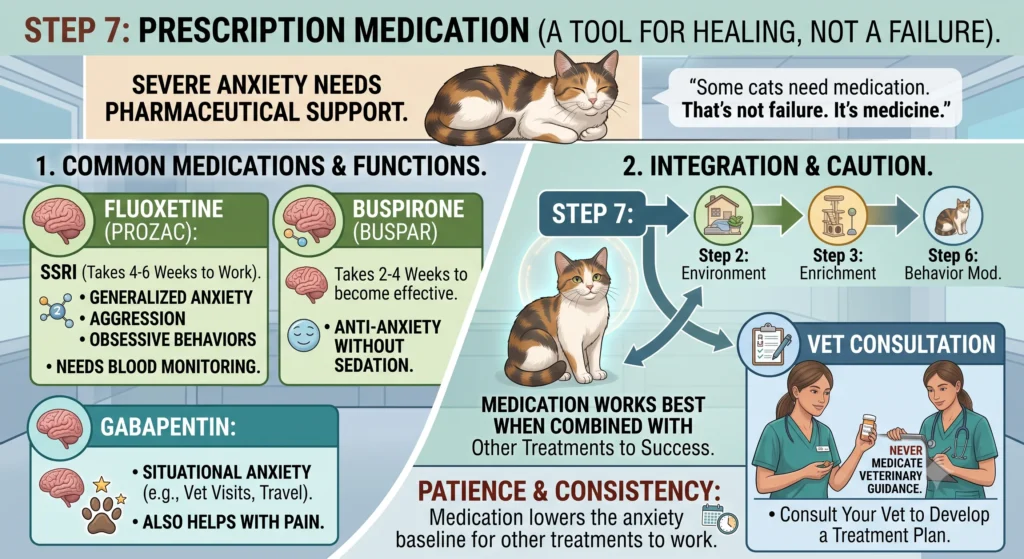
Some cats need medication. That’s not failure. It’s medicine. Severe anxiety that doesn’t respond to other treatments often needs pharmaceutical support, at least temporarily.
Common cat anxiety medications:
- Fluoxetine (Prozac). An SSRI that takes 4 to 6 weeks to work. Used for generalized anxiety, aggression, and obsessive behaviors. Needs blood monitoring.
- Sertraline (Zoloft). Another SSRI option for specific anxiety presentations.
- Buspirone (BuSpar). Anti-anxiety medication without sedation. Takes 2 to 4 weeks to become effective.
- Gabapentin. Used for situational anxiety like vet visits or travel. Also helps with pain.
- Trazodone. Sometimes used for situational anxiety, often combined with other medications.
Medication works best when combined with environmental management and behavior modification. It lowers the anxiety baseline enough for other treatments to work. Never medicate without veterinary guidance.
Separation Anxiety in Cats
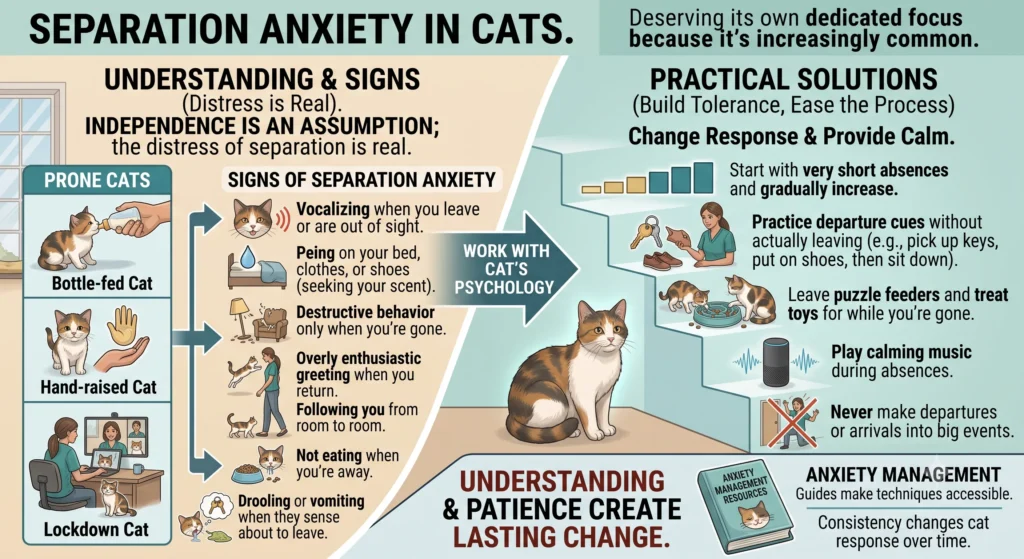
Separation anxiety deserves its own section because it’s increasingly common. Many people assume cats don’t get separation anxiety because they’re independent. That’s wrong.
Cats who were bottle-fed, hand-raised, or who spent lockdowns with constant human presence are especially prone. When the owner returns to a normal work schedule, the cat experiences real distress.
Signs of separation anxiety:
- Vocalizing when you leave or are out of sight
- Peing on your bed, clothes, or shoes (seeking your scent)
- Destructive behavior only when you’re gone
- Overly enthusiastic greeting when you return
- Following you from room to room
- Not eating when you’re away
- Drooling or vomiting when they sense you’re about to leave
Solutions:
- Start with very short absences and gradually increase
- Practice departure cues without actually leaving (pick up keys, put on shoes, then sit down)
- Leave puzzle feeders and treat toys for while you’re gone
- Play calming music during absences
- Never make departures or arrivals into big events
Fireworks, Thunderstorms, and Noise Anxiety
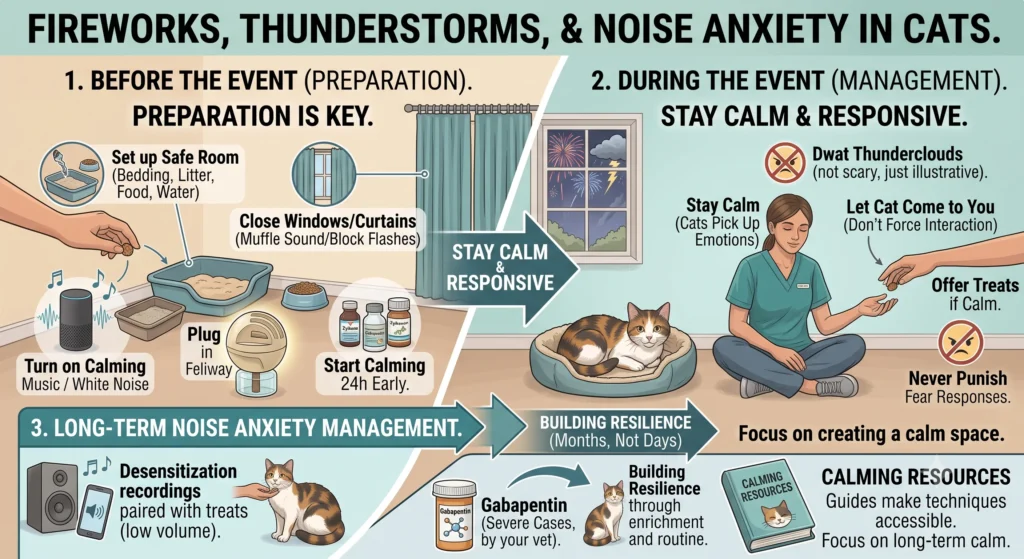
Noise anxiety is one of the most distressing forms of feline stress. Some cats panic during fireworks, thunderstorms, or even household noises like vacuum cleaners.
Before the noise event:
- Set up a safe room with bedding, litter box, food, and water
- Close windows and curtains to muffle sound and block flashes
- Turn on white noise or calming music
- Plug in Feliway diffusers at least 24 hours before
- For predictable events, start calming supplements 3 to 5 days early
During the event:
- Stay calm. Cats pick up on your emotions.
- Let the cat come to you if they want comfort. Don’t force interaction.
- Never punish fear responses. It makes everything worse.
- Offer treats if the cat is calm enough to eat.
Long-term noise anxiety management:
- Desensitization with low-volume recordings paired with treats
- Gabapentin prescribed by your vet for severe cases
- Building resilience through enrichment and routine
Multi-Cat Anxiety
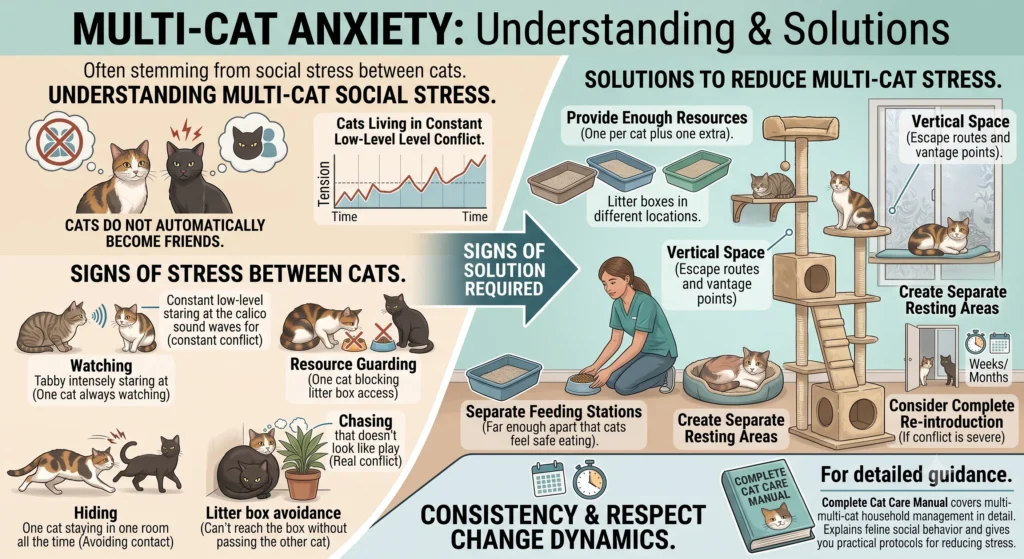
In multi-cat households, anxiety often comes from social stress between cats. Unlike dogs, cats don’t automatically become friends. Some tolerate each other. Some live in constant low-level conflict.
Signs of stress between cats:
- One cat always watching the other
- Cats who won’t eat near each other
- Resource guarding (one cat blocking access to litter boxes or food)
- Chasing that doesn’t look like play
- One cat staying in one room all the time
- Litter box avoidance because the anxious cat can’t reach the box without passing the other cat
How to reduce multi-cat stress:
- Provide enough resources (one per cat plus one extra) in different locations
- Separate feeding stations far enough apart that cats feel safe eating
- Add vertical space for escape routes and vantage points
- Create separate resting areas
- Consider a complete re-introduction if conflict is severe
For detailed guidance on multi-cat dynamics, Complete Cat Care Manual covers multi-cat household management in detail. This book explains feline social behavior and gives you practical protocols for reducing stress between cats.
Expert Quotes on Cat Anxiety
“The most common mistake owners make is assuming their cat’s behavior is just personality when it’s actually anxiety. A cat who hides during parties isn’t antisocial, they’re stressed. Learning the difference between personality and pathology changes everything.”
“You cannot medicate your way out of an inadequate environment. If your cat doesn’t have enough litter boxes, vertical space, and safe retreats, no pill will fix the problem. Environment first. Always.”
“Punishing an anxious cat is one of the worst things you can do. It doesn’t teach them to be less anxious, it teaches them to fear you. And a cat who fears their owner has significantly worse anxiety.”
“Medication is not a failure. When a cat’s anxiety is so severe they can’t eat, can’t use the litter box, or are hurting themselves, medication is compassionate and necessary.”
“The connection between feline anxiety and physical illness is undeniable. Stress-induced cystitis, stress-related aggression, psychogenic alopecia, these are real medical conditions with real physical consequences.”
Mistakes That Make Cat Anxiety Worse
Punishing anxious behavior. Spraying water, yelling, or physically reprimanding a cat for hiding or vocalizing doesn’t fix the problem. It intensifies fear and destroys trust. Your cat learns you’re unpredictable, which makes their anxiety worse.
Forcing interaction. Dragging a hiding cat out from under the bed doesn’t help. It traumatizes them more. Let the cat set the pace.
Missing the subtle signs. By the time you see obvious anxiety, the problem has been building for a long time. Learning to spot early signals like ear rotation and tail flicking lets you intervene sooner.
Skip the vet. Assuming anxiety is purely behavioral without ruling out medical causes leads to months of ineffective treatment. Always get a veterinary exam first.
Expecting instant results. Behavior modification takes time. Pheromone diffusers need weeks. Medication takes 4 to 6 weeks. Patience is essential.
Ignoring the environment. Products and medication without environmental changes treat symptoms while the cause remains. Fix the environment first.
Getting a second cat to help. Sometimes this works. Often it makes things worse, especially with rushed introductions or inadequate resources. Get professional advice first.
For a complete guide to avoiding these mistakes, Cat Behavior Decoded teaches you to read your cat’s signals and respond in ways that build trust instead of fear.
The Lifelong Prevention Plan
Kittens (under 1 year): Socialize early and often. Expose them to different people, animals, surfaces, sounds, and experiences during the critical window (2 to 7 weeks). Handle their paws, mouth, and body regularly. Use positive reinforcement for everything. Build confidence that lasts a lifetime. The Trainable Cat covers kitten socialization protocols in detail.
Adults (1-7 years): Keep up environmental enrichment, consistent routine, and adequate resources. Monitor for subtle behavior changes. Address stressors immediately. Annual vet checkups including behavioral assessment.
Seniors (7+ years): More frequent vet visits. Watch for cognitive dysfunction signs, confusion, disorientation, nighttime yowling. Keep up enrichment even for less active cats. Modify the environment for comfort. Be patient with age-related changes.
When to Get Professional Help
Some situations need more than home management:
- Aggression causing injury to people or other pets
- Severe anxiety that doesn’t improve with environmental changes in 4 to 6 weeks
- Litter box avoidance that persists after medical causes are ruled out
- Self-harm behaviors, over-grooming leading to hair loss or wounds
- Refusal to eat for more than 24 hours
- Any behavior problem putting the cat at risk of rehoming
A veterinary behaviorist can prescribe medication and provide advanced behavior modification. Look for board certification from the American College of Veterinary Behaviorists (ACVB). For less severe cases, a certified cat behavior consultant with IAABC certification can help.
FAQ: Cat Anxiety and Stress
Q: Can cats have panic attacks?
A: Yes. Cats can experience sudden episodes of extreme fear. Signs include hiding, trembling, dilated pupils, rapid breathing, and sometimes aggression. Usually triggered by a specific stressor. If panic episodes happen often, talk to your vet.
Q: How do I know if my cat has anxiety or is just shy?
A: Shyness is a consistent personality trait. Anxiety shows up as changes from normal behavior, physical symptoms, and impacts on eating, grooming, and litter box use. If your cat’s behavior has changed, it’s likely anxiety.
Q: Can cat anxiety be cured?
A: Mild, situational anxiety often resolves with environmental management. Chronic anxiety usually needs ongoing management. Many cats with anxiety live happy lives with proper support.
Q: Is Feliway actually effective?
A: Research shows it reduces urine spraying in up to 90% of cats and decreases stress-related behaviors. Not all cats respond equally, but most improve. Works best for mild to moderate anxiety.
Q: Can I give my cat human anxiety medication?
A: Never. Human medications can be toxic to cats. They metabolize drugs differently. Always consult your veterinarian.
Q: Why is my cat suddenly anxious at night?
A: Nighttime anxiety in cats, especially seniors, can indicate cognitive dysfunction, hyperthyroidism, high blood pressure, or pain. A vet visit is essential to find the cause.
Q: Does catnip help with anxiety?
A: For the 30 to 40% of cats who respond, it can calm them temporarily. For others, it causes excitement. Silver vine works for more cats and tends to be calmer. Neither treats clinical anxiety.
Q: How long does cat anxiety treatment take?
A: Environmental changes help in days to weeks. Feliway takes 7 to 30 days. Supplements take 2 to 4 weeks. Medication takes 4 to 6 weeks. Behavior modification takes weeks to months. Patience is essential.
Q: Can diet affect cat anxiety?
A: Yes. Poor diet can alter brain chemistry. High-quality, balanced food supports optimal brain function. Some veterinary diets include calming supplements.
Q: Should I get a second cat to help my anxious cat?
A: Sometimes this helps, sometimes it backfires. A second cat adds more stress, competition, and conflict risk. Get professional advice before adding another cat.
Q: Can cats outgrow anxiety?
A: Some improve with age, especially if related to poor socialization. Chronic anxiety usually needs ongoing management. Early intervention gives the best results.
Q: Is it okay to comfort an anxious cat?
A: Absolutely. The myth that comforting reinforces fear is wrong. Comforting provides reassurance and strengthens your bond. Just don’t force interaction.
Q: How much does cat anxiety treatment cost?
A: Environmental management is free. Feliway costs $25 to $40. Supplements are $15 to $30 monthly. Vet exams are $100 to $300. Medication is $20 to $60 monthly. Most cats improve with affordable interventions.