

Table of Contents
Cat Separation Anxiety Training Complete Guide to Helping Your Cat Be Alone
You come home from work to find your cat has shredded the curtain by the front door, urinated on your bed, knocked every item off the kitchen counter, or vocalized so loudly that your neighbor left a note asking if your cat is okay. Your cat is not being vindictive or poorly behaved. They are terrified of being alone. Separation anxiety in cats is a condition that causes extreme distress when the cat is separated from their primary caregiver or left alone for extended periods.
Unlike dogs who often destroy furniture or bark excessively, cats with separation anxiety express their distress through inappropriate elimination, excessive vocalization, destructive behavior, over grooming, appetite changes, and withdrawal. The condition is more common than most owners realize, particularly in cats that were orphaned young, bottle fed, adopted from shelters, or have experienced a major routine change like a new job schedule, a move, or a family member leaving.
📚 Recommended Cat Guides
🐱 The Trainable Cat Book
Learn proven methods to train your cat and stop unwanted behaviors.
View Book →❤️ Complete Cat Care Manual
Your complete guide to cat nutrition, health, grooming, behavior, and daily care.
Get the Manual →As a certified veterinary expert and professional cat behaviorist, I have worked with many cats whose separation anxiety was so severe that owners considered rehoming them. In every case, with the right training approach and sometimes medical support, the anxiety improved significantly. The key is understanding that separation anxiety is not a behavioral choice your cat is making. It is a genuine emotional disorder rooted in fear and attachment insecurity.
You cannot punish your way out of separation anxiety, and you cannot ignore it into resolution. The condition requires a systematic approach that gradually teaches your cat that being alone is safe, that you will always return, and that they are capable of coping independently. This guide covers the signs of separation anxiety, why it develops, how to diagnose it properly, the systematic desensitization training process that builds independence, environmental modifications that reduce distress, when medical intervention is appropriate, and long term management strategies that help your cat thrive alone.
Signs of Separation Anxiety in Cats
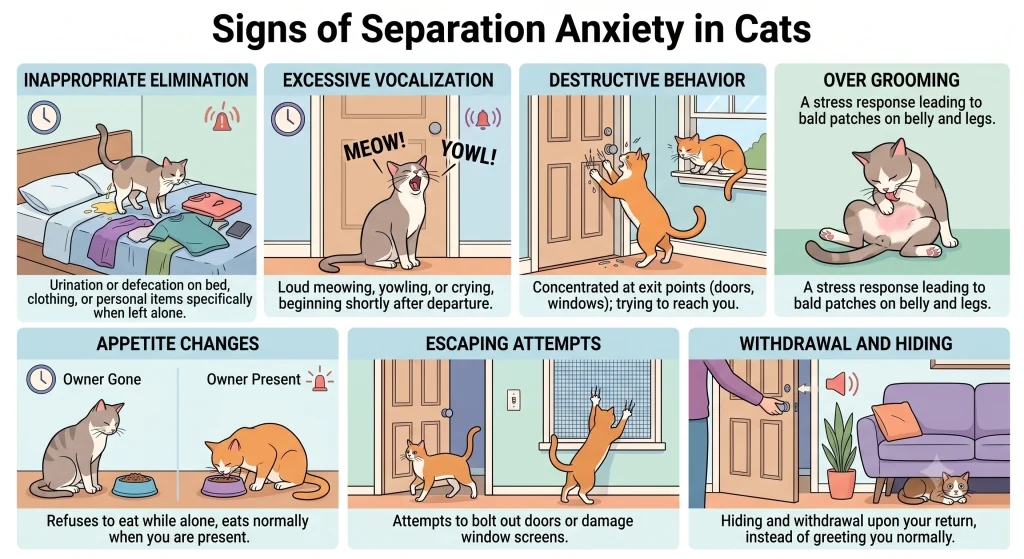
Inappropriate elimination is the most common sign of separation anxiety in cats. A litter box trained cat begins urinating or defecating on your bed, clothing, or personal items specifically when left alone. This is not a litter box problem. It is an anxiety response, and the placement on your personal items reflects the cat’s attachment to your scent. Excessive vocalization, including loud meowing, yowling, or crying that begins shortly after you leave and continues for an extended period, indicates distress.
Destructive behavior concentrated around exit points like doors and windows suggests the cat is trying to reach you or prevent your departure. Over grooming that creates bald patches, particularly on the belly and inner legs, is a stress response that escalates when the cat is alone. Appetite changes, where the cat refuses to eat while you are gone but eats normally when you are present, indicate anxiety affecting normal behavior. Escaping attempts, where the cat tries to bolt out open doors or damage window screens, suggest desperate attempts to follow you. Withdrawal and hiding when you return, rather than greeting you normally, may indicate the cat has been in a prolonged state of distress and has not yet recovered.
Why Separation Anxiety Develops

Separation anxiety develops through several mechanisms. Early weaning or orphaning, where a kitten was separated from their mother and littermates too early, before eight weeks of age, can impair the development of normal independence skills. These cats never learned to self soothe or cope with isolation from their earliest social group. Over attachment, where a cat has become excessively dependent on a single person through constant companionship, can make any separation feel threatening.
Major life changes, including new work schedules that leave the cat alone for the first time, a move to a new home, the addition or loss of a family member, or the loss of another pet, can trigger anxiety in previously stable cats. Traumatic experiences during isolation, such as being trapped in a room, experiencing a loud storm or construction while alone, or being left alone during a frightening event, can create lasting associations between being alone and danger. Some cats have a genetic predisposition to anxiety that manifests as separation distress regardless of their early experiences or life circumstances.
Proper Diagnosis
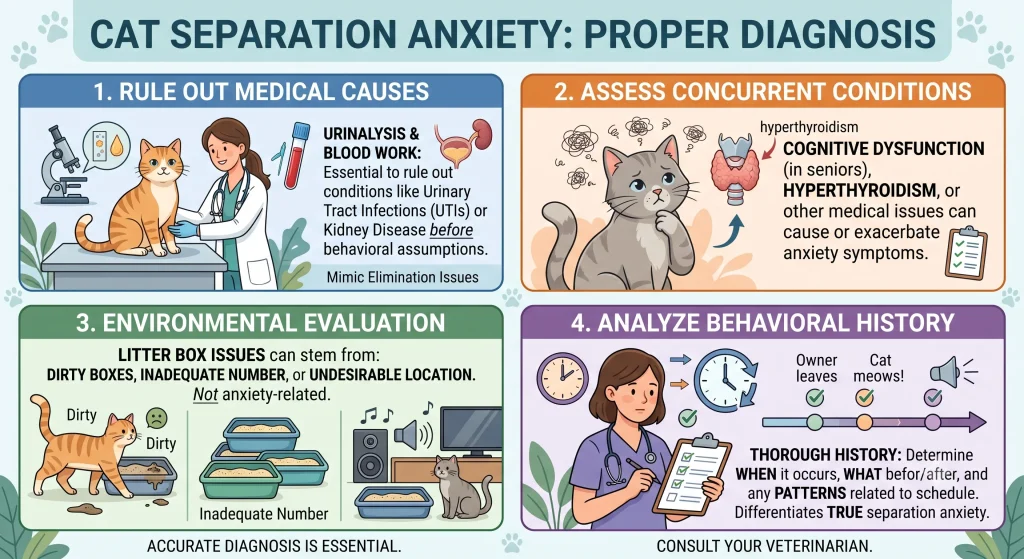
Accurate diagnosis is essential because several conditions mimic separation anxiety. Urinary tract infections, kidney disease, and other medical conditions cause inappropriate elimination that looks identical to anxiety based elimination. A veterinary examination with urinalysis and blood work rules out medical causes before assuming behavioral origins.
Concurrent conditions like cognitive dysfunction in senior cats, hyperthyroidism, or other medical issues can exacerbate or cause anxiety symptoms. Environmental factors like a dirty litter box, inadequate number of litter boxes, or a litter box in an undesirable location can cause elimination problems that are not anxiety related. A thorough behavioral history, including when the behavior occurs, what happens before and after, and any patterns related to your schedule, helps differentiate true separation anxiety from other behavioral issues.
Systematic Desensitization Training
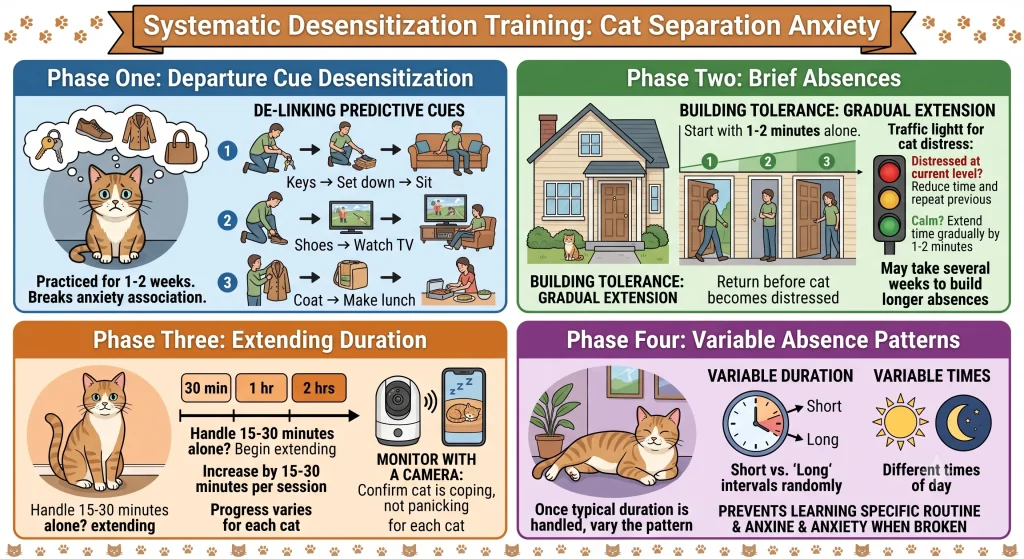
Phase One: Departure Cue Desensitization
Cats with separation anxiety learn to recognize the cues that predict your departure, including picking up keys, putting on shoes, grabbing a coat, or picking up a bag. These cues trigger anxiety before you have even left. Desensitize these cues by performing them randomly throughout the day without leaving. Pick up your keys, set them down, and sit on the couch. Put on your shoes, then watch television. Grab your coat, then make lunch. This teaches your cat that these cues do not always predict departure, breaking the anxiety association. Practice this for one to two weeks before moving to actual departure training.
Phase Two: Brief Absences
Begin leaving your cat alone for very short periods, starting with just one to two minutes. Leave the house, wait outside the door, then return before your cat becomes distressed. Gradually extend the duration by one to two minutes per session over multiple days. The goal is to always return before anxiety peaks, so your cat experiences being alone without reaching panic. If your cat shows distress at any duration, reduce the time and practice more at the previous level. This process requires patience and may take several weeks to build to longer absences.
Phase Three: Extending Duration
Once your cat handles fifteen to thirty minutes alone comfortably, begin extending to longer periods. Increase by fifteen to thirty minutes per session. Some cats progress quickly through this phase while others need many repetitions at each duration before advancing. Monitor your cat through a camera if possible to observe their behavior while alone and confirm they are coping rather than panicking.
Phase Four: Variable Absence Patterns
Once your cat handles your typical absence duration, vary the pattern. Sometimes leave for a short time, sometimes for a long time. Leave at different times of day. This prevents the cat from learning a specific pattern and becoming anxious when the pattern is broken.
Environmental Modifications
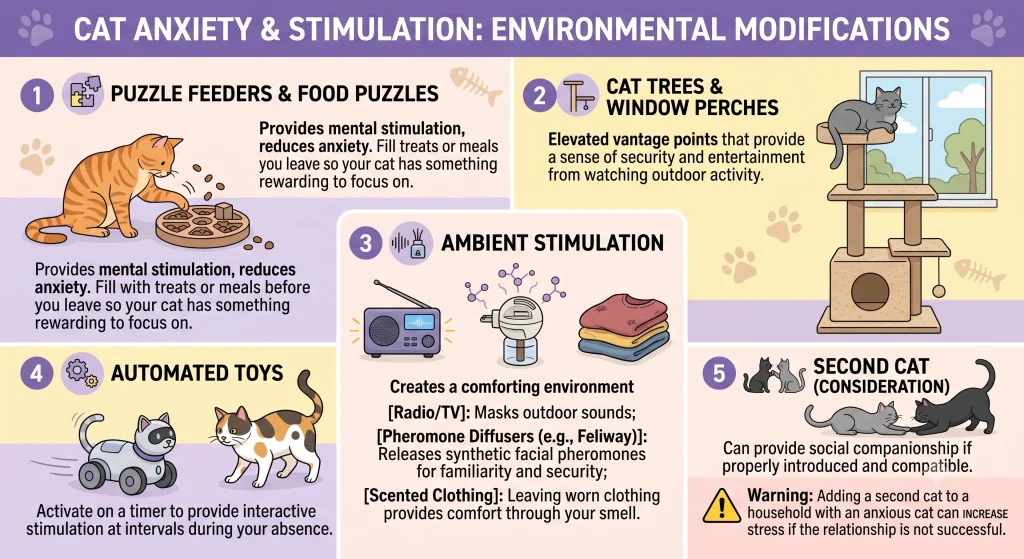
Puzzle feeders and food puzzles occupied your cat’s time and provide mental stimulation that reduces anxiety. Fill them with treats or meals before you leave so your cat has something rewarding to focus on. Cat trees and window perches give your cat elevated vantage points that provide a sense of security and entertainment from watching outdoor activity.
Leaving a radio or television on at low volume provides background noise that masks outdoor sounds and creates ambient stimulation. Pheromone diffusers like Feliway release synthetic facial pheromones that create a sense of familiarity and security. Leaving worn clothing with your scent provides comfort through your smell while you are gone. Automated toys that activate on a timer provide interactive stimulation at intervals during your absence. A second cat, introduced properly and with compatibility confirmed, can provide social companionship that reduces loneliness. However, this only works if both cats get along well. Adding a second cat to a household with an anxious cat can increase stress if the relationship is not successful.
Medical Intervention
Some cats need medical support to reduce anxiety enough for training to be effective. Fluoxetine is a daily medication that reduces anxiety and is commonly prescribed for separation anxiety in cats. It takes four to six weeks to reach full effect and is most effective when combined with behavioral modification. Buspirone is another anxiety medication that may be used for milder cases.
Gabapentin can be used for situational anxiety, such as when you know you will be gone for an unusually long period. Calming supplements containing L theanine, casein derivatives, or other calming agents may help mild cases without prescription medication. Your veterinarian will determine whether medication is appropriate based on the severity of your cat’s anxiety and their overall health.
Expert Tips From My Practice

The most common mistake owners make with separation anxiety is either punishing the behavior or giving in to it by never leaving. Punishing your cat for destructive behavior that occurred while you were gone is completely ineffective because cats cannot connect punishment with past events. They will only become more anxious and fearful. On the other hand, never leaving because your cat cannot cope prevents any progress toward independence.
The effective approach is systematic desensitization combined with environmental support. Leave for very short periods, return before panic, and gradually build up over weeks and months. It is slow, but it works. I also strongly recommend using a camera to monitor your cat while alone so you can make informed decisions about whether they are coping or struggling.
- Never punish separation anxiety behavior. Your cat cannot connect punishment with events that happened while you were gone.
- Start with departure cue desensitization. Break the association between everyday actions and your departure.
- Begin with one to two minute absences. Always return before your cat reaches panic level.
- Use puzzle feeders before leaving. Food puzzles provide positive distraction and mental stimulation.
- Monitor with a camera. Observation helps you make informed decisions about training progress.
- Medication can help training. Fluoxetine reduces anxiety enough for desensitization to work in severe cases.
- Patience is essential. Building independence takes weeks to months, not days.
- Never sneak out. Always say goodbye calmly so your cat does not experience sudden unexpected absence.
FAQ
Do cats really get separation anxiety?
Yes. Separation anxiety in cats is a genuine emotional disorder that causes real distress. It is not attention seeking behavior or a behavioral choice your cat is making.
What are the most common signs of separation anxiety?
Inappropriate elimination on personal items, excessive vocalization after departure, destructive behavior around exits, over grooming, and appetite changes when alone are the most common signs.
Can separation anxiety be cured?
Separation anxiety can be managed effectively with training and sometimes medication. Most cats improve significantly with systematic desensitization, though some may always need management support.
How long does separation anxiety training take?
Building independence typically takes several weeks to months depending on severity. Systematic desensitization requires patience and consistency for lasting results.
Should I get a second cat to help with separation anxiety?
A compatible second cat can provide companionship, but this only works if both cats get along well. An incompatible cat can increase anxiety rather than reduce it.
What medications help separation anxiety in cats?
Fluoxetine is the most commonly prescribed daily medication. Buspirone and gabapentin are alternatives. Supplements with L theanine may help mild cases.
Should I leave the TV on for my anxious cat?
Leaving a radio or television on provides ambient noise that can reduce loneliness and mask outdoor sounds that may trigger anxiety.
Can I crate my cat with separation anxiety?
Crating is generally not recommended for separation anxiety as it can increase panic and cause injury. Open access to the home with safe spaces is preferred.
Is separation anxiety more common in rescue cats?
Rescue cats may be at higher risk due to early life experiences, abandonment, or trauma, but any cat can develop separation anxiety regardless of their background.
When should I see a veterinarian about separation anxiety?
If destructive behavior is severe, inappropriate elimination persists, or your cat shows signs of extreme distress like self harm, schedule a veterinary consultation for assessment and possible medication.