

Table of Contents
Cat Recall Training Complete Guide to Teaching Your Cat to Come When Called
You open the back door to call your cat inside, and they look at you with those half lidded eyes, slowly blink, and then turn away to continue sniffing the bush they were investigating. You call again, louder this time, and they flick an ear in your direction without moving a single muscle. You start shaking the treat bag, and suddenly they materialize at your feet like they teleported. Your cat can hear the treat bag from three rooms away, but they cannot hear you calling their name from ten feet.
This is the universal cat owner experience, and it is exactly why most people believe cats cannot be trained to come when called. The truth is that cats absolutely can learn recall, and many cats learn it faster and more reliably than dogs because of their intense food motivation. The problem is not that cats are untrainable. The problem is that most owners have been accidentally training their cats to ignore their calls for years by calling them for unpleasant experiences like baths, vet visits, or nail trims, while only approaching them for positive experiences like food and petting.
📚 Recommended Cat Guides
🐱 The Trainable Cat Book
Learn proven methods to train your cat and stop unwanted behaviors.
View Book →❤️ Complete Cat Care Manual
Your complete guide to cat nutrition, health, grooming, behavior, and daily care.
Get the Manual →As a certified veterinary expert and professional cat behaviorist, I have taught hundreds of cats reliable recall using positive reinforcement methods that work with feline psychology rather than against it. A cat that comes when called is not only more convenient for you, but significantly safer. Recall can prevent your cat from running out an open door, help you locate a hiding cat during an emergency, and potentially save their life if they escape into an unsafe environment.
This guide covers why cats ignore calls, how to reset their association with their name, the step by step training process that builds reliable recall, how to maintain the behavior long term, troubleshooting common problems, and advanced recall techniques for outdoor cats. Training a cat to come when called is one of the most practical and safety critical skills you can teach.
Why Your Cat Ignores You
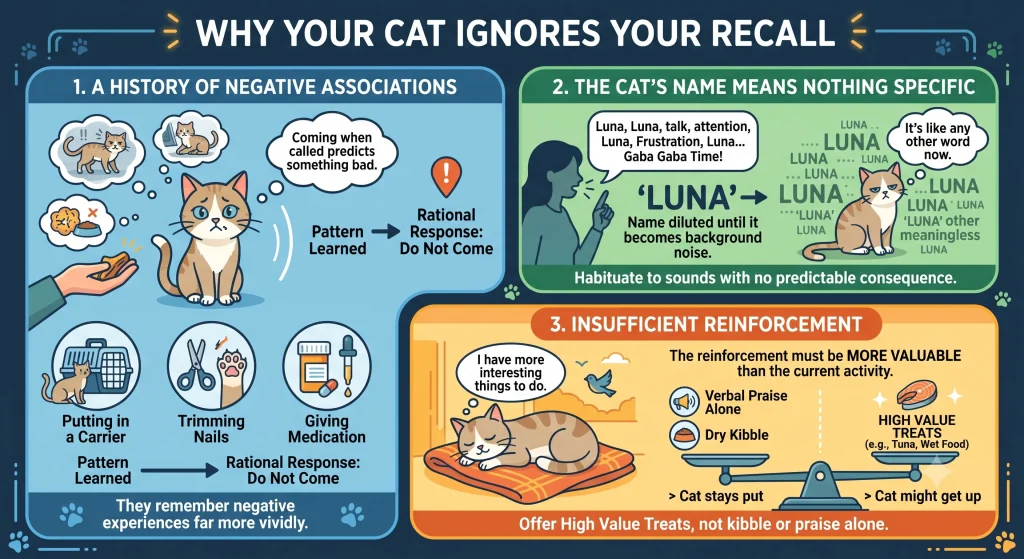
The primary reason cats ignore recall commands is a history of negative associations. If the only time you call your cat is to put them in a carrier, trim their nails, give them medication, or do something they find unpleasant, they quickly learn that coming when called predicts something bad. The rational response is to not come. Cats are excellent at learning patterns, and they remember negative experiences far more vividly than positive ones.
Another reason cats ignore calls is that they have learned their name means nothing specific. Owners who call their cat’s name randomly throughout the day, to get attention, to talk to them, to express frustration, or without any consistent expectation, dilute the meaning of the name until it becomes background noise. Cats habituate to sounds that have no predictable consequence.
If calling your name produces the same result as saying any other word, the cat has no reason to respond to it. Finally, cats are independent creatures who often have more interesting things to do than obey a command. The reinforcement you offer for coming must be more valuable than whatever the cat is currently doing. For most cats, that means high value treats, not dry kibble or verbal praise alone.
Resetting Your Cat’s Name Association
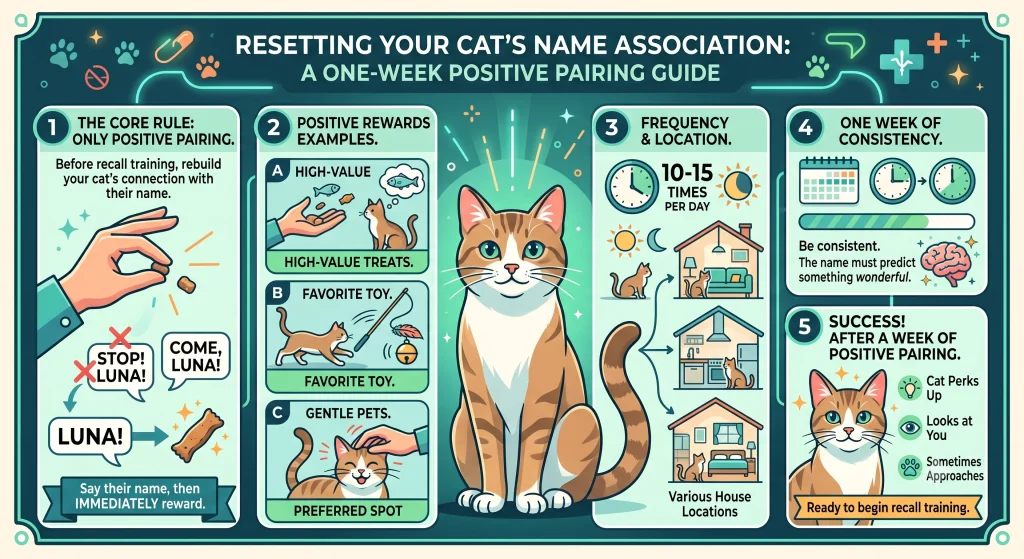
Before starting recall training, you need to rebuild your cat’s association with their name. For the next week, use their name only in connection with something positive. Say their name, then immediately give them a high value treat. Say their name, then offer a favorite toy. Say their name, then give gentle pets in their preferred spot.
Do this at least ten to fifteen times per day in various locations around the house. The goal is to rewire the association so that hearing their name predicts something wonderful is about to happen. During this reset period, do not call your cat’s name to get them to do something, to stop them from doing something, or in any context that might be negative. The name must become a purely positive signal. After a week of consistent positive pairing, your cat should perk up, look at you, and sometimes approach when they hear their name. This indicates the association has reset and you are ready to begin recall training.
Step by Step Recall Training Process
Phase One: Short Distance Indoor Training
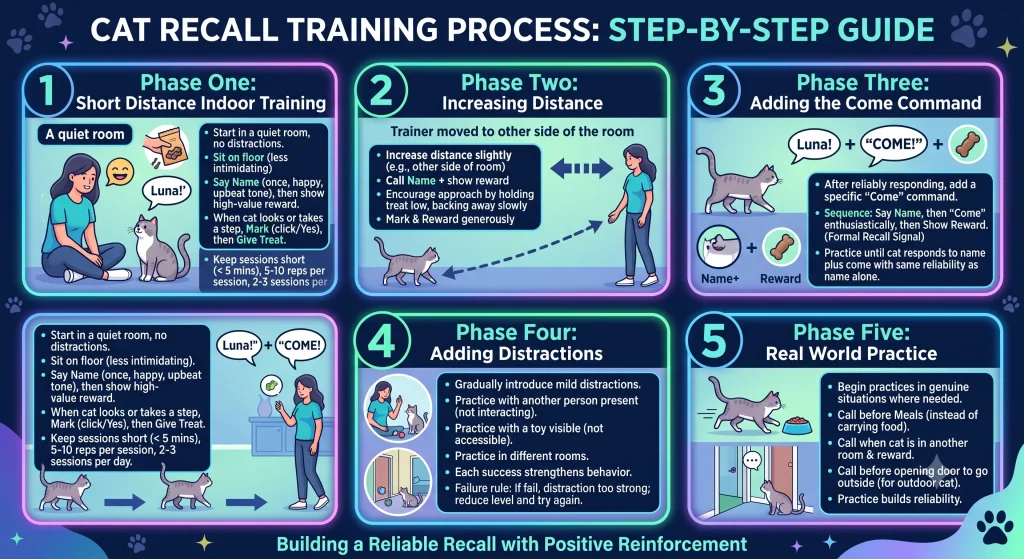
Start training in a quiet room with no distractions. Sit on the floor at your cat’s level, which makes you less intimidating and more approachable. Say your cat’s name once in a happy upbeat tone, then immediately shake a treat or show a high value reward. When your cat looks at you or takes a step toward you, mark that behavior with a clicker or a consistent marker word like yes, then give the treat. Repeat this process five to ten times per session, with two to three sessions per day.
Keep sessions short, under five minutes, because cats have limited attention spans for structured training. In the first few sessions, you are rewarding any response to the name, including just looking at you. This builds the foundation that hearing their name means a reward is available.
Phase Two: Increasing Distance
Once your cat consistently looks at you when they hear their name, increase the distance slightly. Move to the other side of the room and call their name followed by the treat reward. Encourage them to walk toward you by holding the treat low and backing away slowly. As they approach, mark and reward generously. Gradually increase the distance over multiple sessions. If your cat does not respond at the new distance, reduce it back to where they were successful and practice more at that level before advancing. Never increase distance faster than your cat’s skill level supports.
Phase Three: Adding the Come Command
After your cat reliably responds to their name at various indoor distances, add a specific come command. Say their name followed by come in an enthusiastic tone, then show the reward. The sequence is name, command, reward. This two word cue becomes the formal recall signal. Practice this consistently until the cat responds to name plus come with the same reliability as name alone.
Phase Four: Adding Distractions
Gradually introduce mild distractions during training. Practice when another person is present but not interacting with the cat. Practice when a toy is visible but not accessible. Practice in different rooms of the house. Each successful recall in the presence of distractions strengthens the behavior significantly. If your cat fails to respond when a distraction is present, the distraction was too strong. Reduce the distraction level and try again.
Phase Five: Real World Practice
Begin practicing recall in real world situations where you actually need the behavior. Call your cat before meals instead of carrying food to them. Call your cat when they are in another room and reward them for coming to you. Call your cat before opening the door to go outside if they are an outdoor cat. The more you practice in genuine situations, the more reliable the behavior becomes.
Rewards That Work
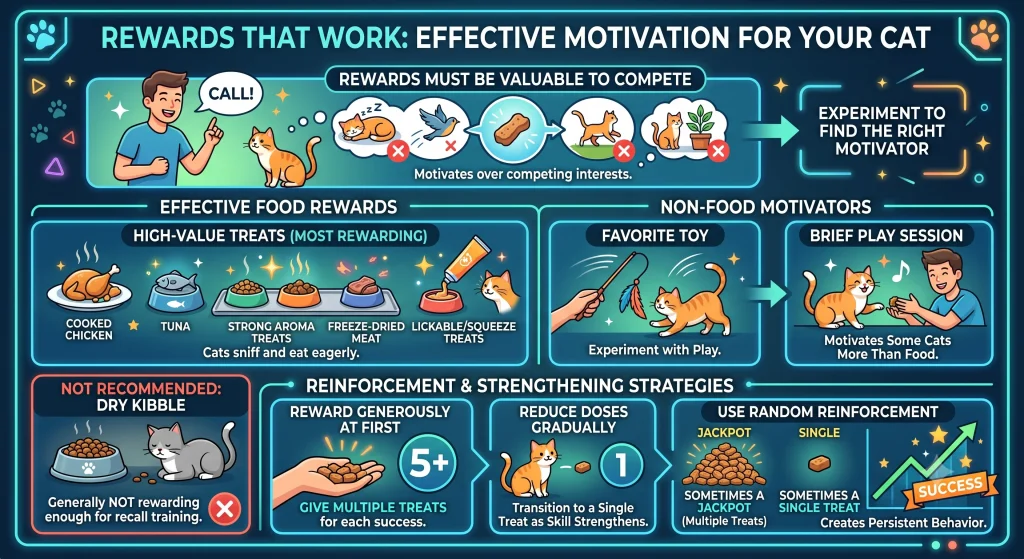
The reward must be valuable enough to compete with whatever your cat was doing before you called them. High value treats include small pieces of cooked chicken, tuna, commercial cat treats with strong aroma, freeze dried meat treats, and lickable squeezable treats. Dry kibble is generally not rewarding enough for recall training.
Some cats respond better to a favorite toy or a brief play session than to food treats. Experiment to find what motivates your individual cat most. Reward generously at first, giving multiple treats for each successful recall, then gradually reduce to a single treat as the behavior strengthens. Random reinforcement, where sometimes the cat gets a jackpot of multiple treats and sometimes a single treat, actually makes the behavior more persistent than consistent single rewards.
Troubleshooting Common Problems
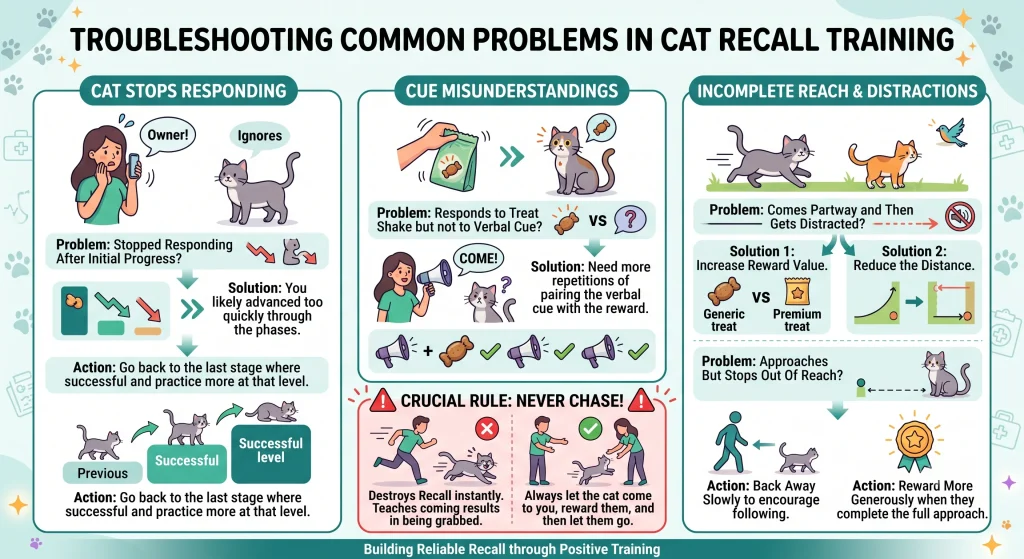
If your cat stops responding after initial progress, you likely advanced too quickly through the phases. Go back to the last stage where they were successful and practice more at that level. If your cat responds to the treat shake but not to the verbal cue, you need more repetitions of pairing the verbal cue with the reward. If your cat comes partway and then gets distracted, the reward needs to be more valuable or the distance needs to be shorter.
If your cat approaches but then stops out of reach, try backing away slowly to encourage following, and reward more generously when they complete the full approach. Never chase your cat to catch them after calling. This teaches them that coming to you results in being grabbed, which destroys recall reliability instantly. Always let the cat come to you, reward them, and then let them go.
Expert Tips From My Practice
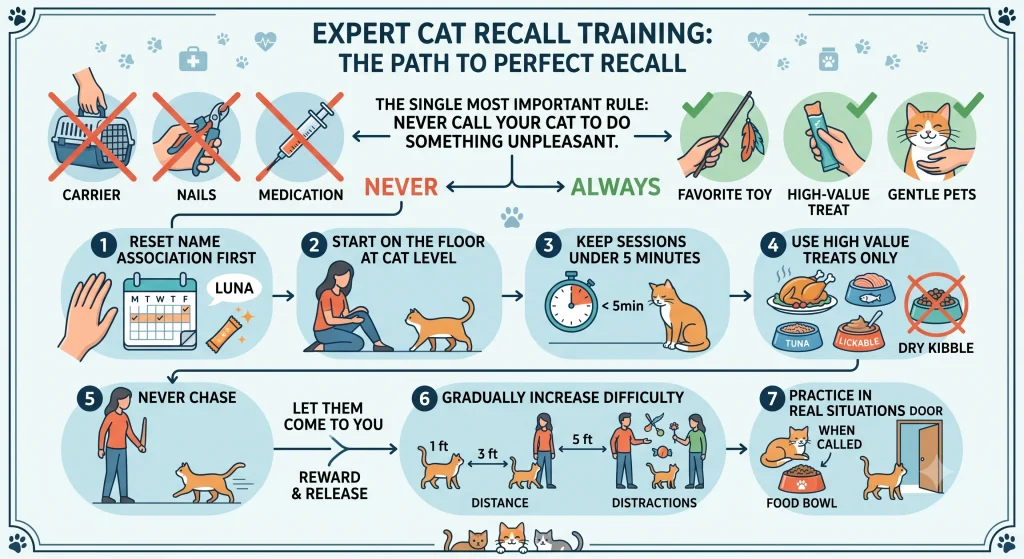
The single most important rule of cat recall training is this: never call your cat to do something unpleasant. If you call your cat and then put them in a carrier, clip their nails, or give them medication, you are actively destroying your recall training. Instead, go get your cat for unpleasant experiences and only call them for wonderful ones.
Over time, your cat will learn that coming when called always results in something great, and they will come running every single time. I have owners who are amazed that their cat comes instantly even when they are outside, and when I ask how they trained it, the answer is always the same. They only ever call their cat for good things. It is that simple and that powerful.
- Reset the name association first. Pair the name with positive experiences for one week before starting recall training.
- Start on the floor at cat level. Sitting on the ground makes you less intimidating and more approachable.
- Keep sessions under five minutes. Cats have limited attention spans for structured training.
- Use high value treats only. Dry kibble is not rewarding enough for recall training.
- Never call for unpleasant experiences. Go get your cat for carrier, nails, or medication instead.
- Never chase your cat. Let them come to you, reward, and release them.
- Gradually increase difficulty. Add distance and distractions slowly as skill improves.
- Practice in real situations. Call before meals, before doors, and during daily routines.
FAQ
Can cats actually be trained to come when called?
Yes. Cats can learn reliable recall using positive reinforcement. Their strong food motivation makes them excellent candidates for this type of training.
How long does it take to train recall?
Most cats show reliable indoor recall within two to four weeks of consistent daily practice. Outdoor reliability may take longer depending on distractions.
What treats work best for recall training?
High value treats with strong aroma work best. Small pieces of cooked chicken, tuna, freeze dried meat, and lickable treats are excellent choices.
Why does my cat ignore me when I call?
Your cat may associate being called with unpleasant experiences, or they may not have learned that their name predicts a reward. Reset the name association before training.
Should I use a clicker for cat recall?
A clicker or consistent marker word like yes helps mark the exact moment of correct behavior. This speeds learning by making the reward timing precise.
Can I train an older cat to come when called?
Yes. Cats of any age can learn recall. Older cats may learn slightly slower than kittens but can achieve the same reliability with patience and consistency.
How do I practice recall outdoors?
Start in a secure enclosed area like a fenced yard. Use a long line or harness initially for safety. Practice with high value rewards and gradually increase distance.
What if my cat comes partway and stops?
The reward may not be valuable enough or the distance too great. Use higher value treats, reduce distance, and back away slowly to encourage following.
Should I call my cat’s name throughout the day?
During training, use the name only when you can reward a response. Random use dilutes the meaning and reduces response reliability.
How do I maintain recall once trained?
Practice regularly in real situations, continue rewarding periodically, and never call your cat for unpleasant experiences. Consistent reinforcement maintains the behavior.