


Table of Contents
Cat Night Behavior Complete Guide to Why Cats Are Active at Night and How to Fix It
You are sound asleep at three in the morning. Suddenly a paw taps your face. Then another paw. Then a full body weight lands on your chest accompanied by loud purring directly in your ear. Your cat is wide awake and wants your attention right now. If you ignore them, the pawing continues, things get knocked off the nightstand, and the yowling begins. You have tried everything.
Feeding later, playing more, locking them out of the bedroom. Nothing works for long. Your cat’s nighttime activity is leaving you exhausted and frustrated. You love your cat, but you also love sleep, and the two seem incompatible. The good news is that this behavior is completely normal for cats, and there are proven strategies to shift their activity patterns without making either of you miserable.
As a certified veterinary expert and professional cat behaviorist, I have helped hundreds of exhausted cat owners reclaim their nights. The most important thing to understand is that your cat is not being spiteful or trying to punish you. They are following instincts that evolved over millions of years, instincts that do not align with your nine to five sleep schedule. Cats are naturally crepuscular, meaning they are most active during dawn and dusk, which are prime hunting times in the wild.
Your three am wake-up call is your cat’s natural hunting instinct telling them that dawn is approaching and it is time to eat, play, and patrol their territory. This guide covers the evolutionary reasons for nighttime activity, the most common reasons your cat wakes you up at night, medical conditions that can cause nighttime restlessness, how to shift your cat’s activity schedule, environmental changes that promote nighttime sleep, and strategies for managing night behavior in multi-cat households. You can sleep through the night again, but it requires understanding your cat’s biology rather than fighting it.
📚 Recommended Cat Guides
🐱 The Trainable Cat Book
Learn proven methods to train your cat and stop unwanted behaviors.
View Book →❤️ Complete Cat Care Manual
Your complete guide to cat nutrition, health, grooming, behavior, and daily care.
Get the Manual →Understanding Your Cat’s Natural Sleep Cycle
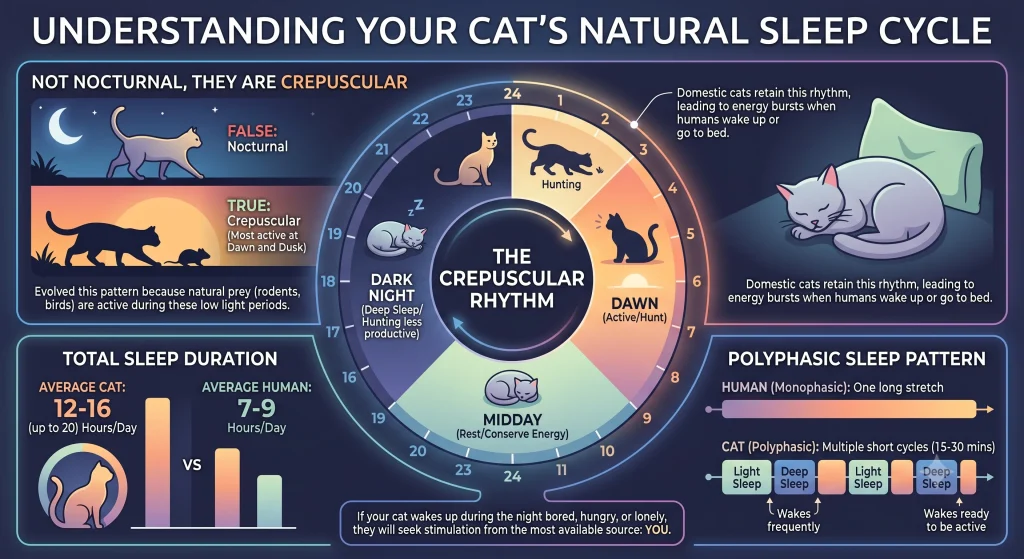
Cats are not nocturnal, though many people assume they are. Cats are crepuscular, which means they are naturally most active during twilight hours at dawn and dusk. This pattern evolved because many of their natural prey species, including rodents and birds, are also active during these low light periods.
Hunting at dawn and dusk gives cats the advantage of low light conditions where their exceptional night vision outperforms their prey’s vision. In the wild, cats spend the middle of the day resting in shaded spots to conserve energy and avoid heat, and they sleep through the darkest part of the night when hunting is less productive. Domestic cats retain this crepuscular rhythm, which explains why your cat is most playful and active right when you are trying to fall asleep or wake up.
Your cat’s sleep cycle is also very different from yours. Cats sleep an average of twelve to sixteen hours per day, with some cats sleeping up to twenty hours. But they do not sleep in one long stretch like humans. They sleep in multiple short cycles of fifteen to thirty minutes, alternating between light sleep and deep sleep throughout the day and night. This polyphasic sleep pattern means your cat wakes up frequently, and when they wake up, they are ready to be active.
Even a cat that seems to sleep all day is actually waking up multiple times, eating, grooming, patrolling, and then going back to sleep. This pattern does not change at night. Your cat will wake up several times during the night, and if they wake up bored, hungry, or lonely, they will seek stimulation from the most available source, which is you.
Common Reasons Cats Wake Owners at Night
Hunger and Feeding Schedule
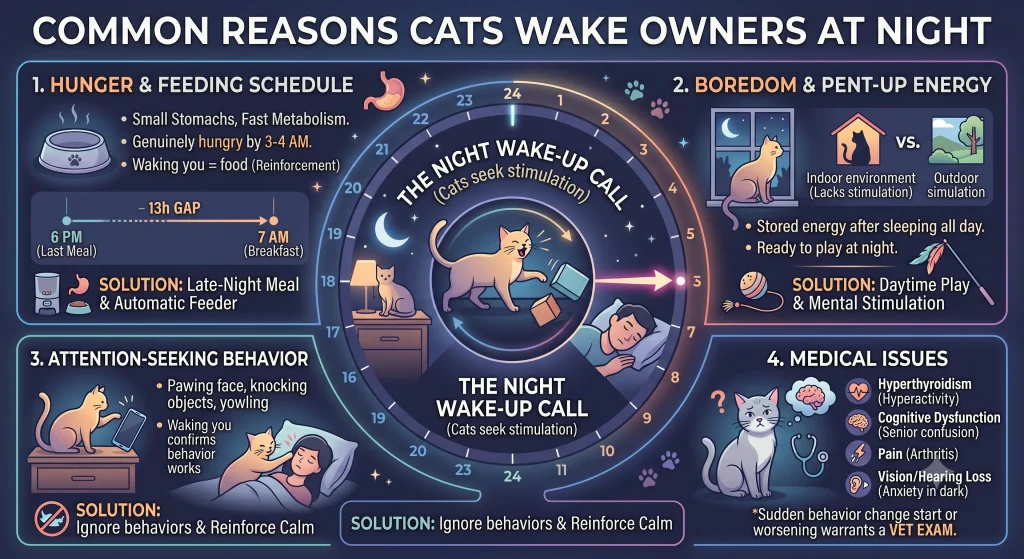
The most common reason cats wake their owners at night is hunger. Cats have small stomachs and fast metabolisms, and they digest food relatively quickly. If your cat’s last meal is at six pm and you do not feed them again until seven am, that is thirteen hours between meals.
Your cat is genuinely hungry by three or four in the morning, and they have learned that waking you up results in food. Even if you do not feed them when they wake you, the act of you waking up, moving, or speaking provides some reinforcement that keeps the behavior going. The solution involves adjusting feeding schedules to include a late night meal and using automatic feeders that remove you from the feeding equation entirely.
Boredom and Pent Up Energy
Cats that do not get enough physical activity and mental stimulation during the day will have energy to burn at night. Indoor cats are particularly prone to nighttime activity because their environment does not provide the natural stimulation that outdoor cats get. A cat that spends the day sleeping while you are at work has stored up energy that needs an outlet. When you go to sleep, the cat is finally ready to play, hunt, and explore. The solution is providing adequate stimulation during your waking hours so your cat is more inclined to sleep when you sleep.
Attention Seeking Behavior
Cats learn quickly what gets your attention. If pawing your face, knocking objects off surfaces, or yowling results in you waking up and interacting with them, even if that interaction is negative, the behavior is reinforced. Cats do not distinguish between positive and negative attention the way humans do. Any response from you confirms that the behavior works. The solution involves ignoring attention seeking behaviors completely while reinforcing calm behaviors during the day.
Medical Issues
Several medical conditions cause increased nighttime activity and restlessness in cats. Hyperthyroidism causes hyperactivity and increased vocalization that is often worse at night. Cognitive dysfunction syndrome in senior cats causes confusion, disorientation, and altered sleep-wake cycles that lead to nighttime wandering and yowling.
Pain from arthritis or other conditions makes it difficult for cats to get comfortable, causing them to move around and vocalize more at night. Vision or hearing loss can cause disorientation and anxiety that worsens at night when the house is dark and quiet. If your cat’s nighttime behavior starts suddenly or worsens progressively, a veterinary examination is warranted to rule out medical causes.
How to Shift Your Cat’s Activity Schedule
Increase Daytime Activity
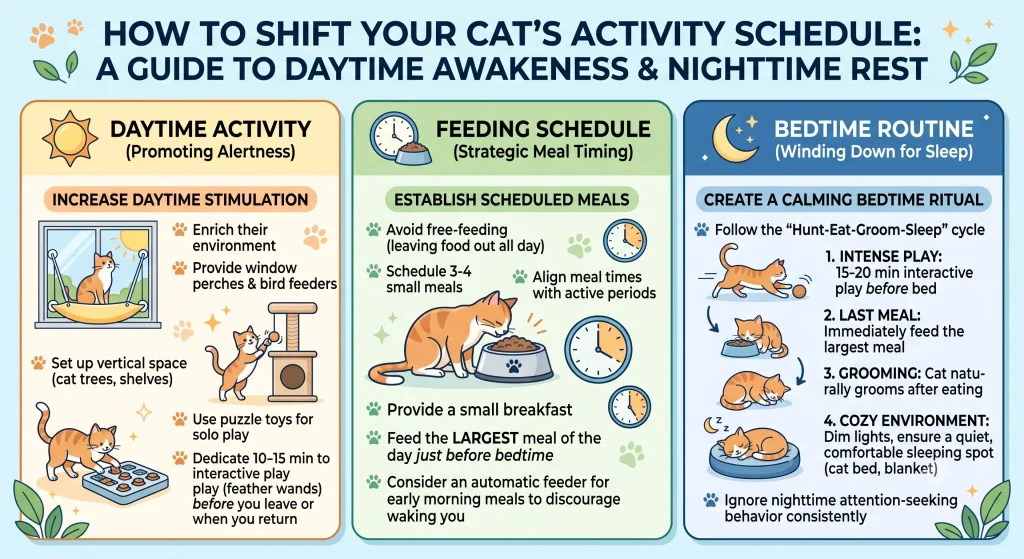
Your cat needs adequate physical and mental stimulation during the day to be tired at night. Schedule at least two dedicated play sessions of ten to fifteen minutes each during your waking hours. Use wand toys that mimic prey movements, encouraging your cat to run, jump, and pounce. The goal is to simulate a successful hunt, which means letting your cat catch the toy at the end of each session. Follow play sessions with a small meal, which mimics the natural hunt-eat-groom-sleep cycle that leads to restful sleep. Interactive puzzle toys and food dispensing toys provide mental stimulation during the day when you are not available to play directly.
Adjust Feeding Schedule
Feeding your cat a substantial meal right before your bedtime can help them sleep longer through the night. Cats digest food and then enter a restful state, similar to the post-meal sleepiness humans experience. A late night feeding, ideally within an hour of your bedtime, provides the calories that sustain your cat through the night and triggers the post-meal relaxation response. If your cat wakes you early in the morning for food, consider an automatic feeder that dispenses a small meal at a set time in the early morning. The feeder becomes the source of food rather than you, which breaks the association between waking you and getting fed.
Create a Bedtime Routine
Cats thrive on predictability. Establishing a consistent bedtime routine signals to your cat that it is time to settle down. The routine might include a play session, followed by a meal, followed by quiet time with gentle brushing or petting. Perform the routine at the same time every night, even on weekends, to establish a predictable pattern. Over time, your cat will learn that the routine leads to a period of quiet and rest. Consistency is more important than the specific activities in the routine.
Environmental Changes That Promote Nighttime Sleep
- Provide nighttime enrichment. Leave out puzzle feeders, treat balls, or food dispensing toys that your cat can interact with independently during the night. These provide entertainment without requiring your participation.
- Create comfortable sleeping areas. Provide cozy, warm sleeping spots in quiet areas away from household noise. Heated cat beds are particularly appealing and encourage extended sleep periods.
- Close blinds or curtains. Outdoor lights, streetlights, and headlights can stimulate your cat’s hunting instincts through windows. Closing blinds reduces visual stimulation during the night.
- Use white noise or calming music. Background noise masks household sounds and outdoor noises that might wake your cat. Calming music designed for cats can promote relaxation.
- Consider a companion cat. In some cases, a second cat provides social stimulation and play that reduces nighttime attention seeking. However, this is not a guaranteed solution and can create new challenges in multi-cat households.
- Lock the bedroom door. If nothing else works, closing your cat out of the bedroom can protect your sleep. Prepare for an adjustment period where your cat may yowl or scratch at the door. Ignore this behavior completely, and it will typically resolve within one to two weeks.
Managing Nighttime Vocalization
Nighttime yowling is one of the most distressing night behaviors for owners. Some cats vocalize at night due to medical conditions including hyperthyroidism, cognitive dysfunction, or hearing loss. Senior cats are particularly prone to nighttime vocalization.
If medical causes are ruled out, the approach to managing vocalization involves ignoring the behavior completely while reinforcing quiet behavior during the day. Any response to yowling, even a negative one like shouting or getting up, reinforces that yowling produces attention. Give your cat attention and treats during quiet periods while completely ignoring yowling episodes. This may initially cause an extinction burst where the yowling gets worse before it gets better. Stay consistent, and the behavior will eventually decrease.
Expert Tips From My Practice
The most successful strategy I recommend for nighttime activity is the automatic feeder. I have seen cases where owners tried everything, play, feeding late, ignoring behavior, and nothing worked long term. The moment they set up an automatic feeder to dispense a small meal at four in the morning, the cat stopped waking them. The cat learned that food comes from the machine, not from waking the human. It removes you from the equation entirely. If you take one piece of advice from this guide, let it be this: an automatic feeder is worth every penny for reclaiming your sleep.
- Do not feed your cat when they wake you. This reinforces the behavior. Use automatic feeders instead.
- Ignore attention seeking at night completely. Any response reinforces the behavior, even negative responses.
- Play before bed is essential. A tired cat sleeps better. Schedule active play within an hour of bedtime.
- Rule out medical causes first. Sudden nighttime activity changes warrant a veterinary check.
- Be patient with the adjustment period. Changing habits takes weeks, not days.
- Automatic feeders are a game changer. They remove you from the feeding equation entirely.
- Senior cats with night vocalization need veterinary evaluation. Cognitive dysfunction and hyperthyroidism are treatable.
- Consistency matters more than intensity. A moderate routine followed every night works better than an intense routine followed sporadically.
FAQ
Why is my cat so active at night?
Cats are naturally crepuscular, meaning they are most active during dawn and dusk. This instinct comes from their wild ancestors who hunted during low light periods. Indoor cats with pent up energy are particularly prone to nighttime activity.
How do I get my cat to sleep through the night?
Increase daytime activity, provide a late night meal, establish a consistent bedtime routine, and use automatic feeders for early morning meals. Environmental enrichment during the night also helps keep cats occupied without waking you.
Why does my cat wake me up at 3 am every day?
Your cat has likely learned that waking you at this time results in attention, food, or interaction. Hunger, boredom, and habit all contribute. An automatic feeder set to dispense food at this time can break the cycle.
Is it normal for cats to yowl at night?
Occasional yowling is normal, but persistent nighttime yowling warrants investigation. Medical causes including hyperthyroidism, cognitive dysfunction, and hearing loss are common in senior cats. Behavioral causes include boredom and attention seeking.
Can I train my cat to sleep at night?
Yes, you can shift your cat’s activity schedule through consistent routines, increased daytime stimulation, and adjusted feeding schedules. It takes time and patience, but most cats adapt to sleeping more during the night.
Should I lock my cat out of the bedroom at night?
If nighttime activity is disrupting your sleep, locking your cat out is reasonable. Prepare for an adjustment period of one to two weeks. Provide enrichment in the area outside your bedroom to keep your cat occupied.
Why is my senior cat suddenly active at night?
Senior cats with hyperthyroidism, cognitive dysfunction, vision loss, or hearing loss often develop altered sleep-wake cycles and increased nighttime activity. A veterinary examination is essential to identify and treat underlying medical causes.
Does my cat need a companion to stop nighttime activity?
A companion cat can help in some cases by providing social stimulation and play, but it is not a guaranteed solution. Some cats become more active with a companion. Consider this option carefully before adopting another cat.
How long does it take to change a cat’s night behavior?
Most cats show improvement within two to four weeks of consistent routine changes. Complete behavior change may take six to eight weeks. Consistency is the most important factor for success.
Can automatic feeders really help with nighttime waking?
Yes, automatic feeders are one of the most effective solutions for early morning waking. When the feeder dispenses food at a set time, the cat learns that food comes from the machine, not from waking you. Most cats adjust within a few days.