

Table of Contents
Cat Aggression Complete Guide to Causes, Types, and Proven Solutions
Your cat was purring in your lap one moment. The next moment they bit your hand hard enough to draw blood. You pulled away and they lunged again, ears flat, pupils dilated, tail lashing.
You feel confused, hurt, and maybe a little betrayed. The cat you love just attacked you for no reason you can identify. You wonder if your cat is dangerous, if something is wrong with them, or if you did something wrong without realizing it. The truth is that aggression in cats is almost never random. It is a response to something specific, a trigger that you and your cat may not even recognize as the cause. Understanding what that trigger is transforms a frightening situation into a solvable problem.
As a certified veterinary expert and professional cat behaviorist, I have worked with hundreds of aggressive cats and their frustrated owners. Almost every case of aggression resolves once the underlying cause is identified and addressed. The problem is not that cats are unpredictable or mean, it is that we misunderstand their communication signals and miss the warnings they give before escalating to aggression.
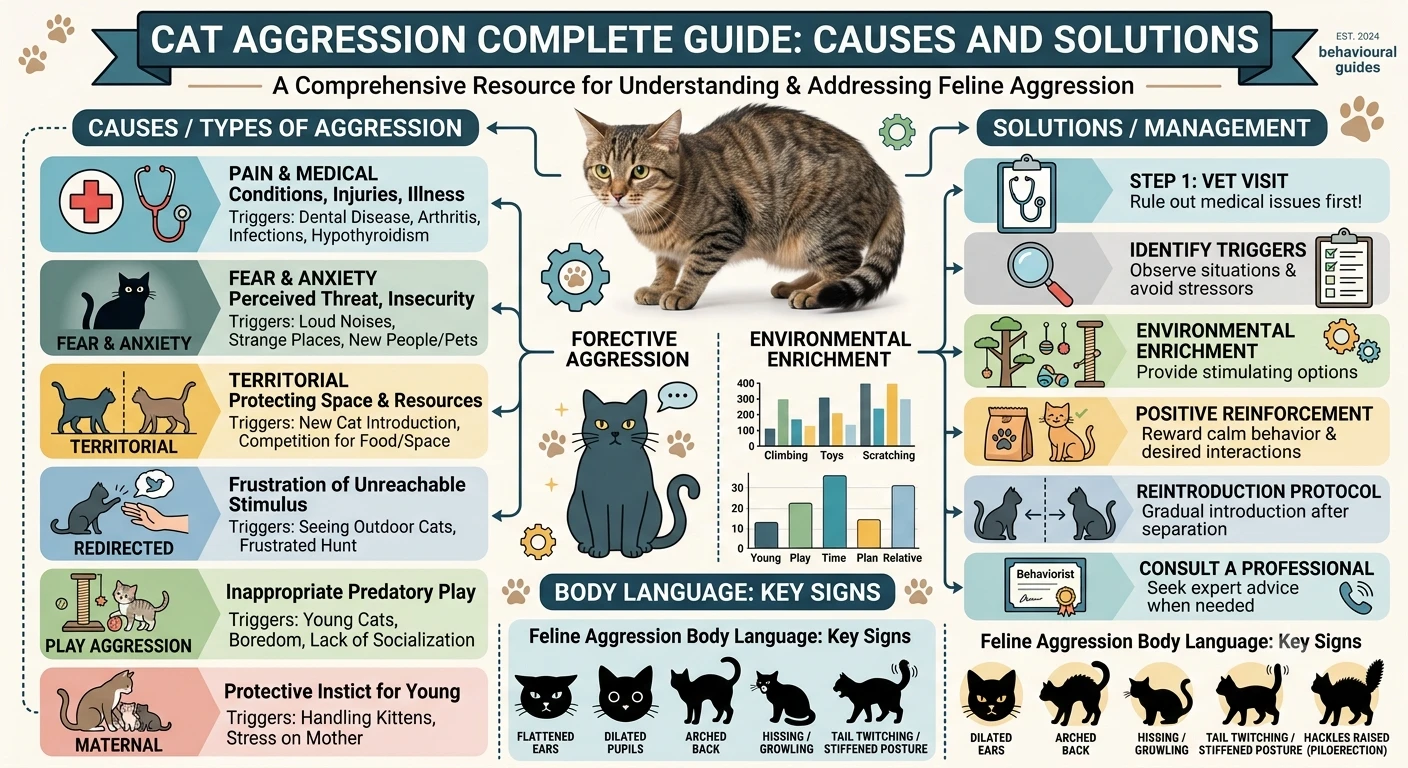
This guide covers every major type of cat aggression, the specific triggers for each type, how to read the warning signs your cat gives before they bite or scratch, immediate steps to stop aggression safely, long term behavior modification strategies, and when aggression signals an underlying medical problem that requires veterinary attention. You can live peacefully with your cat again, but first you need to understand what the aggression is actually telling you.
📚 Recommended Cat Guides
🐱 The Trainable Cat Book
Learn proven methods to train your cat and stop unwanted behaviors.
View Book →❤️ Complete Cat Care Manual
Your complete guide to cat nutrition, health, grooming, behavior, and daily care.
Get the Manual →Understanding Why Cats Become Aggressive
Aggression in cats is a normal communication tool, not a sign of a bad cat or a bad owner. In the wild, aggression serves essential functions including defending territory, protecting resources, establishing social hierarchies, and self-defense against threats.
Domestic cats retain these instincts, and aggression occurs when they perceive a threat, feel cornered, experience pain, or fail to understand a social situation. The key to resolving aggression is recognizing that the cat is not being malicious. They are communicating distress in the only language they have. Your job is to understand what they are saying and address the underlying cause rather than punishing the symptom.
The Aggression Threshold
Every cat has an aggression threshold, the point at which they switch from warning signals to active aggression. Some cats have high thresholds and tolerate significant handling or stress before reacting. Others have low thresholds and escalate quickly with minimal provocation. Understanding your cat’s individual threshold allows you to manage interactions to stay below that threshold. Factors that lower the threshold, making aggression more likely, include pain, illness, fear, previous negative experiences, lack of socialization, and environmental stress. Cats with low thresholds are not bad cats. They are cats that need their triggers managed more carefully.
Types of Cat Aggression
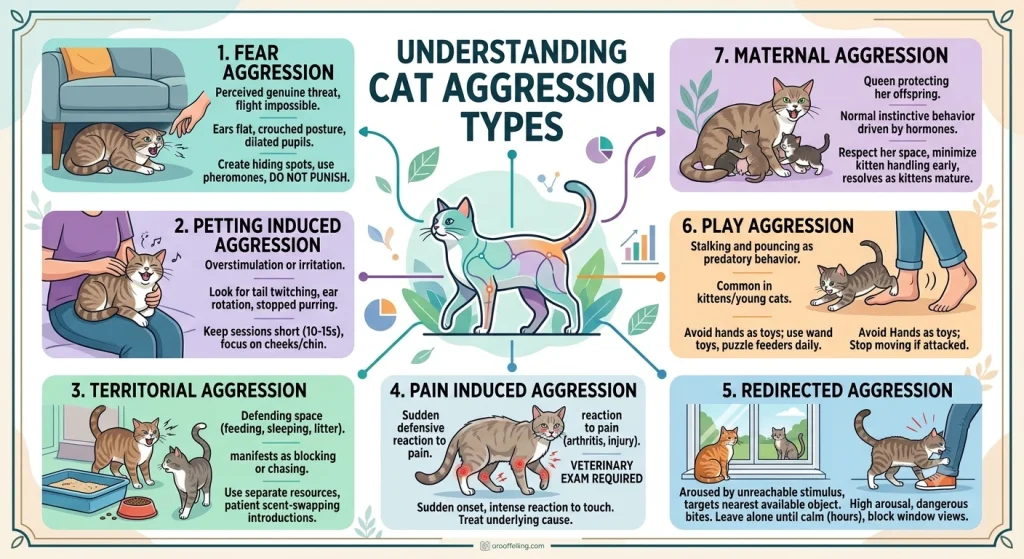
Petting Induced Aggression
This is one of the most common types of aggression cat owners experience and one of the most confusing. Your cat approaches you, rubs against you, jumps on your lap, and purrs while you pet them. Then suddenly, without obvious warning, they bite your hand, scratch, and jump off.
This is not random. Petting induced aggression occurs when petting becomes overstimulating. Cats have sensitive skin and hair follicles that can become irritated with prolonged petting. What starts as pleasurable becomes uncomfortable and then painful. The cat gives subtle warning signals including tail twitching, ear rotation, skin rippling, and stopped purring. When those signals are ignored, the cat escalates to biting to make the discomfort stop.
To manage petting induced aggression, learn to read your cat’s early warning signals. Stop petting at the first sign of tail twitching or ear movement. Focus petting on areas cats typically enjoy, the cheeks, chin, and base of the ears, and avoid the belly, tail, and paws unless your cat specifically invites touch there. Keep petting sessions short, typically ten to fifteen seconds for sensitive cats, and let the cat initiate and end interactions. If your cat shows signs of overstimulation, stop immediately and allow them to leave. Do not chase them for more petting or try to hold them in place.
Fear Aggression
Fear aggression occurs when a cat perceives a genuine threat and cannot escape. The cat’s instinct is to flee from danger, but when flight is impossible, they switch to fight. Fear aggression is common in rescue cats with limited socialization, cats that have experienced trauma, and cats in unfamiliar environments. The cat’s body language signals fear clearly: ears flattened sideways or back, dilated pupils, crouched posture with weight shifted away from the threat, tail tucked or puffed, hissing, and growling. A fearful cat will bite or scratch any target that approaches, including their beloved owner, because survival instinct overrides recognition.
Management of fear aggression focuses on removing the perceived threat and giving the cat space to recover. Never punish a fearful cat, which confirms that you are a threat. Create hiding spots where the cat can retreat safely. Use calming pheromone diffusers and supplements to reduce baseline anxiety. For cats with chronic fear, systematic desensitization gradually exposes them to feared stimuli at very low intensity while pairing with positive experiences like treats. This process takes weeks to months and works best with professional guidance.
Play Aggression
Play aggression looks like stalking, pouncing, and biting that occurs during interactive play or when a cat is bored. It is most common in kittens and young adult cats that did not learn appropriate play inhibition from their mother and littermates. Play aggression is not true aggression in the sense of fear or anger. It is an expression of natural predatory behavior directed at an inappropriate target, usually the owner’s hands, feet, or ankles. The cat is not trying to hurt you. They are practicing hunting skills and your moving body parts are the most exciting target available.
Redirect play aggression by never using hands or feet as play toys. Always use wand toys, fishing pole toys, or laser pointers to engage your cat’s hunting instincts at a distance. Provide at least two dedicated play sessions of ten to fifteen minutes daily. If your cat attacks your feet while you walk, stop moving immediately, which removes the exciting stimulus. Toss a toy away from you to redirect the chase impulse. Interactive puzzle toys and food dispensing toys provide mental stimulation that reduces pent up predatory energy between play sessions.
Redirected Aggression
Redirected aggression occurs when a cat is aroused to an aggressive state by one stimulus but cannot reach that stimulus, so they redirect the aggression toward the nearest available target, often another pet or a human family member. Common triggers include seeing another cat outside through a window, hearing a loud noise, smelling unfamiliar animals on your clothing, or experiencing a frightening event. The cat is highly aroused and will attack anyone who approaches, including people they normally love. This type of aggression is particularly dangerous because the arousal level is so high that the cat may bite repeatedly and with full force.
If redirected aggression occurs, leave the cat completely alone until they calm down, which may take hours or even a day. Do not attempt to soothe, approach, or interact with the cat during this period. Once the cat is calm, identify and address the trigger. Block window views that allow your cat to see outdoor cats. Use opaque window film or keep curtains closed in rooms where your cat spends time. If the trigger was an outdoor cat, use motion activated sprinklers or ultrasonic devices to discourage that cat from approaching. In multi-cat households, separated cats must be reintroduced gradually after a redirected aggression incident, often requiring a full reintroduction protocol over several weeks.
Territorial Aggression
Territorial aggression occurs when a cat perceives an intruder in their territory, whether that intruder is a new cat being introduced to the household, a visiting animal, or even a human family member. Cats are territorial by nature, and they defend spaces they consider their own including sleeping areas, feeding stations, and litter box locations. Territorial aggression manifests as blocking access to areas, hissing, swatting, and chasing the perceived intruder. It is most common in multi-cat households but can occur toward new people moving into the home.
Managing territorial aggression requires slow, controlled introductions. Never force two cats together and expect them to resolve their differences. Use scent swapping by exchanging bedding and toys before visual introductions. Feed cats on opposite sides of a door so they associate positive experiences with each other’s presence. Provide multiple resources including separate food bowls, water stations, litter boxes, and resting areas so cats do not compete for access. While the book Cat Behavior Decoded explains feline territorial dynamics in depth, in my practice the most important principle is patience. Territorial introductions take weeks, not days.
Pain Induced Aggression
Pain induced aggression occurs when a cat in pain reacts defensively to being touched or approached. This is a survival mechanism designed to prevent further injury. Arthritis, dental disease, urinary tract infections, injuries, and post-surgical pain are common causes. A cat in pain may appear fine at rest but react aggressively when touched in a painful area. The aggression is often sudden and intense, with the cat biting or scratching and then immediately fleeing or hiding. This type of aggression is particularly concerning because the owner often does not know the cat is in pain.
Any sudden onset of aggression in a previously friendly cat warrants a veterinary examination to rule out pain. This is especially true for senior cats, cats with chronic health conditions, and cats that show other signs of pain including decreased activity, changes in appetite, hiding, or altered grooming. Treating the underlying pain typically resolves the aggression. Pain management may include medications, joint supplements, weight management, and environmental modifications like providing soft bedding, ramps, and easily accessible resources.
Maternal Aggression
Maternal aggression occurs in mother cats protecting their kittens. This is a normal, instinctive behavior that typically resolves as kittens mature and become independent. The mother cat may hiss, growl, swat, or bite anyone who approaches her kittens, including familiar humans and other pets. The aggression is driven by hormones and the powerful maternal drive to protect offspring. Respect the mother cat’s space, minimize handling of kittens during the first two to three weeks, and allow the mother to control interactions. This aggression resolves naturally as kittens grow and the mother’s protective drive decreases.
Medical Causes of Aggression
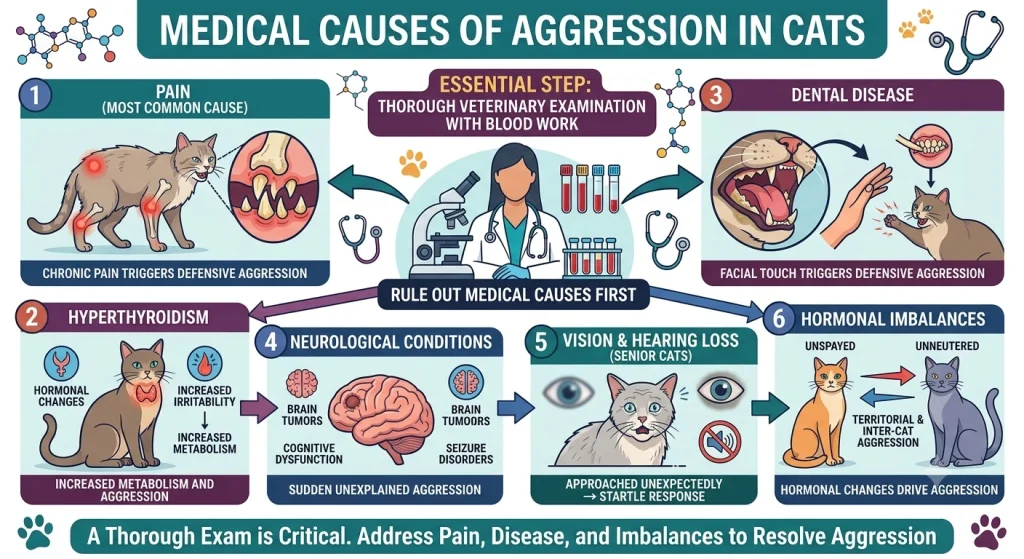
Before implementing any behavior modification plan, rule out medical causes. Pain, as discussed above, is the most common medical cause of aggression. Additional medical causes include hyperthyroidism, which causes hormonal changes that increase irritability and aggression. Dental disease causes chronic pain that triggers defensive aggression when the face or head is touched.
Neurological conditions including brain tumors, cognitive dysfunction, and seizure disorders can cause sudden unexplained aggression. Vision and hearing loss, common in senior cats, cause startle responses that lead to aggression when the cat is approached unexpectedly. Hormonal imbalances in unspayed or unneutered cats contribute to aggression, particularly territorial and inter-cat aggression. A thorough veterinary examination with blood work is essential for any cat with new or worsening aggression.
How to Respond to Aggression Safely
- Do not punish the cat. Punishment increases fear and anxiety, making aggression worse. Cats do not connect punishment with their behavior, only with the person delivering it.
- Stop what you are doing. If a cat shows aggression, freeze and remove the triggering stimulus if possible. Moving away slowly reduces the perceived threat.
- Do not make direct eye contact. Staring is a threat signal in cat body language. Look away or close your eyes partially to signal non-threat.
- Give the cat space to retreat. Ensure the cat has an escape route and a safe hiding place. Cornered cats are more likely to attack.
- Do not reach for the cat. Reaching toward an aggressive cat, even to comfort them, can trigger biting. Let the cat approach you when they are ready.
- Wash and treat bites immediately. Cat bites carry significant infection risk due to the bacteria in cat saliva. Wash thoroughly with soap and water and seek medical attention for any bite that breaks skin.
- Identify and address triggers. After the cat calms down, analyze what triggered the aggression. Identifying the trigger prevents future incidents.
- Consult professionals for severe aggression. Aggression that causes injury, occurs frequently, or involves multiple household members warrants professional help from a veterinarian and a certified behaviorist.
Long Term Behavior Modification
Desensitization and Counterconditioning
Desensitization involves exposing the cat to the aggression trigger at such a low intensity that they do not react fearfully, then gradually increasing intensity over multiple sessions. Counterconditioning pairs that trigger exposure with something positive, usually high value treats, to change the cat’s emotional response. For example, a cat aggressive toward other cats might start by seeing the other cat at a great distance through a cracked door while receiving treats, with the distance gradually decreasing over weeks. This process requires patience and consistency. Rushing triggers setbacks that require starting from scratch.
Environmental Modification
Modifying the environment reduces stress and prevents aggression triggers. Provide vertical space including cat trees, shelves, and window perches that allow cats to observe from safe heights. Create multiple hiding spots where cats can retreat when overwhelmed. Use Feliway pheromone diffusers to create a calming environment. Establish predictable routines for feeding, play, and interaction because predictability reduces anxiety. Provide appropriate outlets for natural behaviors including scratching posts, puzzle feeders, and interactive toys.
Medication Options
In some cases, medication helps reduce anxiety and aggression enough that behavior modification can be effective. Medications including fluoxetine, trazodone, gabapentin, and amitriptyline are used in cats for aggression and anxiety management. These medications are not cures but tools that lower the cat’s baseline anxiety, allowing behavior modification to work. Medication decisions should be made with your veterinarian and ideally under the guidance of a veterinary behaviorist. Never give your cat any medication without veterinary prescription and supervision.
Expert Tips From My Practice
The most important lesson I teach owners about aggression is that the bite is never the beginning of the story. It is the end. There are always warning signals before the bite, but most owners miss them because cat body language is subtle and easy to misinterpret. The tail twitch, the ear rotation, the skin ripple, the sudden stillness. These signals happen seconds to minutes before the bite. If I can teach you to recognize those signals, I can prevent ninety percent of aggression incidents in your household. Your cat is not hiding their feelings. They are broadcasting them clearly. You just need to learn the language.
- Always rule out pain first. Sudden aggression in a previously friendly cat is a veterinary emergency until proven otherwise. Pain is the most common cause and the most treatable.
- Never physically punish aggression. Physical punishment confirms to the cat that you are a threat and makes aggression worse. It damages trust permanently.
- Respect the cat’s communication. When a cat gives warning signals, believe them. Pushing past warnings teaches the cat that subtle signals do not work, so they skip straight to biting.
- Provide appropriate outlets. Aggression often results from unmet needs. Providing appropriate hunting, climbing, scratching, and play outlets reduces frustration based aggression.
- Keep a behavior journal. Record each aggression incident including time, location, trigger, body language leading up to the incident, and what happened afterward. Patterns emerge that identify specific triggers.
- Be patient with progress. Behavior modification takes weeks to months. Rushing causes setbacks. Celebrate small improvements like the cat staying calm one second longer than last week.
- Know when to get help. Aggression that causes injury, involves multiple family members, or persists despite environmental changes requires professional intervention. There is no shame in seeking help.
FAQ
Why does my cat suddenly attack me for no reason?
There is always a reason, even if it is not obvious. Common causes include pain, fear, redirected aggression from seeing something outside, overstimulation from petting, or medical conditions. A veterinary examination is the first step for sudden unexplained aggression.
How do I stop my cat from being aggressive?
Identify the specific type of aggression and address the underlying cause. This may involve pain treatment, environmental modification, behavior modification through desensitization and counterconditioning, or medication. Punishment does not work and makes aggression worse.
What is petting induced aggression in cats?
Petting induced aggression occurs when petting becomes overstimulating or uncomfortable. The cat initially enjoys contact but reaches a threshold where it becomes unpleasant and responds by biting. Learning to read early warning signals prevents these incidents.
Can cats be aggressive due to medical issues?
Yes. Pain, hyperthyroidism, dental disease, neurological conditions, vision loss, hearing loss, and hormonal imbalances all cause aggression. Any sudden behavior change warrants veterinary examination before behavior modification.
How do I introduce a new cat to an aggressive cat?
Use slow, controlled introductions over weeks using scent swapping, feeding on opposite sides of a door, gradual visual exposure through barriers, and supervised short meetings. Never force interactions or expect cats to work things out on their own.
Why is my cat aggressive only toward certain people?
Cat aggression toward specific people usually results from fear based on that person’s appearance, voice, scent, or past interactions. The person may move differently, smell like another animal, or have previously frightened the cat unintentionally.
Is hissing and growling normal cat behavior?
Hissing and growling are normal communication signals indicating fear, discomfort, or threat perception. They are warnings that the cat is uncomfortable, not signs that the cat is bad. Respect these warnings by giving the cat space.
How do I stop my cat from attacking my other cat?
Separate the cats immediately and implement a full reintroduction protocol. Provide multiple resources to reduce competition. Identify triggers like territorial disputes, redirected aggression, or resource guarding. Veterinary evaluation rules out medical contributors.
Can declawing cause aggression in cats?
Yes. Declawing is amputation of the last bone of each toe and often causes chronic pain, sensitivity when the paws are touched, and defensive aggression. Declawed cats may bite more because they lack their primary defense mechanism, making them feel vulnerable.
When should I consider medication for aggressive cat behavior?
Medication is appropriate when behavior modification alone is insufficient, when aggression causes injury, when the cat’s quality of life is impacted by constant anxiety, or when the cat is at risk of relinquishment or euthanasia due to aggression. Consult your veterinarian.