

Table of Contents
How to Teach a Cat to Come When Called: The Easiest Training Method That Works
How to Teach a Cat to Come When Called:
Forget everything you heard about cats being untrainable. That is a myth. Cats are absolutely trainable. They just train differently than dogs. And once you understand how their brains work. Teaching a cat to come when called is actually pretty simple.
As a certified veterinary expert and professional cat behaviorist. I have taught hundreds of cats to come when called. Some learn in a few days. Others take a week or two. But almost every cat can learn this. You just need the right approach. Patience. And really good treats.
This guide walks you through the entire process. Step by step. From the first call to a rock-solid recall. Whether you have a kitten or an adult cat. This method works. And it is easier than you think.
📚 Recommended Cat Guides
🐱 The Trainable Cat Book
Learn proven methods to train your cat and stop unwanted behaviors.
View Book →❤️ Complete Cat Care Manual
Your complete guide to cat nutrition, health, grooming, behavior, and daily care.
Get the Manual →Why Teach Your Cat to Come When Called
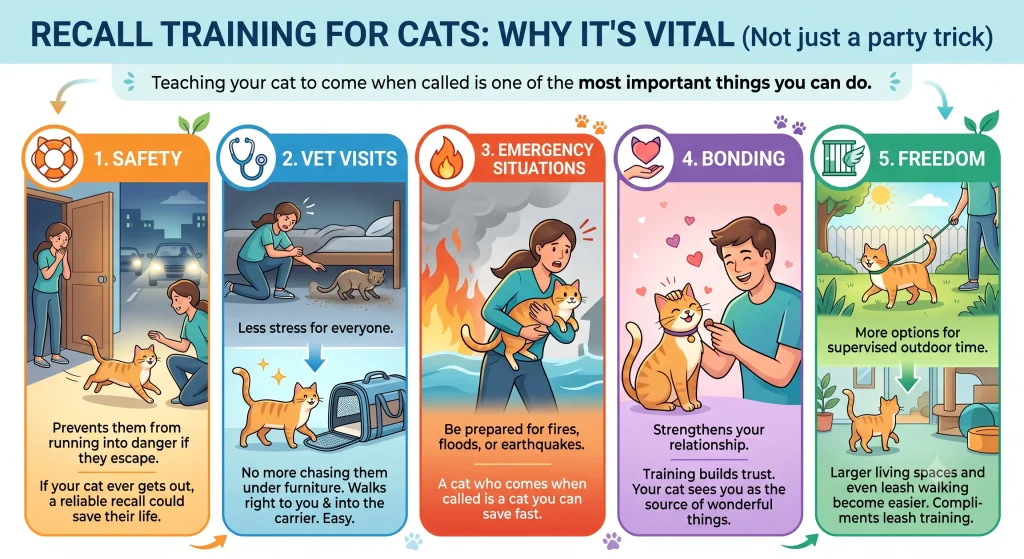
This is not just a party trick. Teaching your cat to come when called is one of the most important things you can do. Here is why.
Safety
If your cat ever gets out. A reliable recall could save their life. Imagine your cat escapes through an open door. Cars are coming. You call them. And they come running back to you. That is the power of recall training. It is not theoretical. It happens. And cats who come when called are safer than cats who do not.
Vet Visits
A cat who comes when called is easier to catch. No more chasing them under the bed when it is time for the vet. No more locking them in the bathroom for an hour while you set up the carrier. A cat with good recall walks right to you. And into the carrier. Easy.
Emergency Situations
Fire. Flooding. Earthquake. If you ever need to evacuate quickly. A cat who comes when called is a cat you can save fast. This is not something you want to think about. But being prepared matters.
Bonding
Training strengthens your relationship. When your cat learns that coming to you results in good things. Trust grows. Your cat sees you as the source of all wonderful things. That is a powerful bond.
Freedom
A cat with reliable recall can safely enjoy more freedom. Supervised outdoor time. Larger living spaces. Even walking on a leash becomes easier when your cat comes when called. Check out our cat leash training guide for how recall and leash training work together.
Can All Cats Be Trained to Come When Called
Short answer. Yes. Almost every cat can learn to come when called. But some cats are easier to train than others.
Food-motivated cats learn fastest. If your cat goes crazy for treats. You have an advantage. Some cats are more interested in play than food. These cats can be trained with toys instead of treats.
Feral or semi-feral cats are harder. But not impossible. It takes more time. More patience. And more distance from the starting point.
Cats with hearing problems cannot be trained with verbal cues. But you can use visual signals. Like a hand signal or a flashlight.
The bottom line. If your cat eats food. They can be trained to come when called.
What You Need to Get Started
Here is your training kit. Simple stuff. Nothing fancy.
- High-value treats. Not regular kibble. Think tuna. Chicken. Freeze-dried meat. Something your cat goes absolutely crazy for. The smellier the better.
- A quiet room. Start in a small room with no distractions. No other pets. No loud noises. Just you. Your cat. And treats.
- A clicker. Optional but helpful. The clicker marks the exact moment your cat does the right thing. More on this below.
- Patience. Lots of it. Training takes time. Especially with cats.
- Consistency. Same word. Same tone. Same reward. Every single time.
Step-by-Step Training Method
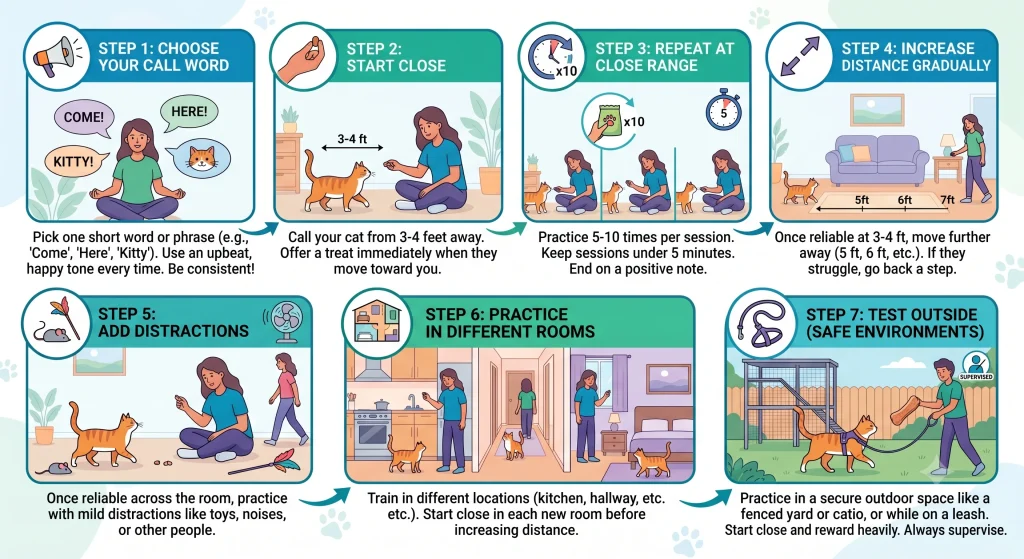
Here is the exact method I use. It works. I have done it hundreds of times. Follow these steps in order. Do not skip ahead.
Step 1: Choose Your Call Word
Pick one word or phrase. Something short. Something you will always use. Popular choices. Come. Here. Come here. Kitty. Or your cat’s name plus come. Like Whiskers come.
Choose one. And stick with it. Do not change words mid-training. Your cat needs to associate one specific sound with the action of coming to you.
Use the same tone of voice every time. Happy. Upbeat. Inviting. Not angry. Not scared. Not whispering. Your cat needs to recognize the sound.
Step 2: Start Close
Stand or sit just three to four feet from your cat. Make sure they can see you. Say your call word once. In a happy tone. When your cat looks at you or takes a step toward you. Click the clicker if using one. Then give them a treat.
That is it. That is the first step. Super simple. Your cat just needs to learn. When I hear that word. Good things happen.
Step 3: Repeat at Close Range
Do this 5 to 10 times per session. Stay close. Three to four feet. Same word. Same tone. Same treat. Every time. Your cat starts to make the connection. Word equals treat.
Keep sessions short. Five minutes maximum. Cats have short attention spans for training. End on a positive note. When your cat is still engaged. Not when they walk away.
Step 4: Increase Distance Gradually
Once your cat consistently comes when called from three to four feet. Increase the distance. Move to five feet. Then six. Then seven. Then across the room.
Never increase distance until your cat is reliable at the current distance. If they stop responding. You moved too fast. Go back one step.
Step 5: Add Distractions
Once your cat comes reliably across the room. Start adding mild distractions. Another person in the room. A toy nearby. A closed door they have to navigate around.
This builds real-world reliability. In the real world. There will always be distractions. Your cat needs to learn to come despite them.
Step 6: Practice in Different Rooms
Move training to different rooms in your house. Your cat needs to learn that the call word works everywhere. Not just in the training room.
Start from scratch in each new room. Close range. Then gradually increase distance. Most cats transfer the behavior quickly once they understand the concept.
Step 7: Test Outside
Once your cat is rock solid indoors. Try it outside. In a fenced yard. On a leash. Or in a catio. Outdoor distractions are much stronger. So start close again. And reward heavily.
Never practice recall in an unfenced area until your cat is 100 percent reliable. And even then. Supervise always.
How Long Does It Take to Train a Cat to Come When Called
Most cats learn the basics in 1 to 2 weeks. Full reliability in 3 to 4 weeks. But this varies widely.
Food-motivated cats learn faster. Kittens learn faster. Confident cats learn faster. Shy or feral cats take longer. Cats who have never been trained take longer.
The key is consistency. Short daily sessions. Same word. Same reward. Same tone. Every single day. Skipping sessions slows progress. Training once a week does not work. You need daily practice.
Clicker Training for Recall
Clicker training is optional but powerful. Here is how it works.
The clicker makes a distinct sound. Click. This sound marks the exact moment your cat does the right thing. It tells your cat. That thing you just did. That is what earns the treat.
To use a clicker for recall training. Click the instant your cat starts moving toward you when you call. Then treat. Over time. Your cat learns. When I hear the word and move toward my human. Click happens. Then treat comes.
The clicker speeds up learning because it is more precise than verbal praise. Your cat knows exactly which behavior earned the reward. This makes the connection faster.
If you do not have a clicker. You can use a marker word. Like yes or good. Say it the instant your cat responds. Then treat. Same concept. Slightly less precise.
Common Mistakes That Ruin Recall Training
Here are the biggest mistakes cat owners make. Avoid these and your training will go much smoother.
- Calling your cat for negative things. Never call your cat to give medicine. Trim nails. Or do anything they dislike. If the only time you call your cat is for bad things. They will stop coming. Call them for treats. For play. For good things. Always.
- Repeating the call word. Say it once. If your cat does not respond. Wait. Try again. Repeating the word teaches your cat they can ignore the first call. Because you will say it again. And again. And again.
- Chasing your cat. If you call your cat and they do not come. Do not chase them. That turns it into a game. And the game is. Human chases me. I win. Stand still. Wait. Try again later.
- Punishing your cat for coming slowly. Your cat came. That is what matters. Do not be frustrated that it took them a minute. Reward the arrival. Not the speed.
- Training when your cat is not hungry. Train before mealtime. When your cat is motivated. Training after a big meal is harder. The treats are less appealing.
- Using low-value treats. Regular kibble is not motivating enough for recall training. You need the good stuff. Tuna. Chicken. Freeze-dried meat. The highest value treats you can find.
- Ending sessions too long. Five minutes maximum. Cats get bored. Stop before they lose interest. End on a win.
- Inconsistency. Same word. Same tone. Same reward. Every time. If you sometimes use come. Sometimes here. Sometimes kitty. Your cat gets confused. Pick one word. Use it always.
What to Do If Your Cat Ignores the Call
Your cat will ignore you sometimes. That is normal. Here is what to do.
First. Do not get frustrated. Frustration shows in your voice. And cats pick up on it. Stay calm. Stay positive.
Second. Check your treats. Are they good enough? Upgrade to something smellier. More tempting. Sometimes the treats are the problem.
Third. Reduce distance. Go back to close range. Rebuild the behavior. Then increase distance again.
Fourth. Check for distractions. Is there another animal? A loud noise? Something interesting outside? Remove distractions if possible.
Fifth. Shorten sessions. Your cat might be bored. Keep sessions super short. Two to three minutes. Lots of treats. High energy.
Sixth. Make sure your cat is healthy. A cat who does not feel well will not respond to training. If your cat suddenly stops responding to recall. And they were previously reliable. Check for health problems. Our guide on why cats stop eating covers health signs to watch for.
Recall Training for Kittens vs Adult Cats
Kittens and adult cats learn differently. Here is how to adjust your approach.
Kittens
Kittens are easier to train. They are naturally curious. Food-motivated. And eager to please. Start training early. As soon as you bring them home. Keep sessions playful. Use their natural curiosity. Kittens learn fast. Sometimes in just a few days.
Adult Cats
Adult cats take longer. They have established habits. And may be less food-motivated. But they can absolutely learn. Be more patient. Use higher-value treats. And keep sessions extra short. Adult cats also benefit from more repetition. Do not rush the process.
Senior Cats
Senior cats can learn too. But they may have hearing issues. Or cognitive decline. Adjust your volume if needed. Use hand signals alongside verbal cues. And be extra patient. Senior cats learn at their own pace.
How to Maintain Recall Once Learned
Training is not a one-time thing. You need to maintain the behavior. Here is how.
- Practice regularly. Even after your cat has learned. Call them a few times a week. And reward. This keeps the behavior fresh.
- Keep treats handy. Always have treats available. If your cat comes to you uninvited. Reward them. This reinforces that coming to you is always good.
- Never stop rewarding. Some people think once the behavior is learned. They can stop giving treats. Wrong. Intermittent reinforcement is important. Reward sometimes. Not every time. But often enough to keep the behavior strong.
- Practice in new environments. Keep challenging your cat. New rooms. New areas. Outdoors. This builds real-world reliability.
Expert Tips From My Practice
Here is what actually works. From real experience. Not theory.
The secret to teaching a cat to come when called is simple. Make coming to you the best thing that ever happened to them. Every time they come. Give them something amazing. Tuna. Chicken. Their favorite treat. Over time. They learn. Coming to my human equals wonderful things. And they come running. Every time.
- Train before meals. Hungry cats are motivated cats. Schedule training 10 to 15 minutes before breakfast or dinner.
- Use a happy voice. Your tone matters more than your words. A bright. Excited tone makes your cat want to come. A flat. Boring tone does not.
- Make yourself the best thing in the room. When you call. Sound like something amazing is about to happen. Because for your cat. Something amazing IS about to happen. Treats.
- End on a win. Always. If your cat comes. Even once. End the session. Celebrate. This leaves your cat wanting more next time.
- Be patient with setbacks. Some days your cat will come perfectly. Other days they will ignore you. That is normal. Stay consistent. Progress is not linear.
- Combine with other training. Recall works great alongside body language reading. Understanding your cat helps you time your calls better.
FAQ
Can you really train a cat to come when called?
Yes. Almost all cats can be trained to come when called. Cats are trainable. They just respond differently than dogs. The key is using high-value treats. Keeping sessions short. And being consistent. Most cats learn in 1 to 4 weeks with daily practice.
How long does it take to teach a cat to come when called?
Most cats learn the basics in 1 to 2 weeks. Full reliability in 3 to 4 weeks. Food-motivated cats learn faster. Shy cats take longer. Daily short sessions of 5 minutes work best. Consistency is the most important factor.
What treats work best for cat recall training?
High-value smelly treats work best. Tuna. Cooked chicken. Freeze-dried meat. Commercial cat treats with strong aroma. Regular kibble is usually not motivating enough. The smellier the treat. The faster your cat learns.
How many times should I practice per day?
One to two short sessions per day is ideal. Each session should be 3 to 5 minutes maximum. Five to ten repetitions per session. More than that and your cat gets bored. Quality matters more than quantity.
My cat ignores me when I call. What am I doing wrong?
Common reasons include treats not being valuable enough. Calling too many times. Training when your cat is not hungry. Too many distractions. Or being inconsistent with the call word. Go back to basics. Close range. Great treats. One call. One reward.
Should I use my cat’s name or a different word?
You can use either. Some people use the cat’s name plus come. Like Luna come. Others use a single word like here. The important thing is consistency. Use the same word every time. And never use the call word for negative things.
Is clicker training necessary for cat recall?
Clicker training is helpful but not required. It speeds up learning by marking the exact moment your cat does the right thing. But you can use a marker word like yes instead. The concept is the same. Mark the behavior. Then reward.
Can I train an adult cat to come when called?
Absolutely. Adult cats can learn recall at any age. It may take longer than training a kitten. But the method is the same. Be patient. Use high-value treats. Keep sessions short. And practice daily.
What if my cat comes sometimes but not always?
Partial recall is normal during training. If your cat comes sometimes. They are learning. Keep practicing. Increase the value of treats. Reduce distractions. And make sure you are not calling too many times in a row. One call. One reward.
Should I reward my cat every time they come?
During initial training. Yes. Reward every single time. Once your cat is reliable. You can switch to intermittent reinforcement. Reward sometimes. But still often enough to keep the behavior strong. Never stop rewarding completely.
My cat was trained but stopped responding. Why?
Behaviors can fade without practice. Go back to basics. Close range. Great treats. Rebuild the behavior. Also check for health problems. Pain or illness can cause a cat to stop responding. If the behavior change is sudden. See your vet.
Can I train my cat to come from outside?
Only after your cat is 100 percent reliable indoors. And only in a fenced area or on a leash. Never practice outdoor recall in an unfenced space. Cats can bolt when scared. Safety first. Always.